eBook - ePub
Open Participatory Security
Unifying Technology, Citizens, and the State
- English
- ePUB (mobile friendly)
- Available on iOS & Android
eBook - ePub
About this book
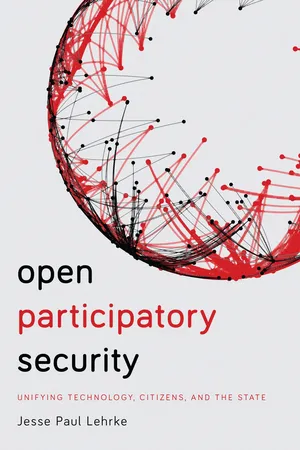
Our modern security systems have recently come under a lot of criticism: as too bureaucratic and unadaptable, too secretive and untrustworthy, and too obsessed with information technology rather than human needs. Yet listing failures is easy; security is never perfect. The question is why current approaches fail and whether there are viable alternatives. The root of their shortcomings is in the interaction of the very pillars of our security system in the contemporary context. While our enemies have adopted the technologies of the Information Age, changing how they organize and fight, these same technologies have only created more vulnerabilities for states. Governments have been generally unwilling to maximize their use of these technologies because it would require the wider release of information and the opening of organizational structures to include society in security making. Yet countering diffuse modern threats striking deep into our states and across our economies requires mobilizing the diffuse skills and variation of modern society. Open approaches for mobilizing participation and coproduction have the capabilities needed to improve contemporary security policy making, problem solving, and provision. Moreover, open participatory security can be effective not only for technical security, but also for restoring trust among the citizens and rebuilding the legitimacy of the state.
Information
Table of contents
- Contents
- Abbreviations
- Author’s Note and Acknowledgements
- Chapter 1: The Foundations of Open Participatory Security
- Chapter 2: The Historical Evolution of Security, Technology, and Participation
- Chapter 3: The Gap between the Contemporary Strategic Context and Security System
- Chapter 4: Openness and Open Government
- Chapter 5: Filling the Security Gap
- Chapter 6: Closing the Insecurity Gap
- Chapter 7: Towards a Perpetual-Beta Open Participatory Security
- Bibliography
- About the Author
Trusted by 375,005 students
Access to over 1.5 million titles for a fair monthly price.
Study more efficiently using our study tools.
Frequently asked questions
Yes, you can cancel anytime from the Subscription tab in your account settings on the Perlego website. Your subscription will stay active until the end of your current billing period. Learn how to cancel your subscription
No, books cannot be downloaded as external files, such as PDFs, for use outside of Perlego. However, you can download books within the Perlego app for offline reading on mobile or tablet. Learn how to download books offline
Perlego offers two plans: Essential and Complete
- Essential is ideal for learners and professionals who enjoy exploring a wide range of subjects. Access the Essential Library with 800,000+ trusted titles and best-sellers across business, personal growth, and the humanities. Includes unlimited reading time and Standard Read Aloud voice.
- Complete: Perfect for advanced learners and researchers needing full, unrestricted access. Unlock 1.5M+ books across hundreds of subjects, including academic and specialized titles. The Complete Plan also includes advanced features like Premium Read Aloud and Research Assistant.
We are an online textbook subscription service, where you can get access to an entire online library for less than the price of a single book per month. With over 1.5 million books across 990+ topics, we’ve got you covered! Learn about our mission
Look out for the read-aloud symbol on your next book to see if you can listen to it. The read-aloud tool reads text aloud for you, highlighting the text as it is being read. You can pause it, speed it up and slow it down. Learn more about Read Aloud
Yes! You can use the Perlego app on both iOS and Android devices to read anytime, anywhere — even offline. Perfect for commutes or when you’re on the go.
Please note we cannot support devices running on iOS 13 and Android 7 or earlier. Learn more about using the app
Please note we cannot support devices running on iOS 13 and Android 7 or earlier. Learn more about using the app
Yes, you can access Open Participatory Security by Jesse Paul Lehrke in PDF and/or ePUB format, as well as other popular books in Politics & International Relations & National Security. We have over 1.5 million books available in our catalogue for you to explore.