Winner of the Louis Brownlow Award for Public Administration
In recent years, the power of American judges to make social policy has been significantly broadened. The courts have reached into many matters once thought to be beyond the customary scope of judicial decisionmaking: education and employment policy, environmental issues, prison and hospital management, and welfare administration—to name a few. This new judicial activity can be traced to various sources, among them the emergence of public interest law firms and interest groups committed to social change through the courts, and to various changes in the law itself that have made access to the courts easier. The propensity for bringing difficult social questions to the judiciary for resolution is likely to persist.
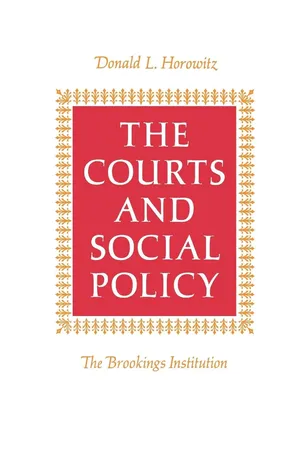
This book is the first comprehensive study of the capacity of courts to make and implement social policy. Donald L. Horowitz, a lawyer and social scientist, traces the imprint of the judicial process on the policies that emerge from it. He focuses on a number of important questions: how issues emerge in litigation, how courts obtain their information, how judges use social science data, how legal solutions to social problems are devised, and what happens to judge-made social policy after decrees leave the court house.
After a general analysis of the adjudication process as it bears on social policymaking, the author presents four cases studies of litigation involving urban affairs, educational resources, juvenile courts and delinquency, and police behavior. In each, the assumption and evidence with which the courts approached their policy problems are matched against data about the social settings from which the cases arose and the effects the decrees had. The concern throughout the book is to relate the policy process to the policy outcome.
From his analysis of adjudication and the findings of his case studies the author concludes that the resources of the courts are not adequate to the new challenges confronting them. He suggests various improvements, but warns against changes that might impair the traditional strengths of the judicial process.
- English
- ePUB (mobile friendly)
- Available on iOS & Android
eBook - ePub
The Courts and Social Policy
About this book
Information
Table of contents
- Foreword
- 1. Social Policy and Judicial Capacity
- 2. Attributes of Adjudication
- 3. The Area-Wide Council Case: The “Great Society" Comes to Court
- 4. Hobson v. Hansen: The Calculus of Equality in School Resources
- 5. In re Gault: On Courts Reforming Courts
- 6. Mapp v. Ohio: Police Behavior and the Courts
- 7. Judicial Capacity Appraised
Trusted by 375,005 students
Access to over 1.5 million titles for a fair monthly price.
Study more efficiently using our study tools.
Frequently asked questions
Yes, you can cancel anytime from the Subscription tab in your account settings on the Perlego website. Your subscription will stay active until the end of your current billing period. Learn how to cancel your subscription
No, books cannot be downloaded as external files, such as PDFs, for use outside of Perlego. However, you can download books within the Perlego app for offline reading on mobile or tablet. Learn how to download books offline
Perlego offers two plans: Essential and Complete
- Essential is ideal for learners and professionals who enjoy exploring a wide range of subjects. Access the Essential Library with 800,000+ trusted titles and best-sellers across business, personal growth, and the humanities. Includes unlimited reading time and Standard Read Aloud voice.
- Complete: Perfect for advanced learners and researchers needing full, unrestricted access. Unlock 1.5M+ books across hundreds of subjects, including academic and specialized titles. The Complete Plan also includes advanced features like Premium Read Aloud and Research Assistant.
We are an online textbook subscription service, where you can get access to an entire online library for less than the price of a single book per month. With over 1.5 million books across 990+ topics, we’ve got you covered! Learn about our mission
Look out for the read-aloud symbol on your next book to see if you can listen to it. The read-aloud tool reads text aloud for you, highlighting the text as it is being read. You can pause it, speed it up and slow it down. Learn more about Read Aloud
Yes! You can use the Perlego app on both iOS and Android devices to read anytime, anywhere — even offline. Perfect for commutes or when you’re on the go.
Please note we cannot support devices running on iOS 13 and Android 7 or earlier. Learn more about using the app
Please note we cannot support devices running on iOS 13 and Android 7 or earlier. Learn more about using the app
Yes, you can access The Courts and Social Policy by Donald L. Horowitz in PDF and/or ePUB format, as well as other popular books in Law & Civil Procedure. We have over 1.5 million books available in our catalogue for you to explore.