eBook - ePub
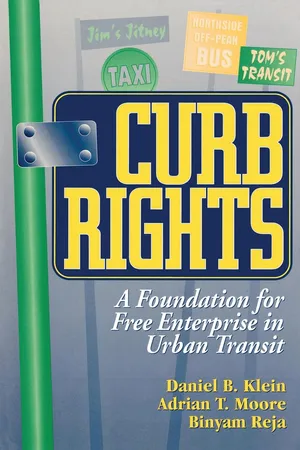
Curb Rights
A Foundation for Free Enterprise in Urban Transit
- English
- ePUB (mobile friendly)
- Available on iOS & Android
eBook - ePub
Curb Rights
A Foundation for Free Enterprise in Urban Transit
About this book
Transit services in the United States are in trouble. Ridership has dwindled, productivity has declined, and operating deficits have widened. The traditional approaches to running transit systems-government planning or operation of bus and rail services, government subsidization of private operations, heavy regulation of all transit modes-have failed, and there is little hope of their ever succeeding under current practices. But public transportation cannot simply be abandoned. Can it, then, be made more self-supporting and efficient? The authors of this book say it's time to rethink the fundamental structure of transit policy. The book focuses on street-based transit-buses, shuttles, and jitneys. (While street-based transit in the U.S. today usually means bus service, in other times and places streets have also been served by smaller vehicles called jitneys that follow a route but not a schedule.) The authors examine a variety of transit services: jitney services from America's past, illegal jitneys today, airport shuttle van services, bus deregulation in Great Britain, and jitney services in less developed countries. The authors propose that urban transit be brought into the fold of market activity by establishing property rights not only in vehicles, but also in curb zones and transit stops. Market competition and entrepreneurship would depend on a foundation of what they call "curb rights." By creating exclusive and transferable curb rights (to bus stops and other pickup points) leased by auction, the authors contend that American cities can have the best of both kinds of markets-scheduled (and unsubsidized) bus service and unscheduled but faster and more flexible jitneys. They maintain that a carefully planned transit system based on property rights would rid the transit market of inefficient government production and overregulation. It would also avoid the problems of a lawless market-cutthroat competition, schedule jockeying, and even curbside conflict among rival operators. Entrepreneurs would be able to introduce ever better service, revise schedules and route structures, establish connections among transit providers, and use new pricing strategies. And travelers would find public transit more attractive than they do now. Once the system of curb rights is sensibly implemented, the authors conclude, the market process will take over. Then the invisible hand can do in transit what it does so well in other parts of the economy.
Information
Table of contents
- 1. Introduction
- Section One: Diagnosing Traditional Transit
- 2. The Triumph of the Automobile
- 3. The Fizzle of Traditional Transit
- 4. Why Traditional Transit Fizzles
- Section Two: Transit Markets Improperly Regulated and Improperly Deregulated
- 5. Jitneys and Interloping
- 6. Edge Transit Services in the United States
- 7. Bus Privatization and Deregulation in Britain
- 8. Contracting Out Bus Service in the United States
- Section Three: Property Rights and Route-Based Transit Markets
- 9. A Property Rights Theory of Transit Markets
- 10. Devising Property Rights for Transit Markets
- 11. How Property Rights Resolve Problems of Free-Market Transit
- Section Four: Policy Recommendations and Conclusions
- 12. Further Policy Recommendations
- 13. Conclusion: Transcending the Choice between Monopoly and Lawless Competition
- References
Trusted by 375,005 students
Access to over 1.5 million titles for a fair monthly price.
Study more efficiently using our study tools.
Frequently asked questions
Yes, you can cancel anytime from the Subscription tab in your account settings on the Perlego website. Your subscription will stay active until the end of your current billing period. Learn how to cancel your subscription
No, books cannot be downloaded as external files, such as PDFs, for use outside of Perlego. However, you can download books within the Perlego app for offline reading on mobile or tablet. Learn how to download books offline
Perlego offers two plans: Essential and Complete
- Essential is ideal for learners and professionals who enjoy exploring a wide range of subjects. Access the Essential Library with 800,000+ trusted titles and best-sellers across business, personal growth, and the humanities. Includes unlimited reading time and Standard Read Aloud voice.
- Complete: Perfect for advanced learners and researchers needing full, unrestricted access. Unlock 1.5M+ books across hundreds of subjects, including academic and specialized titles. The Complete Plan also includes advanced features like Premium Read Aloud and Research Assistant.
We are an online textbook subscription service, where you can get access to an entire online library for less than the price of a single book per month. With over 1.5 million books across 990+ topics, we’ve got you covered! Learn about our mission
Look out for the read-aloud symbol on your next book to see if you can listen to it. The read-aloud tool reads text aloud for you, highlighting the text as it is being read. You can pause it, speed it up and slow it down. Learn more about Read Aloud
Yes! You can use the Perlego app on both iOS and Android devices to read anytime, anywhere — even offline. Perfect for commutes or when you’re on the go.
Please note we cannot support devices running on iOS 13 and Android 7 or earlier. Learn more about using the app
Please note we cannot support devices running on iOS 13 and Android 7 or earlier. Learn more about using the app
Yes, you can access Curb Rights by Daniel B. Klein,Adrian T. Moore,Binyam Reja in PDF and/or ePUB format, as well as other popular books in Business & Business General. We have over 1.5 million books available in our catalogue for you to explore.