This new and final edition is a follow-up to the author's first book, Anticipating Surprise (University Press of America, 2002) and the Handbook of Warning Intelligence (Scarecrow Press, 2010). The first book was an abridged version of Grabo's 1972 manuscript, of which only 200 pages were allowed to be published by the government. The second book was published after it was agreed that the last 10 chapters would remain classified. These final 10 chapters have recently been released by the government and complete the manuscript as it was originally intended to be published by the author in 1972.
The Handbook of Warning Intelligence was written during the cold war and was classified for 40 years. Originally written as a manual for training intelligence analysts, it explains the fundamentals of intelligence analysis and forecasting, discusses military analysis, as well as the difficulties in understanding political, civil, and economic analysis and assessing what it means for analysts to have "warning judgment."
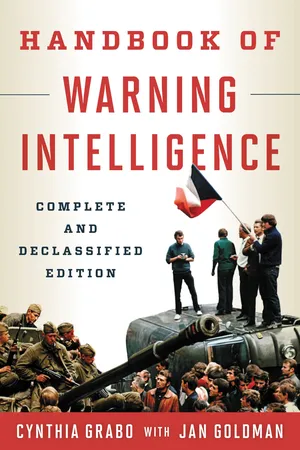
Much of what Grabo wrote in her book seems to appear in many of the numerous commission reports that emerged after the 9/11 attacks. However, her book was written in response to the "surprise attack" of the Soviet Union's invasion of Czechoslovakia in 1968. According to the author, that event was no surprise. And while analysts have to take some of the blame for their failure to strenuously present their case that the threat was real and imminent, what occurred was a failure by policymakers to listen to the warning intelligence reports that were written at the time.
In these last chapters, Grabo discusses scenarios where the United States will need to take action, especially describing Soviet indicators of such action. She also talks on how to influence policymakers to take, or not take, action based on intelligence. After the Soviet Union fell, the government was hesitant to release this information—especially considering what's going on with Putin today.
- English
- ePUB (mobile friendly)
- Available on iOS & Android
eBook - ePub
Handbook of Warning Intelligence
About this book
Information
Table of contents
- Contents
- Foreword
- Foreword to the Previous Edition
- Author’s Note to Original Edition
- Chapter 1: General Nature of the Problem
- Chapter 2: Definitions of Terms and Their Usage
- Chapter 3: What Warning Is and Is Not
- Chapter 4: Warning and Collection
- Chapter 5: Intentions versus Capabilities
- Chapter 6: Problems of Organization and Management
- Chapter 7: Indicator Lists
- Chapter 8: The Compiling of Indications
- Chapter 9: Can Computers Help?
- Chapter 10: Some Fundamentals of Indications Analysis
- Chapter 11: Some Specifics of the Analytical Method
- Chapter 12: What Makes a Good Warning Analyst?
- Chapter 13: Importance of Military Indications
- Chapter 14: Order-of-Battle Analysis in Crisis Situations
- Chapter 15: Analysis of Mobilization
- Chapter 16: Logistics Is the Queen of Battles
- Chapter 17: Other Factors in Combat Preparations
- Chapter 18: Coping with Extraordinary Military Developments
- Chapter 19: Importance of Political Factors for Warning
- Chapter 20: Basic Political Warning—A Problem of Perception
- Chapter 21: Some Specific Factors in Political Warning
- Chapter 22: Economic Indicators
- Chapter 23: Civil Defense
- Chapter 24: Security, Counter-Intelligence and Agent Preparations
- Chapter 25: Warning from the Totality of Evidence
- Chapter 26: The Impact on Warning of Circumstances Leading to War
- Chapter 27: Reconstructing the Enemy’s Decision-Making Process
- Chapter 28: Assessing the Timing of Attack
- Chapter 29: Deception: Can We Cope with It?
- Chapter 30: Analysis with Hostilities Already in Progress
- Chapter 31: Problems Peculiar to Guerrilla Warfare and “Wars of Liberation”
- Chapter 32: Hypothetical Problems of the Coming of World War III
- Chapter 33: Vital Importance of the Judgment
- Chapter 34: What Does the Policy Maker Need, and Want to Know?
- Chapter 35: How to Write Indications or Warning Items
- Chapter 36: Assessing Probabilities
- Chapter 37: Some Major Factors Influencing Judgments and Reporting
- Chapter 38: Most Frequent Errors in the Judgment and Reporting Process
- Chapter 39: A Summing Up, With Some Do’s and Don’ts for Analysts and Supervisors
- About the Authors
Trusted by 375,005 students
Access to over 1.5 million titles for a fair monthly price.
Study more efficiently using our study tools.
Frequently asked questions
Yes, you can cancel anytime from the Subscription tab in your account settings on the Perlego website. Your subscription will stay active until the end of your current billing period. Learn how to cancel your subscription
No, books cannot be downloaded as external files, such as PDFs, for use outside of Perlego. However, you can download books within the Perlego app for offline reading on mobile or tablet. Learn how to download books offline
Perlego offers two plans: Essential and Complete
- Essential is ideal for learners and professionals who enjoy exploring a wide range of subjects. Access the Essential Library with 800,000+ trusted titles and best-sellers across business, personal growth, and the humanities. Includes unlimited reading time and Standard Read Aloud voice.
- Complete: Perfect for advanced learners and researchers needing full, unrestricted access. Unlock 1.5M+ books across hundreds of subjects, including academic and specialized titles. The Complete Plan also includes advanced features like Premium Read Aloud and Research Assistant.
We are an online textbook subscription service, where you can get access to an entire online library for less than the price of a single book per month. With over 1.5 million books across 990+ topics, we’ve got you covered! Learn about our mission
Look out for the read-aloud symbol on your next book to see if you can listen to it. The read-aloud tool reads text aloud for you, highlighting the text as it is being read. You can pause it, speed it up and slow it down. Learn more about Read Aloud
Yes! You can use the Perlego app on both iOS and Android devices to read anytime, anywhere — even offline. Perfect for commutes or when you’re on the go.
Please note we cannot support devices running on iOS 13 and Android 7 or earlier. Learn more about using the app
Please note we cannot support devices running on iOS 13 and Android 7 or earlier. Learn more about using the app
Yes, you can access Handbook of Warning Intelligence by Cynthia Grabo,Jan Goldman in PDF and/or ePUB format, as well as other popular books in Politics & International Relations & Intelligence & Espionage. We have over 1.5 million books available in our catalogue for you to explore.