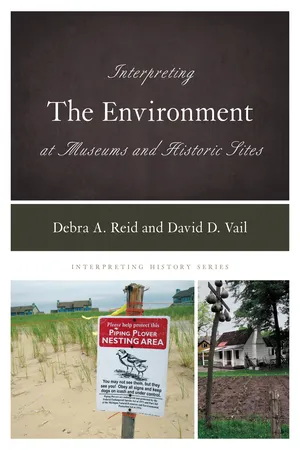
Interpreting the Environment at Museums and Historic Sites is for anyone who wants to better understand the environment that surrounds us and sustains us, who wants to become a better steward of that environment, and who wants to share lessons learned with others. The process starts by focusing attention on the environment – the physical space that constitutes the largest three-dimensional object in museum collections. It involves conceptualizing spaces and places of human influence; spaces that contain layer upon layer documenting human struggles to survive and thrive. This evidence exists in natural environments as well as city centers. The process continues by adopting an environment-centric view of the spaces destined to be interpreted. This mind-set forms the basis for devising research plans that document how humans have changed, destroyed, conserved and sustained spaces over time, and the ways that the environment reacts. Interpretation built on this evidence then becomes the basis for minds-on engagement with the places that humans inhabit and the spaces that they have changed and continue to manipulate.
Interpreting the Environment at Museums and Historic Sites provides a tool kit designed to help you research environmental history, document evidence of human influence on land and the environment over time, and tailor that knowledge to new public engagement. It proposes a multi-disciplinary approach that requires expertise in the humanities as well as the sciences and social sciences to best understand space and place over time. It incorporates case studies of the theory and method of environmental history to explore how human goals take lasting shape in the environment – creating working environments, getting water, generating and harnessing power, growing food, traveling and trading, building things, and preserving natural landscapes.
Features include the Interpreting the Environment Tool Kit to help you launch the good work of interpreting the environment:
Raw Materials (the evidence): landscape, ecosystems, artifacts, and the built environmentPreparation (methods): thinking like a naturalist/scientist; thinking like a historian; combining approachesPlanning (envisioning the goal): proactive message, stewardship, sustainabilityPartnerships (sharing work): strength in numbers; allying across disciplinary divides; united in efforts to inform the public about their individual and collective effects on the landscape and the environmentPotential: educating the public about people and places is part of a world-wide goal with the cumulative effect of saving the planet, one story at a time.A Timeline and Bibliographic essay round out the book's resources.
- English
- ePUB (mobile friendly)
- Available on iOS & Android
eBook - ePub
Interpreting the Environment at Museums and Historic Sites
About this book
Information
Table of contents
- Foreword by John C. F. Luzader
- Preface
- Acknowledgments
- PART I: A PRIMER ON THE ENVIRONMENT, CULTURAL HERITAGE, AND HISTORY INTERPRETATION
- PART II: TELLING STORIES ABOUT HUMANS AND THEIR ENVIRONMENTS: TOPICS AND PRACTICE
- Conclusion
- Bibliographic Essay
- Timeline of Environmental Ideas, Policies, and Legislation
- About the Contributors
Trusted by 375,005 students
Access to over 1.5 million titles for a fair monthly price.
Study more efficiently using our study tools.
Frequently asked questions
Yes, you can cancel anytime from the Subscription tab in your account settings on the Perlego website. Your subscription will stay active until the end of your current billing period. Learn how to cancel your subscription
No, books cannot be downloaded as external files, such as PDFs, for use outside of Perlego. However, you can download books within the Perlego app for offline reading on mobile or tablet. Learn how to download books offline
Perlego offers two plans: Essential and Complete
- Essential is ideal for learners and professionals who enjoy exploring a wide range of subjects. Access the Essential Library with 800,000+ trusted titles and best-sellers across business, personal growth, and the humanities. Includes unlimited reading time and Standard Read Aloud voice.
- Complete: Perfect for advanced learners and researchers needing full, unrestricted access. Unlock 1.5M+ books across hundreds of subjects, including academic and specialized titles. The Complete Plan also includes advanced features like Premium Read Aloud and Research Assistant.
We are an online textbook subscription service, where you can get access to an entire online library for less than the price of a single book per month. With over 1.5 million books across 990+ topics, we’ve got you covered! Learn about our mission
Look out for the read-aloud symbol on your next book to see if you can listen to it. The read-aloud tool reads text aloud for you, highlighting the text as it is being read. You can pause it, speed it up and slow it down. Learn more about Read Aloud
Yes! You can use the Perlego app on both iOS and Android devices to read anytime, anywhere — even offline. Perfect for commutes or when you’re on the go.
Please note we cannot support devices running on iOS 13 and Android 7 or earlier. Learn more about using the app
Please note we cannot support devices running on iOS 13 and Android 7 or earlier. Learn more about using the app
Yes, you can access Interpreting the Environment at Museums and Historic Sites by Debra A. Reid,David D. Vail in PDF and/or ePUB format, as well as other popular books in Business & Museum Administration. We have over 1.5 million books available in our catalogue for you to explore.