Planning Optimal Library Spaces: Principles, Process, and Practices demystifies library space planning, inspires creative thinking, and offers immediate how-to steps to rectify seemingly hopeless situations. It describes an approach to library space planning that introduces and combines a phased implementation strategy with traditional space planning to allow library transformations and renovations to be done as a single project or a series of smaller, separate, and more manageable phased interventions. It allows libraries to meet current needs sooner, as smaller funding opportunities arise, instead of waiting on completely funded projects to develop.
Chapters cover the approach, the importance of community engagement meetings, collection storage strategies, the anatomy of a library project budget, recommendations for getting started, and case studies of both public and academic library planning projects with detailed phasing strategies.
Printed in full color with 148 images, this is a must-have book for librarians, architects, government/education administrators, and anyone involved with, or even thinking about a library planning or renovation project.
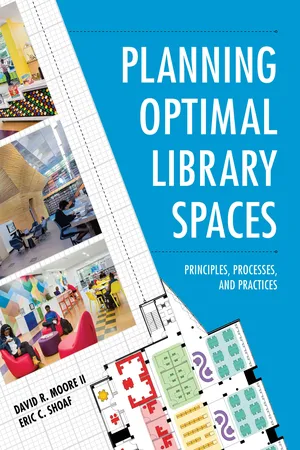
eBook - ePub
Planning Optimal Library Spaces
Principles, Processes, and Practices
- English
- ePUB (mobile friendly)
- Available on iOS & Android
eBook - ePub
About this book
Information
Table of contents
- List of Figures
- Foreword
- Preface
- Acknowledgments
- 1. Introduction to Master Planning and the Road Map Approach
- 2. Why the Road Map Approach?
- 3. Process
- 4. Collection Storage Strategies
- 5. Anatomy of a Library Budget
- 6. Getting Started
- 7. Case Studies
- Bibliography
- About the Authors
Trusted by 375,005 students
Access to over 1.5 million titles for a fair monthly price.
Study more efficiently using our study tools.
Frequently asked questions
Yes, you can cancel anytime from the Subscription tab in your account settings on the Perlego website. Your subscription will stay active until the end of your current billing period. Learn how to cancel your subscription
No, books cannot be downloaded as external files, such as PDFs, for use outside of Perlego. However, you can download books within the Perlego app for offline reading on mobile or tablet. Learn how to download books offline
Perlego offers two plans: Essential and Complete
- Essential is ideal for learners and professionals who enjoy exploring a wide range of subjects. Access the Essential Library with 800,000+ trusted titles and best-sellers across business, personal growth, and the humanities. Includes unlimited reading time and Standard Read Aloud voice.
- Complete: Perfect for advanced learners and researchers needing full, unrestricted access. Unlock 1.5M+ books across hundreds of subjects, including academic and specialized titles. The Complete Plan also includes advanced features like Premium Read Aloud and Research Assistant.
We are an online textbook subscription service, where you can get access to an entire online library for less than the price of a single book per month. With over 1.5 million books across 990+ topics, we’ve got you covered! Learn about our mission
Look out for the read-aloud symbol on your next book to see if you can listen to it. The read-aloud tool reads text aloud for you, highlighting the text as it is being read. You can pause it, speed it up and slow it down. Learn more about Read Aloud
Yes! You can use the Perlego app on both iOS and Android devices to read anytime, anywhere — even offline. Perfect for commutes or when you’re on the go.
Please note we cannot support devices running on iOS 13 and Android 7 or earlier. Learn more about using the app
Please note we cannot support devices running on iOS 13 and Android 7 or earlier. Learn more about using the app
Yes, you can access Planning Optimal Library Spaces by David R. Moore,II,Eric C. Shoaf in PDF and/or ePUB format, as well as other popular books in Languages & Linguistics & Library & Information Science. We have over 1.5 million books available in our catalogue for you to explore.