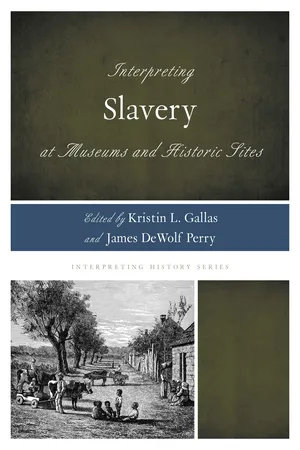
Interpreting Slavery at Museums and Historic Sites aims to move the field forward in its collective conversation about the interpretation of slavery—acknowledging the criticism of the past and acting in the present to develop an inclusive interpretation of slavery. Presenting the history of slavery in a comprehensive and conscientious manner is difficult and requires diligence and compassion—for the history itself, for those telling the story, and for those hearing the stories—but it's a necessary part of our collective narrative about our past, present, and future.
This book features best practices for:
Interpreting slavery across the country and for many people. The history of slavery, while traditionally interpreted primarily on southern plantations, is increasingly recognized as relevant at historic sites across the nation. It is also more than just an African-American/European-American story—it is relevant to the history of citizens of Latino, Caribbean, African and indigenous descent, as well. It is also pertinent to those descended from immigrants who arrived after slavery, whose stories are deeply intertwined with the legacy of slavery and its aftermath.Developing support within an institution for the interpretation of slavery. Many institutions are reticent to approach such a potentially volatile subject, so this book examines how proponents at several sites, including Monticello and Mount Vernon, were able to make a strong case to their constituents. Training interpreters in not only a depth of knowledge of the subject but also the confidence to speak on this controversial issue in public and the compassion to handle such a sensitive historical issue.
The book will be accessible and of interest for professionals at all levels in the public history field, as well as students at the undergraduate and graduate levels in museum studies and public history programs.
- English
- ePUB (mobile friendly)
- Available on iOS & Android
eBook - ePub
Interpreting Slavery at Museums and Historic Sites
About this book
Information
Table of contents
- Cover
- Title
- Copyright
- Dedication
- Foreword
- Acknowledgments
- Preface
- Chapter 1
- Chapter 2
- Chapter 3
- Chapter 4
- Chapter 5
- Chapter 6
- Chapter 7
- Chapter 8
- Conclusion
- Bibliography
- About the Contributors
Trusted by 375,005 students
Access to over 1.5 million titles for a fair monthly price.
Study more efficiently using our study tools.
Frequently asked questions
Yes, you can cancel anytime from the Subscription tab in your account settings on the Perlego website. Your subscription will stay active until the end of your current billing period. Learn how to cancel your subscription
No, books cannot be downloaded as external files, such as PDFs, for use outside of Perlego. However, you can download books within the Perlego app for offline reading on mobile or tablet. Learn how to download books offline
Perlego offers two plans: Essential and Complete
- Essential is ideal for learners and professionals who enjoy exploring a wide range of subjects. Access the Essential Library with 800,000+ trusted titles and best-sellers across business, personal growth, and the humanities. Includes unlimited reading time and Standard Read Aloud voice.
- Complete: Perfect for advanced learners and researchers needing full, unrestricted access. Unlock 1.5M+ books across hundreds of subjects, including academic and specialized titles. The Complete Plan also includes advanced features like Premium Read Aloud and Research Assistant.
We are an online textbook subscription service, where you can get access to an entire online library for less than the price of a single book per month. With over 1.5 million books across 990+ topics, we’ve got you covered! Learn about our mission
Look out for the read-aloud symbol on your next book to see if you can listen to it. The read-aloud tool reads text aloud for you, highlighting the text as it is being read. You can pause it, speed it up and slow it down. Learn more about Read Aloud
Yes! You can use the Perlego app on both iOS and Android devices to read anytime, anywhere — even offline. Perfect for commutes or when you’re on the go.
Please note we cannot support devices running on iOS 13 and Android 7 or earlier. Learn more about using the app
Please note we cannot support devices running on iOS 13 and Android 7 or earlier. Learn more about using the app
Yes, you can access Interpreting Slavery at Museums and Historic Sites by Kristin L. Gallas,James DeWolf Perry in PDF and/or ePUB format, as well as other popular books in Business & Museum Administration. We have over 1.5 million books available in our catalogue for you to explore.