eBook - ePub
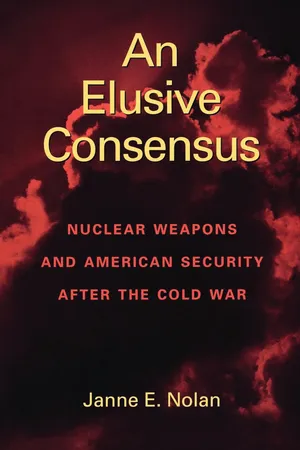
An Elusive Consensus
Nuclear Weapons and American Security after the Cold War
- English
- ePUB (mobile friendly)
- Available on iOS & Android
eBook - ePub
About this book
The United States continues to maintain a large nuclear arsenal guided by a deterrence strategy little changed since the collapse of the Warsaw Pact. Notwithstanding changes in the size and composition of nuclear forces brought about since 1991, the fundamental rationales and planning principles which informed U.S. nuclear policy for decades remain in place--despite the disappearance of a superpower nuclear enemy. In this work, Janne E. Nolan traces the effort to articulate a post-cold war nuclear doctrine through decisions taken in the Bush and Clinton administrations, focusing on the leadership styles of presidents, bureaucratic politics, and broader foreign policy objectives. Based on in-depth interviews with policy participants, this study illuminates in detail the dynamics by which the U.S. government has tried to reflect the dramatically altered international arena in its nuclear policies. In two major policy developments--the 1994 Nuclear Posture Review and the decision to sign the African Nuclear Weapons Free Zone Treaty--U.S. policy makers sought to define the utility of nuclear weapons after the cold war and to gain broad-based consensus. For many reasons, these efforts were largely unsuccessful in developing coherent policies, with the absence of sustained presidential leadership proving most decisive.
Information
Table of contents
- Foreword
- Chapter One Introduction
- Chapter Two The Role of Nuclear Weapons during the Cold War
- Chapter Three The 1993–94 Nuclear Posture Review
- Chapter Four Nuclear Deterrence in the Third World and the Africa Nuclear Weapons-Free Zone Treaty
- Chapter Five Conclusions and Recommendations
- Notes
Trusted by 375,005 students
Access to over 1.5 million titles for a fair monthly price.
Study more efficiently using our study tools.
Frequently asked questions
Yes, you can cancel anytime from the Subscription tab in your account settings on the Perlego website. Your subscription will stay active until the end of your current billing period. Learn how to cancel your subscription
No, books cannot be downloaded as external files, such as PDFs, for use outside of Perlego. However, you can download books within the Perlego app for offline reading on mobile or tablet. Learn how to download books offline
Perlego offers two plans: Essential and Complete
- Essential is ideal for learners and professionals who enjoy exploring a wide range of subjects. Access the Essential Library with 800,000+ trusted titles and best-sellers across business, personal growth, and the humanities. Includes unlimited reading time and Standard Read Aloud voice.
- Complete: Perfect for advanced learners and researchers needing full, unrestricted access. Unlock 1.5M+ books across hundreds of subjects, including academic and specialized titles. The Complete Plan also includes advanced features like Premium Read Aloud and Research Assistant.
We are an online textbook subscription service, where you can get access to an entire online library for less than the price of a single book per month. With over 1.5 million books across 990+ topics, we’ve got you covered! Learn about our mission
Look out for the read-aloud symbol on your next book to see if you can listen to it. The read-aloud tool reads text aloud for you, highlighting the text as it is being read. You can pause it, speed it up and slow it down. Learn more about Read Aloud
Yes! You can use the Perlego app on both iOS and Android devices to read anytime, anywhere — even offline. Perfect for commutes or when you’re on the go.
Please note we cannot support devices running on iOS 13 and Android 7 or earlier. Learn more about using the app
Please note we cannot support devices running on iOS 13 and Android 7 or earlier. Learn more about using the app
Yes, you can access An Elusive Consensus by Janne E. Nolan in PDF and/or ePUB format, as well as other popular books in Politics & International Relations & Arms Control. We have over 1.5 million books available in our catalogue for you to explore.