A 2022 Choice Reviews Outstanding Academic Title
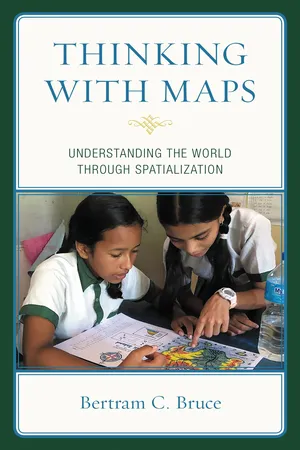
Spatial reasoning, which promises connection across wide areas, is itself ironically often not connected to other areas of knowledge. Thinking with Maps: Understanding the World through Spatialization addresses this problem, developing its argument through historical analysis and cross-disciplinary examples involving maps. The idea of maps here includes traditional cartographic representations of physical environments, but more broadly encompasses the wide variety of ways that visualizations are used across all disciplines to enable understanding, to generate new knowledge, and to effect change.
The idea of thinking with maps is also used broadly. Maps become, not simply one among many items to learn about, but indispensable tools for thinking across every field of inquiry, in a way similar to that of textual and mathematical language. Effective use of maps becomes a way to make knowledge, much as writing or mathematical exploration not only displays ideas, but also creates them. The book shows that maps for thinking are not just a means to improve geographic knowledge, as valuable as that may be. Instead, they provide mechanisms for rejuvenating our engagement with the world, helping us to become more capable of facing our global challenges.
This book has a broader aim: It is fundamentally about general principles of how we learn and know. It calls for a renewed focus on democratic education in which both the means and ends are democratic. Education, just as the political realm, should follow Dewey's dictum that "democratic ends need democratic methods for their realization." Maps and mapping are invaluable in that endeavor.
- English
- ePUB (mobile friendly)
- Available on iOS & Android
eBook - ePub
About this book
Information
Topic
EducationSubtopic
Education Teaching MethodsTable of contents
- Foreword
- Preface
- Acknowledgments
- Introduction
- 1 Way Finding
- 2 Constructing
- 3 Learning
- 4 Expressing
- 5 Solving
- 6 Connecting
- 7 Entering the Map
- 8 What Is a Map?
- Conclusion: The Map Ahead
- About the Author
Trusted by 375,005 students
Access to over 1.5 million titles for a fair monthly price.
Study more efficiently using our study tools.
Frequently asked questions
Yes, you can cancel anytime from the Subscription tab in your account settings on the Perlego website. Your subscription will stay active until the end of your current billing period. Learn how to cancel your subscription
No, books cannot be downloaded as external files, such as PDFs, for use outside of Perlego. However, you can download books within the Perlego app for offline reading on mobile or tablet. Learn how to download books offline
Perlego offers two plans: Essential and Complete
- Essential is ideal for learners and professionals who enjoy exploring a wide range of subjects. Access the Essential Library with 800,000+ trusted titles and best-sellers across business, personal growth, and the humanities. Includes unlimited reading time and Standard Read Aloud voice.
- Complete: Perfect for advanced learners and researchers needing full, unrestricted access. Unlock 1.5M+ books across hundreds of subjects, including academic and specialized titles. The Complete Plan also includes advanced features like Premium Read Aloud and Research Assistant.
We are an online textbook subscription service, where you can get access to an entire online library for less than the price of a single book per month. With over 1.5 million books across 990+ topics, we’ve got you covered! Learn about our mission
Look out for the read-aloud symbol on your next book to see if you can listen to it. The read-aloud tool reads text aloud for you, highlighting the text as it is being read. You can pause it, speed it up and slow it down. Learn more about Read Aloud
Yes! You can use the Perlego app on both iOS and Android devices to read anytime, anywhere — even offline. Perfect for commutes or when you’re on the go.
Please note we cannot support devices running on iOS 13 and Android 7 or earlier. Learn more about using the app
Please note we cannot support devices running on iOS 13 and Android 7 or earlier. Learn more about using the app
Yes, you can access Thinking with Maps by Bertram C. Bruce in PDF and/or ePUB format, as well as other popular books in Education & Education Teaching Methods. We have over 1.5 million books available in our catalogue for you to explore.