The Decline in Educational Standards: From a Public Good to a Quasi-Monopoly is about the "commodification" of education and the factors that have changed education from a public good into a "commodity" over the last 50 years. When we look at today's education, we see that academic standards in public education have been declining for decades even as education funding has reached nearly a trillion dollars per year to fund such failed programs as No Child Left Behind and Common Core. Simultaneously, tuition and fees at public universities have increased nearly 2000 percent over the last 30 years, and student loan debt is now a staggering $1.5 trillion. Quite simply, education has become big business.
This book examines the various issues associated with the commodification of education, especially neoliberalism and privatized Keynesianism—what they are, how they developed, and how they have affected education and public policy. It argues that neoliberalism and the related socioeconomic shift to "debt-based consumerism" are at the center of commodification, leading to a significant decline in the exchange value of a college degree. It also argues that we cannot understand the changes in our public and higher education systems without examining the historical, social, economic, and political factors that have essentially created an education system that is significantly different from what it was in the not so distant past.
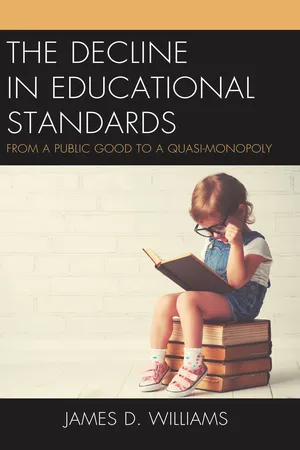
eBook - ePub
The Decline in Educational Standards
From a Public Good to a Quasi-Monopoly
- English
- ePUB (mobile friendly)
- Available on iOS & Android
eBook - ePub
About this book
Information
Topic
EducationSubtopic
Education AdministrationTable of contents
- Contents
- Acknowledgments
- Introduction
- Section I: Economics and Neoliberalism
- Chapter 1: Liberalism and Conservatism: Some Characteristics
- Chapter 2: The Industrial Revolution
- Chapter 3: Socialist Stirrings
- Chapter 4: John Maynard Keynes and Economic Theory
- Chapter 5: The Great Depression
- Chapter 6: Keynesian Economics and The Road to Serfdom
- Chapter 7: The 1970s’ Inflation
- Chapter 8: Debt-Based Consumer Capitalism and Taxation
- Chapter 9: Debt-Based Consumerism and a Mountain of Debt
- Chapter 10: Too Big to Fail
- Section II: What Happened to Public Education?
- Chapter 11: The Common School Movement
- Chapter 12: Meeting Educational Needs in a Diverse Society
- Chapter 13: Intelligence Testing
- Chapter 14: Academic Tracking
- Chapter 15: Criticisms of IQ Testing and Tracking
- Chapter 16: The Effects of the Proximate Environment on IQ and Academic Performance
- Chapter 17: The Commodification of Education
- Chapter 18: Federal Control through Federal Funding
- Chapter 19: Parental Satisfaction and Student Performance
- Chapter 20: Charter Schools, Vouchers, and Politics
- Chapter 21: How Did We Get Here?
- Chapter 22: Following the Money
- Section III: Higher Education as a Quasi-Monopoly
- Chapter 23: Education and the End of Poverty
- Chapter 24: Higher Education in a Privatized-Keynesian World
- Chapter 25: The Democratization of Higher Education
- Chapter 26: The Exchange Value of a College Degree
- Chapter 27: The Gainful Employment Rule and Tacit Collusion
- Chapter 28: Declining Public Confidence and Politicized Faculty
- Section IV: Improving Public and Higher Education
- Chapter 29: Neoliberalism, Privatized Keynesianism, and the Debt Bomb
- Chapter 30: Rethinking Public Education
- Chapter 31: Egalitarianism and the Drive for Equal Outcomes
- Chapter 32: Reforming the Nation’s Education System
- References
- About the Author
Trusted by 375,005 students
Access to over 1.5 million titles for a fair monthly price.
Study more efficiently using our study tools.
Frequently asked questions
Yes, you can cancel anytime from the Subscription tab in your account settings on the Perlego website. Your subscription will stay active until the end of your current billing period. Learn how to cancel your subscription
No, books cannot be downloaded as external files, such as PDFs, for use outside of Perlego. However, you can download books within the Perlego app for offline reading on mobile or tablet. Learn how to download books offline
Perlego offers two plans: Essential and Complete
- Essential is ideal for learners and professionals who enjoy exploring a wide range of subjects. Access the Essential Library with 800,000+ trusted titles and best-sellers across business, personal growth, and the humanities. Includes unlimited reading time and Standard Read Aloud voice.
- Complete: Perfect for advanced learners and researchers needing full, unrestricted access. Unlock 1.5M+ books across hundreds of subjects, including academic and specialized titles. The Complete Plan also includes advanced features like Premium Read Aloud and Research Assistant.
We are an online textbook subscription service, where you can get access to an entire online library for less than the price of a single book per month. With over 1.5 million books across 990+ topics, we’ve got you covered! Learn about our mission
Look out for the read-aloud symbol on your next book to see if you can listen to it. The read-aloud tool reads text aloud for you, highlighting the text as it is being read. You can pause it, speed it up and slow it down. Learn more about Read Aloud
Yes! You can use the Perlego app on both iOS and Android devices to read anytime, anywhere — even offline. Perfect for commutes or when you’re on the go.
Please note we cannot support devices running on iOS 13 and Android 7 or earlier. Learn more about using the app
Please note we cannot support devices running on iOS 13 and Android 7 or earlier. Learn more about using the app
Yes, you can access The Decline in Educational Standards by James D. Williams in PDF and/or ePUB format, as well as other popular books in Education & Education Administration. We have over 1.5 million books available in our catalogue for you to explore.