eBook - PDF
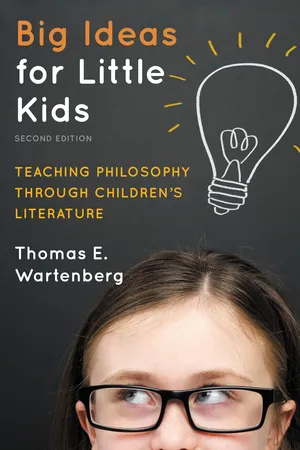
Big Ideas for Little Kids
Teaching Philosophy through Children's Literature
- 192 pages
- English
- PDF
- Available on iOS & Android
eBook - PDF
About this book
Big Ideas for Little Kids includes everything a teacher, a parent, or a college student needs to teach philosophy to elementary school children from picture books. Written in a clear and accessible style, the book explains why it is important to allow young children access to philosophy during primary-school education. Wartenberg also gives advice on how to construct a "learner-centered" classroom, in which children discuss philosophical issues with one another as they respond to open-ended questions by saying whether they agree or disagree with what others have said.
Information
Topic
EducationSubtopic
Education Teaching MethodsTable of contents
- Contents
- List of Tables
- List of Figures
- Preface
- Preface to theFirst Edition
- Part I. TEACHING PHILOSOPHY IN ELEMENTARY SCHOOLS
- Chapter One. Natural-Born Philosophers
- Chapter Two. How I Became a Children’s Philosophy Teacher
- Chapter Three. Learner-Centered Teaching
- Part II. PREPARING TO TEACH
- Chapter Four. The “Game” of Philosophy
- Chapter Five. The Elementary School Introduction to Philosophy Course
- Chapter Six. Preparing for a Philosophy Discussion: The Discussion Framework
- Chapter Seven. Facilitating a Philosophical Discussion
- Chapter Eight. Deepening and Extending the Discussion
- Part III. THE STORIES
- Chapter Nine. “Dragons and Giants”: Teaching Ethics
- Chapter Ten. Frederick: Teaching Social and Political Philosophy
- Chapter Eleven. The Important Book: Teaching Metaphysics
- Chapter Twelve. The Wonderful Wizard of Oz: Teaching the Philosophy of Mind
- Chapter Thirteen. The Giving Tree: Teaching Environmental Philosophy
- Chapter Fourteen. Morris the Moose: Teaching Logic
- Chapter Fifteen. Many Moons: Teaching Epistemology
- Chapter Sixteen. Knuffle Bunny: Teaching the Philosophy of Language
- Chapter Seventeen. Emily’s Art: Teaching Aesthetics
- Part IV. IMPLICATIONS
- Chapter Eighteen. A Sample Discussion of The Giving Tree
- Chapter Nineteen. Conclusion
- Appendix. Suggestions for Further Investigation
- References
Trusted by 375,005 students
Access to over 1.5 million titles for a fair monthly price.
Study more efficiently using our study tools.
Frequently asked questions
Yes, you can cancel anytime from the Subscription tab in your account settings on the Perlego website. Your subscription will stay active until the end of your current billing period. Learn how to cancel your subscription
No, books cannot be downloaded as external files, such as PDFs, for use outside of Perlego. However, you can download books within the Perlego app for offline reading on mobile or tablet. Learn how to download books offline
We are an online textbook subscription service, where you can get access to an entire online library for less than the price of a single book per month. With over 1.5 million books across 990+ topics, we’ve got you covered! Learn about our mission
Look out for the read-aloud symbol on your next book to see if you can listen to it. The read-aloud tool reads text aloud for you, highlighting the text as it is being read. You can pause it, speed it up and slow it down. Learn more about Read Aloud
Yes! You can use the Perlego app on both iOS and Android devices to read anytime, anywhere — even offline. Perfect for commutes or when you’re on the go.
Please note we cannot support devices running on iOS 13 and Android 7 or earlier. Learn more about using the app
Please note we cannot support devices running on iOS 13 and Android 7 or earlier. Learn more about using the app
Yes, you can access Big Ideas for Little Kids by Thomas E. Wartenberg in PDF and/or ePUB format, as well as other popular books in Education & Education Teaching Methods. We have over 1.5 million books available in our catalogue for you to explore.