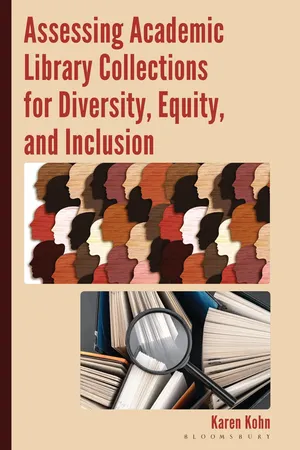
This book provides a practical, step-by-step approach to designing and implementing evaluation projects targeting a variety of DEI goals in academic library collections.
Offering both flexibility and detailed guidance, this book begins with a discussion of aspects of diversity that librarians could target in their assessment projects and notes project planning considerations such as defining a scope and timeline. It particularly notes how larger academic libraries can narrow the scope of a project to make it feasible. Subsequent chapters explain different methods for assessing a collection, with many examples throughout.
Methods include:
- List-checking involves comparing the collection to a list of recommended books.
- Metadata searching produces a count of library holdings that contain certain subject headings or use specific call numbers.
- Diversity coding allows staff to create their own categories and assign them to books in a sample.
All three of these methods can be used to analyze the collection by subject matter. It is possible to use diversity coding to examine author identities as well, a sensitive endeavor for which this book provides both cautions and guidance. A fourth approach focuses on organizational efforts or inputs. This method involves tracking and reflecting on the library's progress towards goals the staff have set, which could involve a variety of collections-related activities, including staff development, changes to workflows, revising policies, or increasing outreach. The book describes advantages and limitations of the four methods, allowing librarians to make an informed choice of which to use. It also offers resources for implementing each of these strategies as well as guidance on creating one's own evaluation tools. Three chapters by guest authors provide examples of DEI assessment projects from academic libraries. A concluding chapter discusses sharing findings and suggests a range of changes libraries can make to their collecting practices.
- 203 pages
- English
- PDF
- Available on iOS & Android
eBook - PDF
Assessing Academic Library Collections for Diversity, Equity, and Inclusion
About this book
Information
Table of contents
- Cover
- Half Title
- Title Page
- Copyright Page
- Contents
- List of Figures
- List of Tables
- List of Text Boxes
- Chapter 1: Assessing Collections for Diversity, Equity, and Inclusion
- Chapter 2: Defining Diversity
- Chapter 3: Choosing an Approach
- Chapter 4: Project Planning
- Chapter 5: List-Checking
- Chapter 6: Two Strategies for List-Checking at the University of West Florida: Melissa Gonzalez
- Chapter 7: Metadata Searching
- Chapter 8: Diversity Coding
- Chapter 9: Coding New Acquisitions for Diversity of Subject Matter and Authorship at a Small College Library: Artemis D. Vex a d Ruth Castillo
- Chapter 10: Assessing Institutional Efforts
- Chapter 11: Assessing DEIJA Projects at Ithaca College Library: Karin Wikoff
- Chapter 12: Moving Forward
- References
- Acknowledgments
- Index
- About the Authors
Trusted by 375,005 students
Access to over 1.5 million titles for a fair monthly price.
Study more efficiently using our study tools.
Frequently asked questions
Yes, you can cancel anytime from the Subscription tab in your account settings on the Perlego website. Your subscription will stay active until the end of your current billing period. Learn how to cancel your subscription
No, books cannot be downloaded as external files, such as PDFs, for use outside of Perlego. However, you can download books within the Perlego app for offline reading on mobile or tablet. Learn how to download books offline
Perlego offers two plans: Essential and Complete
- Essential is ideal for learners and professionals who enjoy exploring a wide range of subjects. Access the Essential Library with 800,000+ trusted titles and best-sellers across business, personal growth, and the humanities. Includes unlimited reading time and Standard Read Aloud voice.
- Complete: Perfect for advanced learners and researchers needing full, unrestricted access. Unlock 1.5M+ books across hundreds of subjects, including academic and specialized titles. The Complete Plan also includes advanced features like Premium Read Aloud and Research Assistant.
We are an online textbook subscription service, where you can get access to an entire online library for less than the price of a single book per month. With over 1.5 million books across 990+ topics, we’ve got you covered! Learn about our mission
Look out for the read-aloud symbol on your next book to see if you can listen to it. The read-aloud tool reads text aloud for you, highlighting the text as it is being read. You can pause it, speed it up and slow it down. Learn more about Read Aloud
Yes! You can use the Perlego app on both iOS and Android devices to read anytime, anywhere — even offline. Perfect for commutes or when you’re on the go.
Please note we cannot support devices running on iOS 13 and Android 7 or earlier. Learn more about using the app
Please note we cannot support devices running on iOS 13 and Android 7 or earlier. Learn more about using the app
Yes, you can access Assessing Academic Library Collections for Diversity, Equity, and Inclusion by Karen Kohn in PDF and/or ePUB format, as well as other popular books in Languages & Linguistics & Library & Information Science. We have over 1.5 million books available in our catalogue for you to explore.