This book is designed to empower librarians to develop their research skills and embrace their identities as scholars.
Many librarians, particularly those in academic libraries, are expected to engage in research and scholarly output. However, unlike disciplinary faculty, most librarians have not completed a PhD program, and many have never designed or participated in original research upon embarking on their career. This edited volume provides inspiration and support for academic librarians looking to develop or refresh their research skills and develop their scholarly identities. The focus of this book is toward empowering librarians as researchers, rather than librarians supporting student or faculty research. This book provides a venue for librarians to share their knowledge on different aspects of research as well as build community for other librarians to actualize their own identities as researchers.
The existing literature and research in the realm of librarian identity development often touches on librarian identities in the face of emerging technologies and new library types, or how librarians can support research at their institutions. However, there is a gap in the literature around librarians developing their own identities as researchers. Librarians have a unique role in the scholarly community; we often sacrifice our own research interests so that we can provide support and instruction to others, whether it be faculty, students, or the public. But the library world holds immense opportunity for developing and executing original research. Additionally, conducting research is beneficial to librarians' individual practice as well as the library community as a whole. This edited volume will provide guidance as well as actionable methods for librarians to develop foundational research philosophies, create communities of practice, and hone practical skills in a wide range of research areas.
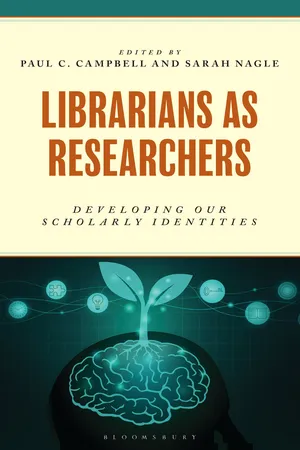
eBook - PDF
Librarians as Researchers
Developing our Scholarly Identities
- 275 pages
- English
- PDF
- Available on iOS & Android
eBook - PDF
About this book
Information
Table of contents
- Half Title
- Title Page
- Copyright
- Contents
- Editors’ Introduction
- Part I: Starting from Scratch—“Wait, Research Is Expected?”
- Chapter 1: Let the Garden Run Wild: Organizational Structures and Organic Growth of Research Identities
- Chapter 2: Where Do I Begin?: Developing a Research Identity as a Librarian
- Chapter 3: LIS Scholarship: Roadmap to Researcher Identity Development
- Chapter 4: Developing a Research Agenda: Connecting Practice with Research
- Chapter 5: Weaving Together Your Identity as a Librarian Researcher and Establishing or Discovering Common Threads: Friendly Advice from One Librarian to Another
- Chapter 6: Leveraging Librarian Skills to Develop Research Identities
- Part II: Creating a Culture of Research
- Chapter 7: Emotional Labor and Research Identity Development: The Early-Career Academic Librarian Experience
- Chapter 8: Squad Goals: Best Practices for Research Writing Communities
- Chapter 9: Implementing a SoTL Framework: Librarians in a Community of Practice
- Chapter 10: Manuscript by May: Fostering a Scholarly Writing Community of Practice
- Chapter 11: Building Support Structures for Non-Tenure-Track Librarian-Researchers: A Case Study at Seattle University
- Chapter 12: LibParlor Online Learning: Developing Librarian-Researcher Identities through a Free Online Curriculum
- Part III: The “How To” of Librarian Research
- Chapter 13: Navigating Cross-institutional Research
- Chapter 14: Designing Research Studies that Sail through the IRB Process
- Chapter 15: Publish or Perish and Playing Nice: And Other Things Library School Did Not Teach Us about the Publication Process
- Chapter 16: Identifying Your Epistemic Point of View and Designing Research
- Chapter 17: Positionality as a Pathway to Understanding Self and Practicing Culturally Responsive Librarianship, Leadership, a d Scholarship
- Index
- About the Editors
- About the Contributors
Trusted by 375,005 students
Access to over 1.5 million titles for a fair monthly price.
Study more efficiently using our study tools.
Frequently asked questions
Yes, you can cancel anytime from the Subscription tab in your account settings on the Perlego website. Your subscription will stay active until the end of your current billing period. Learn how to cancel your subscription
No, books cannot be downloaded as external files, such as PDFs, for use outside of Perlego. However, you can download books within the Perlego app for offline reading on mobile or tablet. Learn how to download books offline
Perlego offers two plans: Essential and Complete
- Essential is ideal for learners and professionals who enjoy exploring a wide range of subjects. Access the Essential Library with 800,000+ trusted titles and best-sellers across business, personal growth, and the humanities. Includes unlimited reading time and Standard Read Aloud voice.
- Complete: Perfect for advanced learners and researchers needing full, unrestricted access. Unlock 1.5M+ books across hundreds of subjects, including academic and specialized titles. The Complete Plan also includes advanced features like Premium Read Aloud and Research Assistant.
We are an online textbook subscription service, where you can get access to an entire online library for less than the price of a single book per month. With over 1.5 million books across 990+ topics, we’ve got you covered! Learn about our mission
Look out for the read-aloud symbol on your next book to see if you can listen to it. The read-aloud tool reads text aloud for you, highlighting the text as it is being read. You can pause it, speed it up and slow it down. Learn more about Read Aloud
Yes! You can use the Perlego app on both iOS and Android devices to read anytime, anywhere — even offline. Perfect for commutes or when you’re on the go.
Please note we cannot support devices running on iOS 13 and Android 7 or earlier. Learn more about using the app
Please note we cannot support devices running on iOS 13 and Android 7 or earlier. Learn more about using the app
Yes, you can access Librarians as Researchers by Paul C. Campbell,Sarah Nagle in PDF and/or ePUB format, as well as other popular books in Languages & Linguistics & Library & Information Science. We have over 1.5 million books available in our catalogue for you to explore.