- 327 pages
- English
- PDF
- Available on iOS & Android
eBook - PDF
About this book
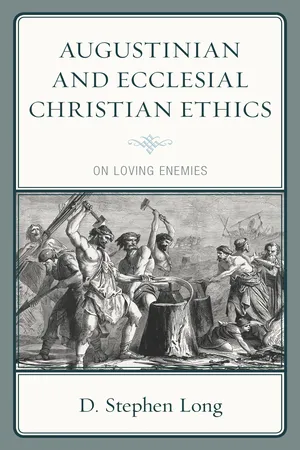
What is the relationship between the command to love one's enemies and the use of violence and/or other coercive political means? This work examines this question by comparing and contrasting two important contemporary approaches to Christian ethics, neoAugustinian and the ecclesial or neoAnabaptist. It traces the complicated conversation that has taken place since John Howard Yoder took on Reinhold Niebuhr's interpretation of the Anabaptists in the 1940's. It consists of three parts. The first part traces the development of the Augustinian-Niebuhrian approach to ethics from Niebuhr through those who have advanced his work including Paul Ramsey, Timothy Jackson, Charles Mathewes, Eric Gregory, and Jennifer Herdt. It also examines the Augustinian ethics of Oliver O'Donovan, John Milbank and Nicholas Wolterstorff. Along with tracing the Augustinian approach and its trajectories through agapism, theology and the interpretation of Augustine, it identifies fifteen criticisms that this approach brings against the neoAnabaptists. The second part traces the origin of the ecclesial or neoAnabaptist approach, and then examines its relationship to, and criticism of, agapism, what theological doctrines are central and its interpretation of Augustine. Its purpose is primarily constructive by explaining the role that ecclesiology, Christology and eschatology have among the neoAnabaptists. The third part addresses the criticisms levied by Augustinians against the neoAnabaptists by drawing on the constructive theology in the second part. It intends to show where the Augustinian critics are correct, where they have missed key theological teachings, and where they misrepresent. It also assesses the summons to the nationalist project the Augustinians put to the neoAnabaptists. If this work is successful, this third part will not be defensive. It will instead illumine the reasons for the criticisms and suggest means by which the conversation that began between Yoder and Niebuhr can continue and possibly bear fruit for theological ethics in both its ecclesial and nationalist projects for generations to come.
Information
Topic
Theology & ReligionSubtopic
Christian TheologyTable of contents
- Contents
- Preface
- Introduction
- Chapter One. Origin and Development of the Augustinian Approach
- Chapter Two. Origin and Development of the Ecclesial Approach
- Chapter Three. Addressing the Critiques
- Conclusion
- Bibliography
- Index
- About the Author
Trusted by 375,005 students
Access to over 1.5 million titles for a fair monthly price.
Study more efficiently using our study tools.
Frequently asked questions
Yes, you can cancel anytime from the Subscription tab in your account settings on the Perlego website. Your subscription will stay active until the end of your current billing period. Learn how to cancel your subscription
No, books cannot be downloaded as external files, such as PDFs, for use outside of Perlego. However, you can download books within the Perlego app for offline reading on mobile or tablet. Learn how to download books offline
Perlego offers two plans: Essential and Complete
- Essential is ideal for learners and professionals who enjoy exploring a wide range of subjects. Access the Essential Library with 800,000+ trusted titles and best-sellers across business, personal growth, and the humanities. Includes unlimited reading time and Standard Read Aloud voice.
- Complete: Perfect for advanced learners and researchers needing full, unrestricted access. Unlock 1.5M+ books across hundreds of subjects, including academic and specialized titles. The Complete Plan also includes advanced features like Premium Read Aloud and Research Assistant.
We are an online textbook subscription service, where you can get access to an entire online library for less than the price of a single book per month. With over 1.5 million books across 990+ topics, we’ve got you covered! Learn about our mission
Look out for the read-aloud symbol on your next book to see if you can listen to it. The read-aloud tool reads text aloud for you, highlighting the text as it is being read. You can pause it, speed it up and slow it down. Learn more about Read Aloud
Yes! You can use the Perlego app on both iOS and Android devices to read anytime, anywhere — even offline. Perfect for commutes or when you’re on the go.
Please note we cannot support devices running on iOS 13 and Android 7 or earlier. Learn more about using the app
Please note we cannot support devices running on iOS 13 and Android 7 or earlier. Learn more about using the app
Yes, you can access Augustinian and Ecclesial Christian Ethics by D. Stephen Long in PDF and/or ePUB format, as well as other popular books in Theology & Religion & Christian Theology. We have over 1.5 million books available in our catalogue for you to explore.