The southernmost and poorest state of the Eurasian space, Tajikistan collapsed immediately upon the fall of the Soviet Union and plunged into a bloody five-year civil war (1992–1997) that left more than 50,000 people dead and more than half a million displaced. After the 1997 Peace Agreements, Tajikistan stood out for being the only post-Soviet country to recognize an Islamic party—the Islamic Renaissance Party of Tajikistan (IRPT)—as a key actor in the civil war as well as in postwar reconstruction and democratization. Tajikistan's linguistic and cultural proximity to Iran notwithstanding, the balance of external powers over the country remains fairly typical of Central Asia, with Russia as the major security provider and China as its principal investor.
Another specificity of Tajikistan is its massive labor migration flows toward Russia. Out of a population of eight million, about one million work abroad seasonally—one of the highest rates of departure in the world. Migration trends have impacted Tajikistan's economy and rent mechanisms: half of the country's GDP comes from migrant remittances, a higher share than anywhere else in the world. However, it is in the societal and cultural realms that migration has had the most transformative effect. Migrants' cultural and societal identities are on the move, with a growing role given to Islam as a normative tool for regulating the cultural shock of migration. Islam, and especially a globalized fundamentalist pietist movement, regulates both physical and moral security in workplace and other settings, and brings migrants together to make their interactions meaningful and socio-politically relevant. It offers a new social prestige to those who work in an environment seen as threatening to their Islamic identity.
The first section of this volume investigates the critical question of the nature of the Tajik political regime, its stability, legitimacy mechanisms, and patterns of centralization. In the volume's second part, we move away from studying the state to delve into the societal fabric of Tajikistan, shaped by local rural specificities and social vulnerabilities in the health sector and gender relationships. The third section of the volume is devoted to identity narratives and changes. While the Tajik regime works hard to control the national narrative and the interpretation of the civil war, society is literally and figuratively on the move, as migration profoundly reshapes societal structures and cultural values.
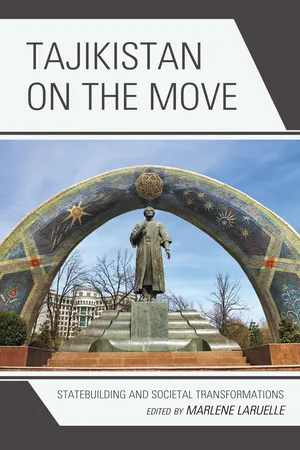
- 337 pages
- English
- PDF
- Available on iOS & Android
eBook - PDF
About this book
Information
Table of contents
- Contents
- List of Figures
- List of Tables
- Acronyms
- Map
- Introduction
- Part I. STATE DYNAMICS, POLITICS, THEIRACTORS, AND THEIR SPACES
- Ch01. Hobbesian Neopatrimonialism
- Ch02. Rebels without a Cause?
- Ch03. From Moscow to Madrid: Governing Security Threats beyond Tajikistan’s Borders
- Ch04. Tajikistan’s Multi-Vector Foreign Policy
- Part II. TAJIK SOCIETY: LOCAL DEVELOPMENTS AND SOCIAL VULNERABILITIES
- Ch05. Dushanbe Is Quite Far
- Ch06. Local Governance in Khatlon, Tajikistan
- Ch07. Development Practices, Insecurity, and Risks
- Ch08. “A Woman without a Man is a Kazan without a Lid”
- Part III. STATE MEMORY AND MOVING IDENTITIES
- Ch09. Oblivion, Ambivalence, and Historical Erasure: Remembering the Civil War in Tajikistan
- Ch10. Translocal Security scapes of Tajik Labor Migrants and the Families and Communities They Leave Behind
- Ch11. Illegal Migrants and Pious Muslims
- Bibliography
- Index
- About the Editor and Contributors
Trusted by 375,005 students
Access to over 1.5 million titles for a fair monthly price.
Study more efficiently using our study tools.
Frequently asked questions
Yes, you can cancel anytime from the Subscription tab in your account settings on the Perlego website. Your subscription will stay active until the end of your current billing period. Learn how to cancel your subscription
No, books cannot be downloaded as external files, such as PDFs, for use outside of Perlego. However, you can download books within the Perlego app for offline reading on mobile or tablet. Learn how to download books offline
Perlego offers two plans: Essential and Complete
- Essential is ideal for learners and professionals who enjoy exploring a wide range of subjects. Access the Essential Library with 800,000+ trusted titles and best-sellers across business, personal growth, and the humanities. Includes unlimited reading time and Standard Read Aloud voice.
- Complete: Perfect for advanced learners and researchers needing full, unrestricted access. Unlock 1.5M+ books across hundreds of subjects, including academic and specialized titles. The Complete Plan also includes advanced features like Premium Read Aloud and Research Assistant.
We are an online textbook subscription service, where you can get access to an entire online library for less than the price of a single book per month. With over 1.5 million books across 990+ topics, we’ve got you covered! Learn about our mission
Look out for the read-aloud symbol on your next book to see if you can listen to it. The read-aloud tool reads text aloud for you, highlighting the text as it is being read. You can pause it, speed it up and slow it down. Learn more about Read Aloud
Yes! You can use the Perlego app on both iOS and Android devices to read anytime, anywhere — even offline. Perfect for commutes or when you’re on the go.
Please note we cannot support devices running on iOS 13 and Android 7 or earlier. Learn more about using the app
Please note we cannot support devices running on iOS 13 and Android 7 or earlier. Learn more about using the app
Yes, you can access Tajikistan on the Move by Marlene Laruelle in PDF and/or ePUB format, as well as other popular books in Politics & International Relations & Central Asian History. We have over 1.5 million books available in our catalogue for you to explore.