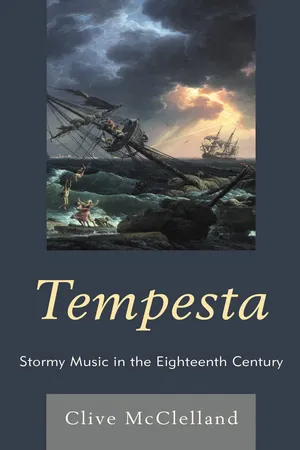
Tempesta is a term coined in this book applying to music that exhibits agitated or violent characteristics in order to evoke terror and chaos, involving ideas like rapid scale passages, driving rhythmic figurations, strong accents, full textures, and robust instrumentation including prominent brass and timpani. Music of this type was used for storm scenes, which in operas of the 17th and 18th centuries are almost invariably of supernatural origin, and other frightening experiences such as pursuit, madness, and rage.
This 'stormy' music formed the ingredients of a particular style in the later 18th century that scholars in recent decades have referred to as Sturm und Drang, implying a relationship to German literature which I believe is unhelpful and misleading. Haydn's so-called Sturm und Drang symphonies exhibit characteristics that are no different to his depictions of storms in his operas and sacred music, and there is no evidence of Haydn suffering some kind of personal crisis, or even of him responding to the 'spirit of the age'. He was simply exploring the expressive possibilities of the style for dramatic/rhetorical effect. Scholars have been dissatisfied with the term for some time, but no-one has previously suggested an alternative. The term tempesta therefore applies to all manifestations of this kind of music, a label that acknowledges the 'stormy' origins of the style, but which also recognizes that it functions as a counterpart to ombra.
Tempesta contributed enormously to the continued popularity of operas on supernatural subjects, and quickly migrated towards sacred music and even instrumental music, where it became part of the topical discourse. The music does not merely represent the supernatural, it instills an emotional response in the listener. Awe and terror had already been identified as sources of the sublime, notably by Edmund Burke (predating the German literary Sturm und Drang), and the latter half of the century saw the rise of Gothic literature. The supernatural remained popular in theaters and opera houses, and special music that could produce an emotional response of such magnitude was a powerful tool in the composer's expressive armory.
- 257 pages
- English
- PDF
- Available on iOS & Android
eBook - PDF
About this book
Information
Subtopic
MusicTable of contents
- Contents
- Introduction
- Abbreviations
- Chapter One. Tempesta in Context
- Chapter Two. Tonality
- Chapter Three. Harmony and Line
- Chapter Four. Tempo and Rhythm
- Chapter Five. Texture, Dynamics, and Instrumentation
- Chapter Six. Case Studies in Opera
- Chapter Seven. Tempesta in Sacred Music
- Chapter Eight. Tempesta in Instrumental Music
- Chapter Nine. Towards Romanticism
- Appendix A. A Taxonomy of Tempesta Characteristics
- Bibliography
- Index
- About the Author
Trusted by 375,005 students
Access to over 1.5 million titles for a fair monthly price.
Study more efficiently using our study tools.
Frequently asked questions
Yes, you can cancel anytime from the Subscription tab in your account settings on the Perlego website. Your subscription will stay active until the end of your current billing period. Learn how to cancel your subscription
No, books cannot be downloaded as external files, such as PDFs, for use outside of Perlego. However, you can download books within the Perlego app for offline reading on mobile or tablet. Learn how to download books offline
Perlego offers two plans: Essential and Complete
- Essential is ideal for learners and professionals who enjoy exploring a wide range of subjects. Access the Essential Library with 800,000+ trusted titles and best-sellers across business, personal growth, and the humanities. Includes unlimited reading time and Standard Read Aloud voice.
- Complete: Perfect for advanced learners and researchers needing full, unrestricted access. Unlock 1.5M+ books across hundreds of subjects, including academic and specialized titles. The Complete Plan also includes advanced features like Premium Read Aloud and Research Assistant.
We are an online textbook subscription service, where you can get access to an entire online library for less than the price of a single book per month. With over 1.5 million books across 990+ topics, we’ve got you covered! Learn about our mission
Look out for the read-aloud symbol on your next book to see if you can listen to it. The read-aloud tool reads text aloud for you, highlighting the text as it is being read. You can pause it, speed it up and slow it down. Learn more about Read Aloud
Yes! You can use the Perlego app on both iOS and Android devices to read anytime, anywhere — even offline. Perfect for commutes or when you’re on the go.
Please note we cannot support devices running on iOS 13 and Android 7 or earlier. Learn more about using the app
Please note we cannot support devices running on iOS 13 and Android 7 or earlier. Learn more about using the app
Yes, you can access Tempesta by Clive McClelland in PDF and/or ePUB format, as well as other popular books in Media & Performing Arts & Music. We have over 1.5 million books available in our catalogue for you to explore.