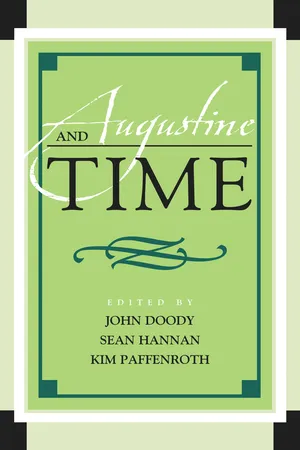
This collection examines the topic of time in the life and works of Augustine of Hippo. Adopting a global perspective on time as a philosophical and theological problem, the volume includes reflections on the meaning of history, the mortality of human bodies, and the relationship between temporal experience and linguistic expression. As Augustine himself once observed, time is both familiar and surprisingly strange. Everyone's days are structured by temporal rhythms and routines, from watching the clock to whiling away the hours at work. Few of us, however, take the time to sit down and figure out whether time is real or not, or how it is we are able to hold our past, present, and future thoughts together in a straight line so that we can recite a prayer or sing a song.
Divided into five sections, the essays collected here highlight the ongoing relevance of Augustine's work even in settings quite distinct from his own era and context. The first three sections, organized around the themes of interpretation, language, and gendered embodiment, engage directly with Augustine's own writings, from the Confessions to the City of God and beyond. The final two sections, meanwhile, explore the afterlife of the Augustinian approach in conversation with medieval Islamic and Christian thinkers (like Avicenna and Aquinas), as well as a broad range of Buddhist figures (like Dharmakirti and Vasubandhu).
What binds all of these diverse chapters together is the underlying sense that, regardless of the century or the tradition in which we find ourselves, there is something about the puzzle of temporality that refuses to go away. Time, as Augustine knew, demands our attention. This was true for him in late ancient North Africa. It was also true for Buddhist thinkers in South and East Asia. And it remains just as true for humankind in the twenty-first century, as people around the globe continue to grapple with the reality of time and the challenges of living in a world that always seems to be to be speeding up rather than slowing down.
- 357 pages
- English
- PDF
- Available on iOS & Android
eBook - PDF
Augustine and Time
About this book
Information
Topic
PhilosophySubtopic
European Medieval HistoryTable of contents
- Cover
- Half Title
- Series Page
- Title Page
- Copyright Page
- Contents
- Introduction
- Part I: Interpreting Augustine on Time
- Chapter 1: Time, Eternity, and History in Augustine’s Early Works
- Chapter 2: Keeping Time in Mind: Saint Augustine’s Proposed Solution to a Perplexing Problem
- Chapter 3: Time after Augustine
- Part II: Time, Language, and Song
- Chapter 4: Living as Singing: Augustine’s Understanding of the Voice of Creatures in the Confessiones
- Chapter 5: Time, Mirror of the Soul
- Chapter 6: The Inner Word and the Outer World: Time, Temporality, and Language in Augustine and Gadamer
- Part III: Time, Embodiment, and Gender
- Chapter 7: Augustinian Temporality and Resurrected Bodies
- Chapter 8: Love in the Time of Augustine: Rape, Suicide, and Resurrection in City of God
- Chapter 9: Augustine and the Gendered Self in Time
- Part IV: Augustinian Temporality in the Middle Ages
- Chapter 10: Augustine and Avicenna on the Puzzle of Time without Time
- Chapter 11: The Timing of Creation: Aquinas’s Reception of Augustine
- Chapter 12: Augustine’s Dilemma: Divine Eternity and the Reality of Temporal Passage
- Chapter 13: Thomas Bradwardine: A Fourteenth-Century Augustinian View of Time
- Chapter 14: Time after Time: Gregory of Rimini, Contingents Past and Future, and Augustinian Critique
- Part V: Augustinian and Buddhist Temporalities
- Chapter 15: Non-Presentism in Antiquity: South Asian Buddhist Perspectives
- Chapter 16: Breaking the Stream of Consciousness: Momentariness and the Eternal Present
- Chapter 17: Out of the Abyss: On Pedagogical Relationality and Time in the Confessions and the Lotus Sutra
- Bibliography
- About the Editors and Contributors
Trusted by 375,005 students
Access to over 1.5 million titles for a fair monthly price.
Study more efficiently using our study tools.
Frequently asked questions
Yes, you can cancel anytime from the Subscription tab in your account settings on the Perlego website. Your subscription will stay active until the end of your current billing period. Learn how to cancel your subscription
No, books cannot be downloaded as external files, such as PDFs, for use outside of Perlego. However, you can download books within the Perlego app for offline reading on mobile or tablet. Learn how to download books offline
Perlego offers two plans: Essential and Complete
- Essential is ideal for learners and professionals who enjoy exploring a wide range of subjects. Access the Essential Library with 800,000+ trusted titles and best-sellers across business, personal growth, and the humanities. Includes unlimited reading time and Standard Read Aloud voice.
- Complete: Perfect for advanced learners and researchers needing full, unrestricted access. Unlock 1.5M+ books across hundreds of subjects, including academic and specialized titles. The Complete Plan also includes advanced features like Premium Read Aloud and Research Assistant.
We are an online textbook subscription service, where you can get access to an entire online library for less than the price of a single book per month. With over 1.5 million books across 990+ topics, we’ve got you covered! Learn about our mission
Look out for the read-aloud symbol on your next book to see if you can listen to it. The read-aloud tool reads text aloud for you, highlighting the text as it is being read. You can pause it, speed it up and slow it down. Learn more about Read Aloud
Yes! You can use the Perlego app on both iOS and Android devices to read anytime, anywhere — even offline. Perfect for commutes or when you’re on the go.
Please note we cannot support devices running on iOS 13 and Android 7 or earlier. Learn more about using the app
Please note we cannot support devices running on iOS 13 and Android 7 or earlier. Learn more about using the app
Yes, you can access Augustine and Time by John Doody,Sean Hannan,Kim Paffenroth in PDF and/or ePUB format, as well as other popular books in Philosophy & European Medieval History. We have over 1.5 million books available in our catalogue for you to explore.