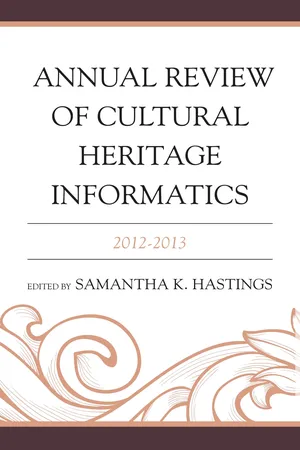
The premier volume of the Annual Review of Cultural Heritage Informatics (ARCHI), edited by Samantha Kelly Hastings, is the polestar publication for cultural heritage scholars, professionals, and students. Featuring sixteen original works selected by the distinguished editorial board of international scholars, ARCHI presents a broad spectrum of the cultural heritage informatics field. Whether one is interested in cultural heritage preservation, digitization, digital humanities, user behavior, technology, or educational practices, ARCHI is the central source for current and emerging trends in the rapidly expanding cultural heritage informatics field.
Major sections include Best Practices, Digital Communities, Education, Field Reports, and Technology:
• Best Practices contributors, such as distinguished scholars Michèle V. Cloonan, Martha Mahard, Daniel Gelaw Alemneh, Abebe Rorissa, Jeannette A. Bastian, and Ross Harvey, explore the increasingly converging, distributed, and pluralistic nature of digital cultural heritage and suggest new perspectives on traditional preservation and access methodologies.
• Digital Communities authors emphasize the role of cultural maps in interpreting digital representations and advocate for the preservation of digital cultural discourse.
• Education offerings include an exploration of a current cultural heritage informatics educational program and an analysis of educational resources available to local history and genealogy collection librarians.
• Field Reports case studies include active digitization programs, cultural heritage preservation initiatives, and developing cultural heritage research agendas in Ethiopia, Pennsylvania (U.S.), Australia, and Romania.
• Technology for promoting the accessibility and preservation of cultural heritage is explored from the specific perspectives of a digital humanities virtual reality application, identification of a metric enabling libraries and archives to invoke analog video reproduction rights under the United States Copyright Act, folksonomies and other social networking tools as finding aid extensions, and a review of digital collection user studies.
In addition to the five major sections, a nascent sixth, Reviews, section is introduced and the vision charted for its expansion in future volumes. Providing a compendium of current research, educational initiatives, and best practices, ARCHI is a pivotal resource for cultural heritage informatics scholars, practitioners, and students. By challenging readers to explore a variety of contexts and offering critical evaluation of conventional practices, ARCHI promotes new ideas and offers new pathways of development for the cultural heritage informatics field.
- 317 pages
- English
- PDF
- Available on iOS & Android
eBook - PDF
About this book
Information
Table of contents
- Contents
- List of Figures
- List of Tables
- List of Articles by Section with Abstracts
- Acknowledgments
- Introduction
- Part I. BEST PRACTICES
- Chapter 1. Digital Preservation: Whose Responsibility?
- Chapter 2. Facilitating Discovery and Use of Digital Cultural Heritage Resources with Folksonomies: A Review
- Chapter 3. Experiments in Cultural Heritage Informatics: Convergence and Divergence
- Part II. DIGITAL COMMUNITIES
- Chapter 4. Web Representation and Interpretation of Culture: The Case of a Holistic Healing System
- Chapter 5. Knitting as Cultural Heritage: Knitting Blogs and Conservation
- Part III. EDUCATION
- Chapter 6. Developing Twenty-First-Century Cultural Heritage Information Professionals for Digital Stewardship: A Framework for Curriculum Design
- Chapter 7. Local History and Genealogy Collections in Libraries: The Challenge to Library and Information Science Educators
- Part IV. FIELD REPORTS
- Chapter 8. Initiatives in Digitization and Digital Preservation of Cultural Heritage in Ethiopia
- Chapter 9. Creating the Online Literary and Cultural Heritage Map of Pennsylvania
- Chapter 10. The Community Heritage Grants Program in Australia: Report of a Survey
- Chapter 11. Toward a Study of “Unofficial” Museums
- Part V. TECHNOLOGY
- Chapter 12. Ghosts of the Horseshoe, a Mobile Application: Fostering a New Habit of Thinking about the History of University of South Carolina’s Historic Horseshoe
- Chapter 13. Tune In, Turn On, Drop Out: Section 108(c) and Evaluating Deterioration in Commercially Produced VHS Collections
- Chapter 14. The Devils You Don’t Know: The New Lives of the Finding Aid
- Chapter 15. If You Build It, Will They Come? A Review of Digital Collection User Studies
- Part VI. REVIEWS (NASCENT)
- Chapter 16. Memories of a Museum Visit
- Index
- About the Editor
Trusted by 375,005 students
Access to over 1.5 million titles for a fair monthly price.
Study more efficiently using our study tools.
Frequently asked questions
Yes, you can cancel anytime from the Subscription tab in your account settings on the Perlego website. Your subscription will stay active until the end of your current billing period. Learn how to cancel your subscription
No, books cannot be downloaded as external files, such as PDFs, for use outside of Perlego. However, you can download books within the Perlego app for offline reading on mobile or tablet. Learn how to download books offline
Perlego offers two plans: Essential and Complete
- Essential is ideal for learners and professionals who enjoy exploring a wide range of subjects. Access the Essential Library with 800,000+ trusted titles and best-sellers across business, personal growth, and the humanities. Includes unlimited reading time and Standard Read Aloud voice.
- Complete: Perfect for advanced learners and researchers needing full, unrestricted access. Unlock 1.5M+ books across hundreds of subjects, including academic and specialized titles. The Complete Plan also includes advanced features like Premium Read Aloud and Research Assistant.
We are an online textbook subscription service, where you can get access to an entire online library for less than the price of a single book per month. With over 1.5 million books across 990+ topics, we’ve got you covered! Learn about our mission
Look out for the read-aloud symbol on your next book to see if you can listen to it. The read-aloud tool reads text aloud for you, highlighting the text as it is being read. You can pause it, speed it up and slow it down. Learn more about Read Aloud
Yes! You can use the Perlego app on both iOS and Android devices to read anytime, anywhere — even offline. Perfect for commutes or when you’re on the go.
Please note we cannot support devices running on iOS 13 and Android 7 or earlier. Learn more about using the app
Please note we cannot support devices running on iOS 13 and Android 7 or earlier. Learn more about using the app
Yes, you can access Annual Review of Cultural Heritage Informatics by Samantha K. Hastings in PDF and/or ePUB format, as well as other popular books in Languages & Linguistics & Museum Administration. We have over 1.5 million books available in our catalogue for you to explore.