Over the past fifteen years, the dramatic increase of online self-help legal re-sources, information, and tools specifically developed for use by low-income individuals without legal counsel has been promoted as one way to help those individuals who are caught in this "justice gap." Unfortunately, however, opportunities arising from the Internet and related information and communication technologies do not accrue to everyone equally as physical, intellectual, and social barriers to information persist.
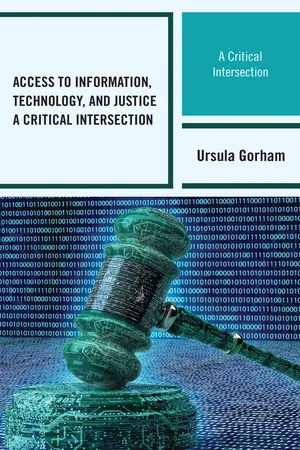
Access to Information, Technology, and Justice: A Critical Intersection, as the first ever book length examination of the use of technology to expand access to justice in the United States, highlights an emerging paradox wherein the technological transformation that has created an increasing array of legal self-help resources and services is also creating barriers to access for disadvantaged individuals. Those who cannot read, those who do not speak the English language, those who are unfamiliar with the law, and those with limited digital literacy skills all find themselves at a fundamental disadvantage. The legal community has only begun to examine whether these resources and services are, in fact, meeting the needs of struggling self-help users. This book builds upon existing work in this area by undertaking an in-depth exploration of how information and communication technologies are changing – and failing to change – the legal in-formation landscape for those who most need this information. Drawing upon the ongoing collaborative efforts of legal aid organizations, libraries, courts, and non-profit organizations, this book provides a framework for removing barriers to equitable access to legal information, with the ultimate goal of encouraging continued discussion and action.
- 167 pages
- English
- PDF
- Available on iOS & Android
eBook - PDF
About this book
Information
Table of contents
- Contents
- List of Figures and Tables
- Acknowledgments
- Introduction
- List of Abbreviations
- Ch01. The Emergence of a Justice Gap
- Ch02. Self-Help in the Legal Context
- Ch03. The Expanding Role of Technology in Legal Self-Help
- Ch04. Overview of Statewide Legal Information Websites
- Ch05. Opening Up the “Black Box” of Statewide Legal Information Websites
- Ch06. Collaboration in the Realm of Access to Justice
- Ch07. Recommendations for Policy and Practice
- Appendix A. List of Statewide Legal Information Websites
- Appendix B. Survey Questions
- Appendix C. State Profiles
- Bibliography
- Index
- About the Author
Trusted by 375,005 students
Access to over 1.5 million titles for a fair monthly price.
Study more efficiently using our study tools.
Frequently asked questions
Yes, you can cancel anytime from the Subscription tab in your account settings on the Perlego website. Your subscription will stay active until the end of your current billing period. Learn how to cancel your subscription
No, books cannot be downloaded as external files, such as PDFs, for use outside of Perlego. However, you can download books within the Perlego app for offline reading on mobile or tablet. Learn how to download books offline
Perlego offers two plans: Essential and Complete
- Essential is ideal for learners and professionals who enjoy exploring a wide range of subjects. Access the Essential Library with 800,000+ trusted titles and best-sellers across business, personal growth, and the humanities. Includes unlimited reading time and Standard Read Aloud voice.
- Complete: Perfect for advanced learners and researchers needing full, unrestricted access. Unlock 1.5M+ books across hundreds of subjects, including academic and specialized titles. The Complete Plan also includes advanced features like Premium Read Aloud and Research Assistant.
We are an online textbook subscription service, where you can get access to an entire online library for less than the price of a single book per month. With over 1.5 million books across 990+ topics, we’ve got you covered! Learn about our mission
Look out for the read-aloud symbol on your next book to see if you can listen to it. The read-aloud tool reads text aloud for you, highlighting the text as it is being read. You can pause it, speed it up and slow it down. Learn more about Read Aloud
Yes! You can use the Perlego app on both iOS and Android devices to read anytime, anywhere — even offline. Perfect for commutes or when you’re on the go.
Please note we cannot support devices running on iOS 13 and Android 7 or earlier. Learn more about using the app
Please note we cannot support devices running on iOS 13 and Android 7 or earlier. Learn more about using the app
Yes, you can access Access to Information, Technology, and Justice by Ursula Gorham in PDF and/or ePUB format, as well as other popular books in Languages & Linguistics & Library & Information Science. We have over 1.5 million books available in our catalogue for you to explore.