Death and Finitude offers an examination and defense of a pragmatic transcendental anthropology applicable to the concepts of limit, finitude, and mortality that are constitutive of human life as we know it. Sami Pihlström develops a special kind of philosophical anthropology—a pragmatic yet transcendental examination of the human condition—that interprets what is worth preserving in the tradition of transcendental philosophy in such a manner that this unusual combination will crucially enrich our understanding of a human problem we all share: mortality.
In some sense, all serious philosophy inevitably reflects on the human condition and is thus philosophical anthropology, broadly conceived. There can hardly be any more serious problem concerning the human condition than the problem of death. Yet, mainstream analytic contributions to the philosophy of death usually addresses death in general, and it is far from obvious that such contributions are philosophically relevant in the sense of addressing the agony of an individual human being trying to understand their own mortal condition. "Continental" philosophy of death may be frustrating in a different sense, as it often fails to be conceptually as clear and argumentatively as rigorous as the analytic literature. Claiming to address my "being-toward-death", such contributions may also fail to speak to the mortal individual if they end up in endless pseudo-philosophical jargon. It is against this background of frustration that Death and Finitude contributes to humanity's on-going reflections on death, dying, and mortality—from a pragmatist yet transcendental perspective, seeking to accommodate these topics within a broader philosophical anthropology.
The book is primarily intended for academic philosophers, but the potential readership includes not only scholars but also both graduate students and advanced undergraduates, as well as general educated readers. It is relevant to the concerns of philosophers specializing in transcendental philosophy, philosophical anthropology, pragmatism, Wittgenstein, and the philosophy of religion. As the book may be said to be an attempt to "philosophize historically," it is in principle of interest to both systematically and historically oriented philosophers and students.
eBook - PDF
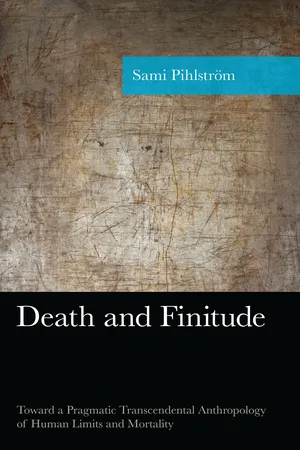
Death and Finitude
Toward a Pragmatic Transcendental Anthropology of Human Limits and Mortality
- 229 pages
- English
- PDF
- Available on iOS & Android
eBook - PDF
Death and Finitude
Toward a Pragmatic Transcendental Anthropology of Human Limits and Mortality
About this book
Information
Topic
PhilosophySubtopic
Ethics & Moral PhilosophyTable of contents
- Table of Contents
- Preface
- Chapter One: Introduction
- Chapter Two: Mortality and Philosophical Anthropology
- Chapter Three: The Self as a Limit
- Chapter Four: Death—Mine or the Other’s?
- Chapter Five: Death, Guilt, and (In)equality
- Chapter Six: Controlling Death?
- Chapter Seven: Conclusion
- Bibliography
- Index
- About the Author
Trusted by 375,005 students
Access to over 1.5 million titles for a fair monthly price.
Study more efficiently using our study tools.
Frequently asked questions
Yes, you can cancel anytime from the Subscription tab in your account settings on the Perlego website. Your subscription will stay active until the end of your current billing period. Learn how to cancel your subscription
No, books cannot be downloaded as external files, such as PDFs, for use outside of Perlego. However, you can download books within the Perlego app for offline reading on mobile or tablet. Learn how to download books offline
Perlego offers two plans: Essential and Complete
- Essential is ideal for learners and professionals who enjoy exploring a wide range of subjects. Access the Essential Library with 800,000+ trusted titles and best-sellers across business, personal growth, and the humanities. Includes unlimited reading time and Standard Read Aloud voice.
- Complete: Perfect for advanced learners and researchers needing full, unrestricted access. Unlock 1.5M+ books across hundreds of subjects, including academic and specialized titles. The Complete Plan also includes advanced features like Premium Read Aloud and Research Assistant.
We are an online textbook subscription service, where you can get access to an entire online library for less than the price of a single book per month. With over 1.5 million books across 990+ topics, we’ve got you covered! Learn about our mission
Look out for the read-aloud symbol on your next book to see if you can listen to it. The read-aloud tool reads text aloud for you, highlighting the text as it is being read. You can pause it, speed it up and slow it down. Learn more about Read Aloud
Yes! You can use the Perlego app on both iOS and Android devices to read anytime, anywhere — even offline. Perfect for commutes or when you’re on the go.
Please note we cannot support devices running on iOS 13 and Android 7 or earlier. Learn more about using the app
Please note we cannot support devices running on iOS 13 and Android 7 or earlier. Learn more about using the app
Yes, you can access Death and Finitude by Sami Pihlström in PDF and/or ePUB format, as well as other popular books in Philosophy & Ethics & Moral Philosophy. We have over 1.5 million books available in our catalogue for you to explore.