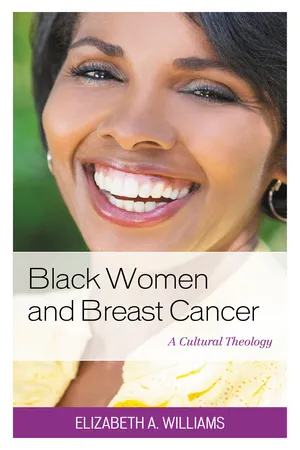
Christian theology at its core is a story about someone being in trouble. In response to this trouble, the triune God intervenes. God identifies with those in trouble, walking with them through the experience. Yet, the God of Christian theology goes a step further. God prevails over trouble. God is an overcomer. Black women with breast cancer identify with this God. They also see themselves in this theological narrative. They see themselves in the midst of troubles, troubles like racism, poverty and environmental exposures that create the disease affecting their bodies. They see the troubles of breast cancer, their biological disposition towards more aggressive cancers, later stage diagnoses, poorer prognoses, diminished quality of care and worse outcomes.
Black women also palpably feel the troubles breast cancer brings like fear, physical disfigurement, social isolation, being stereotyped for treatment decisions, abandonment and even death. Black women feel the myriad troubles breast cancer brings. But, Black women also know God in their troubles. They know an active God who identifies with and prioritizes their needs. They know this God, through scripture and experience, as God who puts them front and center. And because they know God as an overcomer and creative force, they know themselves as overcomers. For with God, their troubles do not last always.
Black women with breast cancer construct a cultural theology of breast cancer out of knowing God. Borne out of experiences of the Black Church, womanist theology and their intersectional identities of race, class and gender, this theological investigation, informed by anthropology, examines how Black women construct an ontology of who God is and how God operates and gain a God consciousness that shapes their response to the disease. Using pain, faith and testimony as tools to struggle against breast cancer Black survivors' theology transforms them from victims of breast cancer to change agents. Out of their lives as survivors comes a theology of complex hope- one cognizant of Black women's breast cancer disparities, yet oriented towards Black women's achievement of health in the present and the future– a sufficient hope to sustain Black women through it all.
- 183 pages
- English
- PDF
- Available on iOS & Android
eBook - PDF
About this book
Information
Topic
Theology & ReligionSubtopic
TheologyTable of contents
- Contents
- Preface
- Acknowledgments
- Introduction
- I: The God of Black Women and Breast Cancer
- II: Black Women Respond to God and Breast Cancer
- Conclusion
- Bibliography
- Index
- About the Author
Trusted by 375,005 students
Access to over 1.5 million titles for a fair monthly price.
Study more efficiently using our study tools.
Frequently asked questions
Yes, you can cancel anytime from the Subscription tab in your account settings on the Perlego website. Your subscription will stay active until the end of your current billing period. Learn how to cancel your subscription
No, books cannot be downloaded as external files, such as PDFs, for use outside of Perlego. However, you can download books within the Perlego app for offline reading on mobile or tablet. Learn how to download books offline
Perlego offers two plans: Essential and Complete
- Essential is ideal for learners and professionals who enjoy exploring a wide range of subjects. Access the Essential Library with 800,000+ trusted titles and best-sellers across business, personal growth, and the humanities. Includes unlimited reading time and Standard Read Aloud voice.
- Complete: Perfect for advanced learners and researchers needing full, unrestricted access. Unlock 1.5M+ books across hundreds of subjects, including academic and specialized titles. The Complete Plan also includes advanced features like Premium Read Aloud and Research Assistant.
We are an online textbook subscription service, where you can get access to an entire online library for less than the price of a single book per month. With over 1.5 million books across 990+ topics, we’ve got you covered! Learn about our mission
Look out for the read-aloud symbol on your next book to see if you can listen to it. The read-aloud tool reads text aloud for you, highlighting the text as it is being read. You can pause it, speed it up and slow it down. Learn more about Read Aloud
Yes! You can use the Perlego app on both iOS and Android devices to read anytime, anywhere — even offline. Perfect for commutes or when you’re on the go.
Please note we cannot support devices running on iOS 13 and Android 7 or earlier. Learn more about using the app
Please note we cannot support devices running on iOS 13 and Android 7 or earlier. Learn more about using the app
Yes, you can access Black Women and Breast Cancer by Elizabeth A. Williams in PDF and/or ePUB format, as well as other popular books in Theology & Religion & Theology. We have over 1.5 million books available in our catalogue for you to explore.