One of the oldest cities in the world, Beijing was an imperial capital for centuries. After the founding of the People's Republic of China in 1949, Beijing became not only the political center of the new communist country, but also the signifier of socialist ideol-ogy and revolutionary culture. Now, in the 21st century, Beijing embodies global conflicts and global connections. Over the course of the last century, then, Beijing moved from the quintessential "traditional" capital to the symbol of communist urban form and finally to a cosmopolitan metropolis. These three stages in the history of Beijing and its shifting representations are the topic of this study.
Like other capitals, Beijing is much more than its physical entity. It also functions as a concept, a representation. As city planners have (and continue to) present Beijing to the world as a model, the fluctuating images of Beijing have become solidified in urban space. Today, the urban form of Beijing juxtaposes diverse spaces that span centuries, embodying the various representations of the city by its planners in different eras. These representations of space also provide possibilities for writers to rethink and rebuild the city in their literary works. Chinese writers and filmmakers often essentialize those urban spaces by making them symbols of different urban cultures, the old houses representing "traditional," "patriarchal" Chinese culture while soviet-style buildings reflect revolu-tionary culture. Finally, the more recent sprouting of apartments, condos, and townhouses stands for the invasion of western modernity and provides evidence of global capitalism in contemporary China.
Inspired by Henri Lefebvre, this study establishes a framework that connects urban spaces (representations of space) to writers and literary productions (representational space). I analyze the three major urban spatial forms of traditional, communist, and glob-alized Beijing and examine what these urban spaces mean to Chinese writers and filmmakers as well as how they use them to configure particular images of Beijing. I argue that these different configurations are actually the projections of those writers and filmmakers' own cultural imaginations; they provoke a form of emotional catharsis and also produce alternative visions of the cityscape.
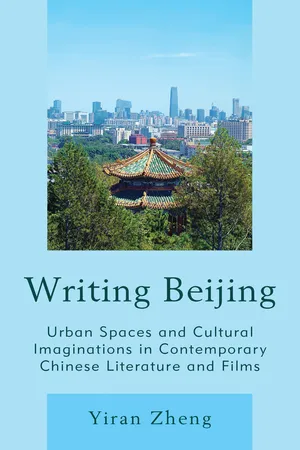
eBook - PDF
Writing Beijing
Urban Spaces and Cultural Imaginations in Contemporary Chinese Literature and Films
- 169 pages
- English
- PDF
- Available on iOS & Android
eBook - PDF
Writing Beijing
Urban Spaces and Cultural Imaginations in Contemporary Chinese Literature and Films
About this book
Information
Table of contents
- Contents
- Figures
- Introduction
- P A R T I
- Chapter 1. Work Unit Compound: An Emergence of a New Urban Space
- Chapter 2. “Gongheguo xingui” (New Aristocrats of the PRC)
- Chapter 3. Red Nostalgia in the Literature of the Military Compound
- P A R T I I
- Chapter 4. Siheyuan: Signifier of Traditional and Masculine City
- Chapter 5. Second-Generation Beijing Flavor Writers
- Chapter 6. Traditional Beijing and Masculine Beijing in Second-Generation Beijing Flavor Literature
- P A R T I I I
- Chapter 7. Modern and Postmodern Architectures: Presentations of the Global Context
- Chapter 8. Beijing Floaters
- Chapter 9. Cosmopolitan Metropolis as an Urban Dream in Sixth-Generation Films
- Conclusion
- References
- Index
- About the Author
Trusted by 375,005 students
Access to over 1.5 million titles for a fair monthly price.
Study more efficiently using our study tools.
Frequently asked questions
Yes, you can cancel anytime from the Subscription tab in your account settings on the Perlego website. Your subscription will stay active until the end of your current billing period. Learn how to cancel your subscription
No, books cannot be downloaded as external files, such as PDFs, for use outside of Perlego. However, you can download books within the Perlego app for offline reading on mobile or tablet. Learn how to download books offline
Perlego offers two plans: Essential and Complete
- Essential is ideal for learners and professionals who enjoy exploring a wide range of subjects. Access the Essential Library with 800,000+ trusted titles and best-sellers across business, personal growth, and the humanities. Includes unlimited reading time and Standard Read Aloud voice.
- Complete: Perfect for advanced learners and researchers needing full, unrestricted access. Unlock 1.5M+ books across hundreds of subjects, including academic and specialized titles. The Complete Plan also includes advanced features like Premium Read Aloud and Research Assistant.
We are an online textbook subscription service, where you can get access to an entire online library for less than the price of a single book per month. With over 1.5 million books across 990+ topics, we’ve got you covered! Learn about our mission
Look out for the read-aloud symbol on your next book to see if you can listen to it. The read-aloud tool reads text aloud for you, highlighting the text as it is being read. You can pause it, speed it up and slow it down. Learn more about Read Aloud
Yes! You can use the Perlego app on both iOS and Android devices to read anytime, anywhere — even offline. Perfect for commutes or when you’re on the go.
Please note we cannot support devices running on iOS 13 and Android 7 or earlier. Learn more about using the app
Please note we cannot support devices running on iOS 13 and Android 7 or earlier. Learn more about using the app
Yes, you can access Writing Beijing by Yiran Zheng in PDF and/or ePUB format, as well as other popular books in Social Sciences & Asian Literary Criticism. We have over 1.5 million books available in our catalogue for you to explore.