This monograph examines the relationship between music and memory as it relates to the Gallipoli Campaign (1915-6). Drawing upon a wide variety of sources in many languages, it explores the multiple ways in which music is employed to remember and to forget, to celebrate and to commemorate a victory (on the part of the Central Powers) and a defeat (on the part of the Allied forces) in the Dardanelles during the First World War (1914-8). Further, it argues that commemoration itself can be viewed as an 'instrument of war'. In particular, it investigates the complex positionality of individual actors during the centennial commemorations of the Gallipoli landings (24 April, 2015) where the Australians and the Turks most notably have employed music to reimagine the past, both nationalities invoking the 'Gallipoli spirit' (tr. 'Çanakkale ruhu') to advance a nationalist agenda and a resurgent militarism through the selective memorialization of an imperial past.
The book interrogates through music the ambivalent position of minorities. With specific reference to the Irish (amongst the British) and the Armenians (amongst the Ottomans), it shows how song might serve both to articulate a nationalist defiance and an imperialist consensus during a tumultuous period of irredentism. By uncovering the complex pathways of musical transmission, it demonstrates through musical analysis how the colonized could become the colonizer (in the case of the Irish) or a minority might conform to a majority (in the case of the Armenians). Further, the publication looks at the uneasy alliance between the Turks and the Germans. It focuses on a German musician (as an imperial bandmaster) and Germanic entrepreneurs (in the recording industry) who entertained or who served the German Mission in Istanbul. Here, it considers by way of musical composition the shared wish on the part of the Germans and the Turks to create a Lebensraum in Asia.
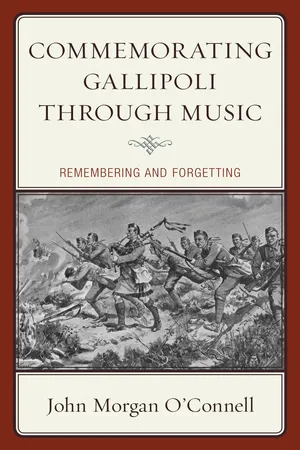
- 333 pages
- English
- PDF
- Available on iOS & Android
eBook - PDF
About this book
Information
Subtopic
World War ITable of contents
- Cover
- Commemorating Gallipoli through Music
- Contents
- List of Figures
- List of Tables
- Preface
- Acknowledgments
- Prelude
- Order of Mejidieh
- Chapter 1
- A Soldier’s Lament
- Chapter 2
- The Holy War
- Chapter 3
- Old Gallipoli
- Chapter 4
- Mehter in the Museum
- Chapter 5
- Hybrid Turks
- Chapter 6
- Sound Bites
- Chapter 7
- Music as Memory
- Coda
- The Gallipoli Spirit
- Appendix I
- Sheet Music Examples
- Appendix II
- Lyrics
- Bibliography
- Index
- About the Author
Trusted by 375,005 students
Access to over 1.5 million titles for a fair monthly price.
Study more efficiently using our study tools.
Frequently asked questions
Yes, you can cancel anytime from the Subscription tab in your account settings on the Perlego website. Your subscription will stay active until the end of your current billing period. Learn how to cancel your subscription
No, books cannot be downloaded as external files, such as PDFs, for use outside of Perlego. However, you can download books within the Perlego app for offline reading on mobile or tablet. Learn how to download books offline
Perlego offers two plans: Essential and Complete
- Essential is ideal for learners and professionals who enjoy exploring a wide range of subjects. Access the Essential Library with 800,000+ trusted titles and best-sellers across business, personal growth, and the humanities. Includes unlimited reading time and Standard Read Aloud voice.
- Complete: Perfect for advanced learners and researchers needing full, unrestricted access. Unlock 1.5M+ books across hundreds of subjects, including academic and specialized titles. The Complete Plan also includes advanced features like Premium Read Aloud and Research Assistant.
We are an online textbook subscription service, where you can get access to an entire online library for less than the price of a single book per month. With over 1.5 million books across 990+ topics, we’ve got you covered! Learn about our mission
Look out for the read-aloud symbol on your next book to see if you can listen to it. The read-aloud tool reads text aloud for you, highlighting the text as it is being read. You can pause it, speed it up and slow it down. Learn more about Read Aloud
Yes! You can use the Perlego app on both iOS and Android devices to read anytime, anywhere — even offline. Perfect for commutes or when you’re on the go.
Please note we cannot support devices running on iOS 13 and Android 7 or earlier. Learn more about using the app
Please note we cannot support devices running on iOS 13 and Android 7 or earlier. Learn more about using the app
Yes, you can access Commemorating Gallipoli through Music by John Morgan O'Connell in PDF and/or ePUB format, as well as other popular books in Media & Performing Arts & World War I. We have over 1.5 million books available in our catalogue for you to explore.