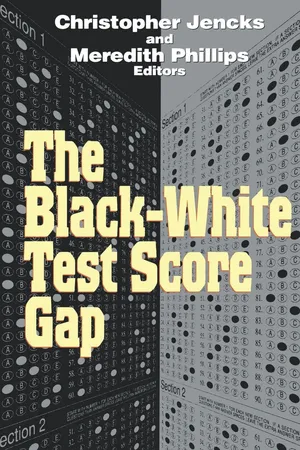
The test score gap between blacks and whites-on vocabulary, reading, and math tests, as well as on tests that claim to measure scholastic aptitude and intelligence--is large enough to have far-reaching social and economic consequences. In their introduction to this book, Christopher Jencks and Meredith Phillips argue that eliminating the disparity would dramatically reduce economic and educational inequality between blacks and whites. Indeed, they think that closing the gap would do more to promote racial equality than any other strategy now under serious discussion. The book offers a comprehensive look at the factors that contribute to the test score gap and discusses options for substantially reducing it.
Although significant attempts have been made over the past three decades to shrink the test score gap, including increased funding for predominantly black schools, desegregation of southern schools, and programs to alleviate poverty, the median black American still scores below 75 percent of American whites on most standardized tests. The book brings together recent evidence on some of the most controversial and puzzling aspects of the test score debate, including the role of test bias, heredity, and family background. It also looks at how and why the gap has changed over the past generation, reviews the educational, psychological, and cultural explanations for the gap, and analyzes its educational and economic consequences.
The authors demonstrate that traditional explanations account for only a small part of the black-white test score gap. They argue that this is partly because traditional explanations have put too much emphasis on racial disparities in economic resources, both in homes and in schools, and on demographic factors like family structure. They say that successful theories will put more emphasis on psychological and cultural factors, such as the way black and white parents teach their children to deal with things they do not know or understand, and the way black and white children respond to the same classroom experiences. Finally, they call for large-scale experiments to determine the effects of schools' racial mix, class size, ability grouping, and other policies.
In addition to the editors, the contributors include Claude Steele, Ronald Ferguson, William G. Bowen, Philip Cook, and William Julius Wilson.
- 536 pages
- English
- PDF
- Available on iOS & Android
eBook - PDF
The Black-White Test Score Gap
About this book
Information
Topic
EducationSubtopic
Education GeneralTable of contents
- Cover
- Contents
- 1 The Black-White Test Score Gap: An Introduction
- PART I: Test Bias, Heredity, and Home Environment
- PART II: How and Why the Gap Has Changed
- PART III: The Impact of Schools and Culture
- PART IV: Do Test Scores Matter?
- PART V: Commentary
- Contributors
- Index
Trusted by 375,005 students
Access to over 1.5 million titles for a fair monthly price.
Study more efficiently using our study tools.
Frequently asked questions
Yes, you can cancel anytime from the Subscription tab in your account settings on the Perlego website. Your subscription will stay active until the end of your current billing period. Learn how to cancel your subscription
No, books cannot be downloaded as external files, such as PDFs, for use outside of Perlego. However, you can download books within the Perlego app for offline reading on mobile or tablet. Learn how to download books offline
Perlego offers two plans: Essential and Complete
- Essential is ideal for learners and professionals who enjoy exploring a wide range of subjects. Access the Essential Library with 800,000+ trusted titles and best-sellers across business, personal growth, and the humanities. Includes unlimited reading time and Standard Read Aloud voice.
- Complete: Perfect for advanced learners and researchers needing full, unrestricted access. Unlock 1.5M+ books across hundreds of subjects, including academic and specialized titles. The Complete Plan also includes advanced features like Premium Read Aloud and Research Assistant.
We are an online textbook subscription service, where you can get access to an entire online library for less than the price of a single book per month. With over 1.5 million books across 990+ topics, we’ve got you covered! Learn about our mission
Look out for the read-aloud symbol on your next book to see if you can listen to it. The read-aloud tool reads text aloud for you, highlighting the text as it is being read. You can pause it, speed it up and slow it down. Learn more about Read Aloud
Yes! You can use the Perlego app on both iOS and Android devices to read anytime, anywhere — even offline. Perfect for commutes or when you’re on the go.
Please note we cannot support devices running on iOS 13 and Android 7 or earlier. Learn more about using the app
Please note we cannot support devices running on iOS 13 and Android 7 or earlier. Learn more about using the app
Yes, you can access The Black-White Test Score Gap by Christopher Jencks,Meredith Phillips in PDF and/or ePUB format, as well as other popular books in Education & Education General. We have over 1.5 million books available in our catalogue for you to explore.