In the winter of 1913, a small crowd gathered on the streets of a famous red-light district on the outskirts of Tokyo. Curious patrons, journalists, and onlookers formed a steady procession to see the prostitute, Wada Yoshiko, and celebrate the release of her new book. A Prostitute's Tale divulged inner secrets about her co-workers, patrons, and difficult confinement in a government-run syphilis hospital. According to the press, the author was a literary prostitute, a new expert, and a compelling version of Japan's new woman. Soon widely acclaimed, her literary work heralded a growing public desire for inside knowledge about the lived experiences of pleasure workers.
Wada's success was the product of more than half-a-century of high-stakes conversations about the future of Japan. Her fame as an author simultaneously challenged and complemented previous discussions about the role of the female prostitute in the modern nation-state. However, while her perspective was new, the information she shared invoked key themes that had proliferated about her in prior decades. Since the 1850s, when Japan was forced to sign the "unequal" commercial treaties with the Western imperial powers, wide-ranging debates had taken place that linked the prostitute to national security and international prestige in imperative new ways.
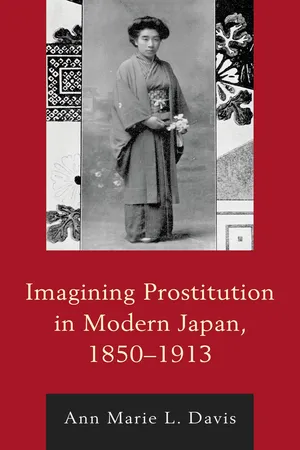
Imagining Prostitution in Modern Japan traces the symbol of the prostitute as a project of nation- and empire-building from the 1850s to 1913, ending one year after the death of the Meiji emperor, and coincidentally, the year of Wada's publication. It untangles how ideas about pleasure work intersected with Japan's transformation into a modern nation according to Western models. It asserts that the figure of the prostitute was a powerful symbolic resource that wide-ranging interest groups deployed, variously, to negotiate and define shifting distinctions of status, identity, and power. Each of the debates about the prostitute was in turn central to and mutually constitutive of the emergent social order in Meiji Japan.
- 249 pages
- English
- PDF
- Available on iOS & Android
eBook - PDF
Imagining Prostitution in Modern Japan, 1850–1913
About this book
Information
Table of contents
- Contents
- Acknowledgments
- One. Introduction
- Two. Camouflaging Chaos with Pleasure: Images of the Yokohama Pleasure Zone
- Three. Counting Bodies: Enumerating Prostitutes and the Guardians of the National Body
- Four. Freedom, People’s Rights, and the Early Abolition Movement: Contesting Modernity, Enlightenment, and Power
- Five. Writing A Prostitute’s Tale by Wada Yoshiko
- Six. Epilogue
- Bibliography
- Index
- About the Author
Trusted by 375,005 students
Access to over 1.5 million titles for a fair monthly price.
Study more efficiently using our study tools.
Frequently asked questions
Yes, you can cancel anytime from the Subscription tab in your account settings on the Perlego website. Your subscription will stay active until the end of your current billing period. Learn how to cancel your subscription
No, books cannot be downloaded as external files, such as PDFs, for use outside of Perlego. However, you can download books within the Perlego app for offline reading on mobile or tablet. Learn how to download books offline
Perlego offers two plans: Essential and Complete
- Essential is ideal for learners and professionals who enjoy exploring a wide range of subjects. Access the Essential Library with 800,000+ trusted titles and best-sellers across business, personal growth, and the humanities. Includes unlimited reading time and Standard Read Aloud voice.
- Complete: Perfect for advanced learners and researchers needing full, unrestricted access. Unlock 1.5M+ books across hundreds of subjects, including academic and specialized titles. The Complete Plan also includes advanced features like Premium Read Aloud and Research Assistant.
We are an online textbook subscription service, where you can get access to an entire online library for less than the price of a single book per month. With over 1.5 million books across 990+ topics, we’ve got you covered! Learn about our mission
Look out for the read-aloud symbol on your next book to see if you can listen to it. The read-aloud tool reads text aloud for you, highlighting the text as it is being read. You can pause it, speed it up and slow it down. Learn more about Read Aloud
Yes! You can use the Perlego app on both iOS and Android devices to read anytime, anywhere — even offline. Perfect for commutes or when you’re on the go.
Please note we cannot support devices running on iOS 13 and Android 7 or earlier. Learn more about using the app
Please note we cannot support devices running on iOS 13 and Android 7 or earlier. Learn more about using the app
Yes, you can access Imagining Prostitution in Modern Japan, 1850–1913 by Ann Marie L. Davis in PDF and/or ePUB format, as well as other popular books in History & Japanese History. We have over 1.5 million books available in our catalogue for you to explore.