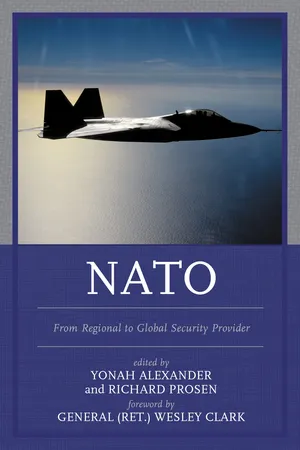
The purpose of NATO: From Regional to Global Security Provider is to provide a comprehensive analysis of the Alliance's new vision (the new Strategic Concept) and common security impact – associated tasks to be undertaken within a short and longer term time horizon. The book serves as a relevant and timely study of the most pressing issues facing NATO today – including recent lessons gained. It provides recommendations for consideration and further discussion (i.e., the "what" and the "how" regarding future policy options for the North Atlantic Alliance). The intended audience includes international security policy-makers, government officials, elected leaders, academics, interested professionals, civil society and members of the public.
Specifically, the book focuses on six topic areas. Part I, the Introduction, relates to conceptual and organizational changes, membership expansion and enlargement. Part II consists of emerging security challenges, including terrorism, piracy, homeland threats, cyber defense and information warfare, energy security, non-proliferation and countering WMD. Part III incorporates national and regional challenges such as the Balkans, Iraq, Afghanistan/Pakistan, the Horn of Africa, North Africa and the Middle East.
Part IV deals with military and non-military assets. It integrates capability development, burden sharing, common funding, ballistic missile defenses and the phased adaptive approach, non-strategic nuclear weapons, and a broad-based comprehensive approach to security. Part V covers multifaceted collaborative relationships between NATO and various governmental, inter-governmental, and non-governmental bodies. This section incorporates outreach and engagement with Russia, India, Pakistan, and China, as well as with other non-NATO countries, the Mediterranean Dialogue (MD), and the Istanbul Cooperation Initiative (ICI). Formal and informal linkages with the EU, OSCE, and the UN are also essential features of such a cooperative activity. Additionally, the expanding participation of civil society and growing involvement of new key NATO interlocutors (e.g., NGOs, academics) have created new international partnering opportunities as a means of bolstering global security through innovative public-private partnerships.
Part VI includes a Summary and Conclusions.
- 320 pages
- English
- PDF
- Available on iOS & Android
eBook - PDF
About this book
Information
Table of contents
- Contents
- Acronyms
- Foreword
- Introduction
- Chapter One: Asymmetric Threats and New Security Challenges
- Chapter Two: NATO’s Cyber Decade?
- Chapter Three: Counter-Piracy
- Chapter Four: The New NATO Policy Guidelines on Counterterrorism
- Chapter Five: NATO and the Balkans
- Chapter Six: Operation Unified Protector
- Chapter Seven: NATO and Afghanistan
- Chapter Eight: Capabilities Development and Common Funding
- Chapter Nine: NATO Ballistic Missile Defense
- Chapter Ten: NATO-Russian Relations
- Chapter Eleven: The Changing Parameters of the Transatlantic Security Relationship
- Chapter Twelve: Partnership for Peace Consortium (PfPC)
- Chapter Thirteen: NATO Partnerships into the Future
- Chapter Fourteen: NATO as a Security Exporter
- Chapter Fifteen: Summary and Conclusions
- Selected Bibliography
- Index
- About the Editors
Trusted by 375,005 students
Access to over 1.5 million titles for a fair monthly price.
Study more efficiently using our study tools.
Frequently asked questions
Yes, you can cancel anytime from the Subscription tab in your account settings on the Perlego website. Your subscription will stay active until the end of your current billing period. Learn how to cancel your subscription
No, books cannot be downloaded as external files, such as PDFs, for use outside of Perlego. However, you can download books within the Perlego app for offline reading on mobile or tablet. Learn how to download books offline
Perlego offers two plans: Essential and Complete
- Essential is ideal for learners and professionals who enjoy exploring a wide range of subjects. Access the Essential Library with 800,000+ trusted titles and best-sellers across business, personal growth, and the humanities. Includes unlimited reading time and Standard Read Aloud voice.
- Complete: Perfect for advanced learners and researchers needing full, unrestricted access. Unlock 1.5M+ books across hundreds of subjects, including academic and specialized titles. The Complete Plan also includes advanced features like Premium Read Aloud and Research Assistant.
We are an online textbook subscription service, where you can get access to an entire online library for less than the price of a single book per month. With over 1.5 million books across 990+ topics, we’ve got you covered! Learn about our mission
Look out for the read-aloud symbol on your next book to see if you can listen to it. The read-aloud tool reads text aloud for you, highlighting the text as it is being read. You can pause it, speed it up and slow it down. Learn more about Read Aloud
Yes! You can use the Perlego app on both iOS and Android devices to read anytime, anywhere — even offline. Perfect for commutes or when you’re on the go.
Please note we cannot support devices running on iOS 13 and Android 7 or earlier. Learn more about using the app
Please note we cannot support devices running on iOS 13 and Android 7 or earlier. Learn more about using the app
Yes, you can access NATO by Yonah Alexander,Richard Prosen in PDF and/or ePUB format, as well as other popular books in Politics & International Relations & Middle Eastern Politics. We have over 1.5 million books available in our catalogue for you to explore.