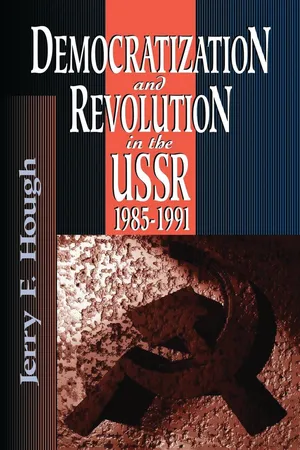
Democratization and Revolution in the USSR, 1985-91 presents a strikingly new view of the Gorbachev era and the reasons for the collapse of the Soviet Union. Written by one of America's most distinguished specialists on the former Soviet Union, this is the first comprehensive overview of the Gorbachev period and describes it as a real revolution, not mere ""reform.""
According to Hough, despite Mikhail Gorbachev's talk of a regulated market, he never understood that a market must be created on a solid institutional and legal base. He was determined to use democratization to free himself from party control, but he saw democracy as a way of achieving near- universal consensus, not a mechanism for forcing through difficult choices. The many memoirs that have become available in the last few years, including those of Gorbachev himself, show that Premier Nikolai Ryzhkov and the ""bureaucrats"" in his government actually were the serious economic reformers in the leadership. Gorbachev opposed the key transitional steps at every stage and was far closer to the assumptions of shock therapy than he or his opponents ever recognized.
Hough explains that Gorbachev was not alone in thinking that the destruction of old institutions was enough to unleash a market. Westerners also talked of leaping a chasm in a single jump as if democratic and market institutions existed pre-created on the other side. But, precisely because Gorbachev (and later Boris Yeltsin) was encouraged in all his worst mistakes by Western advice, his failure has crucial implications for Western thinking about the process of democratization and marketization. This unprecedented book explores those implications in depth.
Selected by Choice as an Outstanding Book for 1998
- 559 pages
- English
- PDF
- Available on iOS & Android
eBook - PDF
Democratization and Revolution in the USSR, 1985-91
About this book
Information
Table of contents
- Cover
- Contents
- 1. Introduction
- 2. Prelude to Revolution
- 3. Gorbachev' s Ascent and the Circular Flow of Power
- 4. The Tragedy of Economic Reform
- 5. Democratization and the 1989 USSR Election
- 6. Foreign and Domestic Policy and the Issue of Eastern Europe
- 7. Soviet Federalism and the Problem of Russia
- 8. The End of Communist Party Rule
- 9. The 1990 Russian Election
- 10. The Straggle between Gorbachev and Yeltsin
- 11. The Controversy over Economic Reform
- 12. The Union Treaty
- 13. The Russian Presidential Election and the August Coup d'État
- 14. Economic Options and the Breakup of the Union
- 15. Conclusion
- Index
Trusted by 375,005 students
Access to over 1.5 million titles for a fair monthly price.
Study more efficiently using our study tools.
Frequently asked questions
Yes, you can cancel anytime from the Subscription tab in your account settings on the Perlego website. Your subscription will stay active until the end of your current billing period. Learn how to cancel your subscription
No, books cannot be downloaded as external files, such as PDFs, for use outside of Perlego. However, you can download books within the Perlego app for offline reading on mobile or tablet. Learn how to download books offline
Perlego offers two plans: Essential and Complete
- Essential is ideal for learners and professionals who enjoy exploring a wide range of subjects. Access the Essential Library with 800,000+ trusted titles and best-sellers across business, personal growth, and the humanities. Includes unlimited reading time and Standard Read Aloud voice.
- Complete: Perfect for advanced learners and researchers needing full, unrestricted access. Unlock 1.5M+ books across hundreds of subjects, including academic and specialized titles. The Complete Plan also includes advanced features like Premium Read Aloud and Research Assistant.
We are an online textbook subscription service, where you can get access to an entire online library for less than the price of a single book per month. With over 1.5 million books across 990+ topics, we’ve got you covered! Learn about our mission
Look out for the read-aloud symbol on your next book to see if you can listen to it. The read-aloud tool reads text aloud for you, highlighting the text as it is being read. You can pause it, speed it up and slow it down. Learn more about Read Aloud
Yes! You can use the Perlego app on both iOS and Android devices to read anytime, anywhere — even offline. Perfect for commutes or when you’re on the go.
Please note we cannot support devices running on iOS 13 and Android 7 or earlier. Learn more about using the app
Please note we cannot support devices running on iOS 13 and Android 7 or earlier. Learn more about using the app
Yes, you can access Democratization and Revolution in the USSR, 1985-91 by Jerry F. Hough in PDF and/or ePUB format, as well as other popular books in Politics & International Relations & Communism, Post-Communism & Socialism. We have over 1.5 million books available in our catalogue for you to explore.