Over the last fifty years Western Christianity has been criticized as a cause and enabler of Earth's ecological crisis. It has been said that Christianity promotes a spiritual-material dualism where the material side of life has little sacred value. Also noted in the critique is the hesitancy of many Christians to embrace modern scientific understandings of creation, especially evolution. Some Christian writers have responded by accepting modern cosmology and evolution, and advocating for a "sacramental" creation spirituality, oftentimes supported by fresh readings of earlier Christian writings.
In Whole-Earth Ethics for Holy Ground, Dr. Stephen Hastings begins by offering a genre defining overview of late 20th century and early 21st century writings that he calls "sacramental" creation spirituality. These writings are characterized by their acceptance of the scientific creation story of cosmogenesis and evolution, and their recovery of authentic Christian nature mysticism. Hastings then looks at Teilhard de Chardin (1881–1955 CE), Maximus the Confessor (c.580–662 CE), and Nicholas of Cusa (1401–1464 CE). Together the teachings of Maximus and Nicholas support Teilhard's call for a theology of a Creator God robust enough to encompass the most expansive and complicated propositions about creation made by science, while remaining as close as the real presence of Christ in the Eucharist. The integrated teachings of these three figures suggest the consecration of creation as its condition of being, meaning that God is present in all things. This consecration or presence inspires sacramental experiences that are revelations of God in and through creation. These complement the sacramental experience of Christ in the Eucharist. Together these sacramental encounters converge to support the conclusion that just as one receives and responds to Christ present in the elements of the communion table, so one ought to receive and respond to oneself, one's neighbors, and all creation as the universal consecrated and sacramental neighborhood. This is a whole-Earth sacramental ethic that is what we need today, centered on all life and ecosystems.
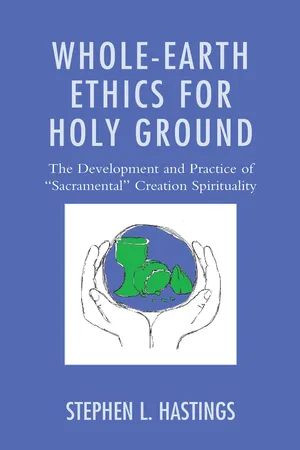
eBook - PDF
Whole-Earth Ethics for Holy Ground
The Development and Practice of "Sacramental" Creation Spirituality
- 167 pages
- English
- PDF
- Available on iOS & Android
eBook - PDF
Whole-Earth Ethics for Holy Ground
The Development and Practice of "Sacramental" Creation Spirituality
About this book
Information
Topic
Theology & ReligionSubtopic
Religion & ScienceTable of contents
- Contents
- Introduction
- 1 The Integration of Science in Sacramental Creation Spirituality: Relatedness, Responsibility, Redemption
- 2 The Recovery of Nature Mysticism in Sacramental Creation Spirituality: The Via Positiva, Panentheism, Sacramentalism
- 3 Teilhard de Chardin and the Case for New Theology in Light of a New Creation Story
- 4 Sacramental Creation Spirituality in Maximus the Confessor and Nicholas of Cusa
- 5 The Coincidence and Convergence of Natural and Eucharistic Sacraments
- 6 The Coincidence and Convergence of Ecological and Eucharistic Ethics in a Consecrated Universe
- Conclusion
- Postlude
- Bibliography
- Index
- About the Author
Trusted by 375,005 students
Access to over 1.5 million titles for a fair monthly price.
Study more efficiently using our study tools.
Frequently asked questions
Yes, you can cancel anytime from the Subscription tab in your account settings on the Perlego website. Your subscription will stay active until the end of your current billing period. Learn how to cancel your subscription
No, books cannot be downloaded as external files, such as PDFs, for use outside of Perlego. However, you can download books within the Perlego app for offline reading on mobile or tablet. Learn how to download books offline
Perlego offers two plans: Essential and Complete
- Essential is ideal for learners and professionals who enjoy exploring a wide range of subjects. Access the Essential Library with 800,000+ trusted titles and best-sellers across business, personal growth, and the humanities. Includes unlimited reading time and Standard Read Aloud voice.
- Complete: Perfect for advanced learners and researchers needing full, unrestricted access. Unlock 1.5M+ books across hundreds of subjects, including academic and specialized titles. The Complete Plan also includes advanced features like Premium Read Aloud and Research Assistant.
We are an online textbook subscription service, where you can get access to an entire online library for less than the price of a single book per month. With over 1.5 million books across 990+ topics, we’ve got you covered! Learn about our mission
Look out for the read-aloud symbol on your next book to see if you can listen to it. The read-aloud tool reads text aloud for you, highlighting the text as it is being read. You can pause it, speed it up and slow it down. Learn more about Read Aloud
Yes! You can use the Perlego app on both iOS and Android devices to read anytime, anywhere — even offline. Perfect for commutes or when you’re on the go.
Please note we cannot support devices running on iOS 13 and Android 7 or earlier. Learn more about using the app
Please note we cannot support devices running on iOS 13 and Android 7 or earlier. Learn more about using the app
Yes, you can access Whole-Earth Ethics for Holy Ground by Stephen L. Hastings in PDF and/or ePUB format, as well as other popular books in Theology & Religion & Religion & Science. We have over 1.5 million books available in our catalogue for you to explore.