Using the Education for All (EFA) global movement as the setting, this book surveys the complex labyrinths of international education policy making, the design and implementation of system-wide educational reform, and the assessment of learning outcomes in the African context. It addresses the following questions: what does it mean for African states to reform their educational systems to meet the global agenda of Education for All and the Millennium Development Goals? Under what structural conditions have African governments implemented universal primary education programs, and with what outcomes? What are the lessons learned and how do these inform the post-2015 agenda for universal primary education in Africa and other developing countries? This book provides answers to these questions and opens the possibilities for new approaches to Education for All in the context of constrained resources, unstable political climates, and the agency of local communities.
It is undeniable that African governments responded to the educational goals espoused in EFA and MDG paradigms through their own "education for all" plans and expended vast resources to realize these objectives. However, there remains a serious gap in knowledge about the design of these plans, the influence of local and international forces in their development, the challenges inherent in executing comprehensive and multifaceted reforms to achieve these goals, and the success of the reform measures as evident in student learning outcomes.
This book addresses this knowledge gap in three ways. First, it utilizes empirical data collected over a five-year period from six African countries—Kenya, Mali, Senegal, Nigeria, Tanzania, and Uganda—to illuminate how the global agenda on education has been debated, designed, and implemented across the continent, and with what outcomes. Second, it frames the six nation case studies within the wider logic of international educational policy agenda and the continent-wide search for education quality. Finally, the analysis of universal primary education strategies is undertaken from an interdisciplinary perspective thereby allowing a more comprehensive view of the educational reform.
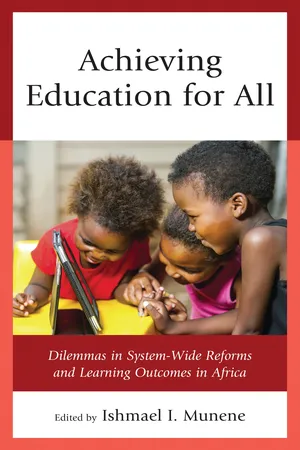
eBook - PDF
Achieving Education for All
Dilemmas in System-Wide Reforms and Learning Outcomes in Africa
- 265 pages
- English
- PDF
- Available on iOS & Android
eBook - PDF
Achieving Education for All
Dilemmas in System-Wide Reforms and Learning Outcomes in Africa
About this book
Information
Table of contents
- Contents
- figures
- Tables
- Foreword: Citizens Acting to Improve Learning
- Acknowledgments
- Chapter 1. Introduction: Universal Primary Education (UPE) in Africa: The Dilemmas of Access, Equality, and Quality
- Chapter 2. Universal Primary Education and the Challenge of Quality in Sub-Saharan Africa
- Chapter 3. Measuring Learning Outcomes: Lessons from the Uwezo Experience
- Chapter 4. The Challenge of Access, Quality, and Equity: Education in Kenya, 1963 to 2015
- Chapter 5. Schooling and Learning in Tanzania: Trends and Issues in Basic Education
- Chapter 6. Tracing Universal Primary Education in Uganda since Independence (1962–2014)
- Chapter 7. Dilemmas of Education for All in Mali: An Evaluation of Learning Outcomes
- Chapter 8. The Long Way from Elitism to Massification: What Is the Place of Good-Quality Learning in the Senegalese School?
- Chapter 9. Conclusion. Questioning the UPE Paradigm, Reframing the UPE Strategy
- Index
- About the Contributors
Trusted by 375,005 students
Access to over 1.5 million titles for a fair monthly price.
Study more efficiently using our study tools.
Frequently asked questions
Yes, you can cancel anytime from the Subscription tab in your account settings on the Perlego website. Your subscription will stay active until the end of your current billing period. Learn how to cancel your subscription
No, books cannot be downloaded as external files, such as PDFs, for use outside of Perlego. However, you can download books within the Perlego app for offline reading on mobile or tablet. Learn how to download books offline
Perlego offers two plans: Essential and Complete
- Essential is ideal for learners and professionals who enjoy exploring a wide range of subjects. Access the Essential Library with 800,000+ trusted titles and best-sellers across business, personal growth, and the humanities. Includes unlimited reading time and Standard Read Aloud voice.
- Complete: Perfect for advanced learners and researchers needing full, unrestricted access. Unlock 1.5M+ books across hundreds of subjects, including academic and specialized titles. The Complete Plan also includes advanced features like Premium Read Aloud and Research Assistant.
We are an online textbook subscription service, where you can get access to an entire online library for less than the price of a single book per month. With over 1.5 million books across 990+ topics, we’ve got you covered! Learn about our mission
Look out for the read-aloud symbol on your next book to see if you can listen to it. The read-aloud tool reads text aloud for you, highlighting the text as it is being read. You can pause it, speed it up and slow it down. Learn more about Read Aloud
Yes! You can use the Perlego app on both iOS and Android devices to read anytime, anywhere — even offline. Perfect for commutes or when you’re on the go.
Please note we cannot support devices running on iOS 13 and Android 7 or earlier. Learn more about using the app
Please note we cannot support devices running on iOS 13 and Android 7 or earlier. Learn more about using the app
Yes, you can access Achieving Education for All by Ishmael I. Munene in PDF and/or ePUB format, as well as other popular books in Politics & International Relations & Education Administration. We have over 1.5 million books available in our catalogue for you to explore.