eBook - PDF
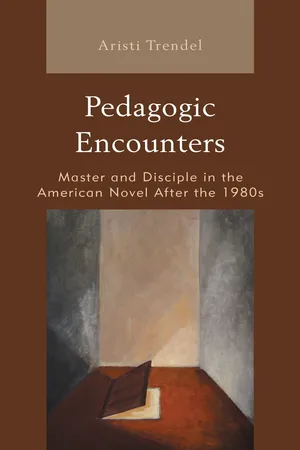
Pedagogic Encounters
Master and Disciple in the American Novel After the 1980s
- 175 pages
- English
- PDF
- Available on iOS & Android
eBook - PDF
About this book
This book offers a new approach to the genre of the campus novel. Through a critical analysis of eleven novels, Aristi Trendel argues that the specificity and complexity of the pedagogic rapport between professor and student calls for a new genre: the Master-Disciple novel. After the 1980s, the professor-student relationship was highly scrutinized and politicized, making the Master-Disciple novel essential to critical theorists and educators. Furthermore, the Master-Disciple novel broadens the scope of the campus novel as the master-pupil rapport can develop beyond the halls of academia. Though some of the novels analyzed in this book have been thoroughly discussed before, Trendel reads them through the lens of the pedagogic rapport and in constant dialogue with a broad range of themes, such as gender, sexuality, and power. The book will be important for academics, students, and all who are interested in the bond between teacher and student.
Information
Table of contents
- Contents
- Introduction
- 1 Lying in the Pedgagogical Encounter
- 2 Mentorship and Gratitude in Lan Samantha Chang’s All Is Forgotten, Nothing Is Lost
- 3 The Power Differential Between Professor and Student in Francine Prose’s Blue Angel
- 4 The Myth of the Wounded Healer in Pedagogy
- 5 The Poet and His Translator in John Crowley’s The Translator
- 6 Queering Master and Disciple in Susan Choi’s My Education
- 7 Pedagogical Encounters in John Updike’s Roger’s Version and Terrorist
- 8 Master and Disciple in Cities of Light
- 9 Embodied Interaffectivity in Russell Banks’s Lost Memory of Skin
- 10 The Pedagogic Encounter in the Time of the Posthuman
- Conclusion
- Bibliography
- Index
- About the Author
Trusted by 375,005 students
Access to over 1.5 million titles for a fair monthly price.
Study more efficiently using our study tools.
Frequently asked questions
Yes, you can cancel anytime from the Subscription tab in your account settings on the Perlego website. Your subscription will stay active until the end of your current billing period. Learn how to cancel your subscription
No, books cannot be downloaded as external files, such as PDFs, for use outside of Perlego. However, you can download books within the Perlego app for offline reading on mobile or tablet. Learn how to download books offline
Perlego offers two plans: Essential and Complete
- Essential is ideal for learners and professionals who enjoy exploring a wide range of subjects. Access the Essential Library with 800,000+ trusted titles and best-sellers across business, personal growth, and the humanities. Includes unlimited reading time and Standard Read Aloud voice.
- Complete: Perfect for advanced learners and researchers needing full, unrestricted access. Unlock 1.5M+ books across hundreds of subjects, including academic and specialized titles. The Complete Plan also includes advanced features like Premium Read Aloud and Research Assistant.
We are an online textbook subscription service, where you can get access to an entire online library for less than the price of a single book per month. With over 1.5 million books across 990+ topics, we’ve got you covered! Learn about our mission
Look out for the read-aloud symbol on your next book to see if you can listen to it. The read-aloud tool reads text aloud for you, highlighting the text as it is being read. You can pause it, speed it up and slow it down. Learn more about Read Aloud
Yes! You can use the Perlego app on both iOS and Android devices to read anytime, anywhere — even offline. Perfect for commutes or when you’re on the go.
Please note we cannot support devices running on iOS 13 and Android 7 or earlier. Learn more about using the app
Please note we cannot support devices running on iOS 13 and Android 7 or earlier. Learn more about using the app
Yes, you can access Pedagogic Encounters by Aristi Trendel in PDF and/or ePUB format, as well as other popular books in Literature & Literary Criticism History & Theory. We have over 1.5 million books available in our catalogue for you to explore.