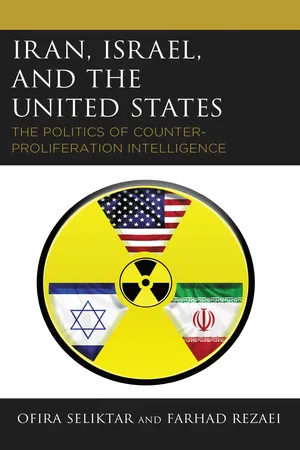
This book analyzes the process of evaluating Iran's nuclear project and the efforts to roll it back, resulting in the 2015 nuclear agreement known as the Joint Comprehensive Plan of Action (JCPA). Despite its aura of scientific exactitude, nuclear intelligence is complex and susceptible to methodological disagreements and political bias at the international oversight level—the International Atomic Energy Agency (IAEA)—and within the countries involved in the rollback project – Israel and the United States.
To highlight both the technological problems of assessing compliance and the politicization, each chapter in the book uses a real-time comparison of the nuclear developments in Iran, and the perception of Israel and the United States. This methodology yielded some significant results. Essentially, two camps had formed in each country; those who were pushing for an agreement with Iran and those who opposed it.
The Israeli intelligence agencies – the Mossad and the Military Intelligence – as well as the highly secretive Israeli Atomic Energy Commission (IAEC) which advised them considered the program to be weak and slow moving. The right-wing government of Benjamin Netanyahu suggested that Iran was steps away from the "point of no return," making it an existential threat to Israel.
A virtually identical split emerged in Washington. While the intelligence community and the advising scientists from the National Nuclear Laboratories, considered Iran progress to be relatively modest, the Republicans and the Israel lobby - the Jewish organizations and the Christian Zionists— warned of the imminent danger of a nuclear Iran.
With the Obama administration pushing for the JCPOA, a fierce debate took place in Congress. The Israeli intelligence and military chiefs led by the Mossad chief Meir Dagan, which had previously blocked Netanyahu from a preemptive action, quietly supported the agreement. In Washington, the Israel lobby, and the Republicans, helped by Netanyahu, mounted an all-out effort to defeat the deal in Congress. The pro-deal coalition fought back by mobilizing the scientific community, military and intelligence officials, the business lobby, and grassroots Democrats.
The JCPOA represents the first successful effort of peaceful counterproliferation. At the same, excessive politicization has clouded its legitimacy and cast doubt about its future.
eBook - PDF
Iran, Israel, and the United States
The Politics of Counter-Proliferation Intelligence
- 285 pages
- English
- PDF
- Available on iOS & Android
eBook - PDF
Iran, Israel, and the United States
The Politics of Counter-Proliferation Intelligence
About this book
Information
Table of contents
- Cover
- Iran, Israel, and the United States
- Iran, Israel, and the United States: The Politics of Counter-Proliferation Intelligence
- Copyright
- Contents
- Abbreviations
- Chapter 1
- The View from Tehran
- The View from Tehran
- The View from Tehran
- The View from Tehran
- The View from Tehran
- Conclusions
- Bibliography
- Index
- About the Authors
Trusted by 375,005 students
Access to over 1.5 million titles for a fair monthly price.
Study more efficiently using our study tools.
Frequently asked questions
Yes, you can cancel anytime from the Subscription tab in your account settings on the Perlego website. Your subscription will stay active until the end of your current billing period. Learn how to cancel your subscription
No, books cannot be downloaded as external files, such as PDFs, for use outside of Perlego. However, you can download books within the Perlego app for offline reading on mobile or tablet. Learn how to download books offline
Perlego offers two plans: Essential and Complete
- Essential is ideal for learners and professionals who enjoy exploring a wide range of subjects. Access the Essential Library with 800,000+ trusted titles and best-sellers across business, personal growth, and the humanities. Includes unlimited reading time and Standard Read Aloud voice.
- Complete: Perfect for advanced learners and researchers needing full, unrestricted access. Unlock 1.5M+ books across hundreds of subjects, including academic and specialized titles. The Complete Plan also includes advanced features like Premium Read Aloud and Research Assistant.
We are an online textbook subscription service, where you can get access to an entire online library for less than the price of a single book per month. With over 1.5 million books across 990+ topics, we’ve got you covered! Learn about our mission
Look out for the read-aloud symbol on your next book to see if you can listen to it. The read-aloud tool reads text aloud for you, highlighting the text as it is being read. You can pause it, speed it up and slow it down. Learn more about Read Aloud
Yes! You can use the Perlego app on both iOS and Android devices to read anytime, anywhere — even offline. Perfect for commutes or when you’re on the go.
Please note we cannot support devices running on iOS 13 and Android 7 or earlier. Learn more about using the app
Please note we cannot support devices running on iOS 13 and Android 7 or earlier. Learn more about using the app
Yes, you can access Iran, Israel, and the United States by Ofira Seliktar,Farhad Rezaei in PDF and/or ePUB format, as well as other popular books in Politics & International Relations & International Relations. We have over 1.5 million books available in our catalogue for you to explore.