eBook - PDF
Polarization and Political Party Factions in the 2020 Election
- 237 pages
- English
- PDF
- Available on iOS & Android
eBook - PDF
Polarization and Political Party Factions in the 2020 Election
About this book
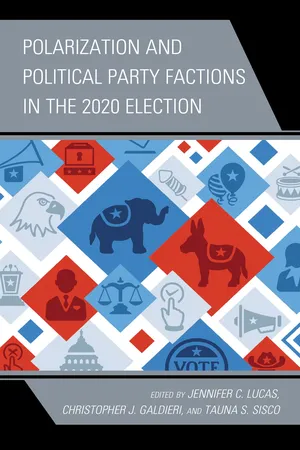
This volume explores the conflict between two forces: party polarization and party factionalism. The major change in America's two political parties over the past half-century has been increased polarization, which has led to a new era of heightened inter-party competition resulting in stronger and more cohesive parties. At the same time, elections, particularly primaries, often reveal deep internal factional divisions within both the parties, and the 2020 election was no different. The Democratic coalition typically pits moderate or establishment candidates against progressive activists and candidates, while the Republican Party in 2020 was, at times, polarized not only between moderates and conservatives but between those willing to criticize President Trump and those who would not. How did these two opposing forces shape the outcome of the 2020 election, and what are the consequences for the future of American party politics and elections?
Information
Table of contents
- Cover
- Half Title
- Title Page
- Copyright Page
- Contents
- List of Figures and Tables
- Acknowledgments
- Introduction
- Section I: Party Activists and Factions
- Chapter 1: Social Media Activism and Party Polarization: Did Democratic Social Media Activists Influence the Outcome of the 200 Presidential Election?
- Chapter 2: Persistent Factionalism?: An Analysis of Endorsements in the 2020 Democratic Primary
- Chapter 3: Honest Abe Rebukes “The Donald”: Rhetoric in the Lincoln Project
- Part II: Polarization and Party Competition in Congressional Elections
- Chapter 4: Negative Partisanship and Negative Partisan Branding: Twitter, Websites, and the 2020 Congressional Elections
- Chapter 5: What Do the 2020 Congressional Primaries Tell Us about the Direction of the Democratic Party?
- Chapter 6: Twitter Use in the 2020 Senate Races
- Chapter 7: Party, Ideology, and Competitiveness: Small Dollar Donors in U.S. House Elections, 2016–2020
- Section III: Parties and Voters in the 2020 Election
- Chapter 8: Forecasting the Party Vote in the 2020 Election: What Went Wrong with the Polls
- Chapter 9: The Evolution of the Republican Party Coalition, 1968–2020
- Chapter 10: Ideological Cleavages in the Democratic Primary Electorate
- Chapter 11: The Political Geography of the 2020 Presidential Election: Small Shifts with Major Consequences in a Geographically Polarized Country
- Section IV: The Consequences of Polarization
- Chapter 12: Pandemic Politics: State-Level Changes in Election Administration Laws in the 2020 Election
- Index
- About the Contributors
Trusted by 375,005 students
Access to over 1.5 million titles for a fair monthly price.
Study more efficiently using our study tools.
Frequently asked questions
Yes, you can cancel anytime from the Subscription tab in your account settings on the Perlego website. Your subscription will stay active until the end of your current billing period. Learn how to cancel your subscription
No, books cannot be downloaded as external files, such as PDFs, for use outside of Perlego. However, you can download books within the Perlego app for offline reading on mobile or tablet. Learn how to download books offline
Perlego offers two plans: Essential and Complete
- Essential is ideal for learners and professionals who enjoy exploring a wide range of subjects. Access the Essential Library with 800,000+ trusted titles and best-sellers across business, personal growth, and the humanities. Includes unlimited reading time and Standard Read Aloud voice.
- Complete: Perfect for advanced learners and researchers needing full, unrestricted access. Unlock 1.5M+ books across hundreds of subjects, including academic and specialized titles. The Complete Plan also includes advanced features like Premium Read Aloud and Research Assistant.
We are an online textbook subscription service, where you can get access to an entire online library for less than the price of a single book per month. With over 1.5 million books across 990+ topics, we’ve got you covered! Learn about our mission
Look out for the read-aloud symbol on your next book to see if you can listen to it. The read-aloud tool reads text aloud for you, highlighting the text as it is being read. You can pause it, speed it up and slow it down. Learn more about Read Aloud
Yes! You can use the Perlego app on both iOS and Android devices to read anytime, anywhere — even offline. Perfect for commutes or when you’re on the go.
Please note we cannot support devices running on iOS 13 and Android 7 or earlier. Learn more about using the app
Please note we cannot support devices running on iOS 13 and Android 7 or earlier. Learn more about using the app
Yes, you can access Polarization and Political Party Factions in the 2020 Election by Jennifer C. Lucas,Christopher J. Galdieri,Tauna Starbuck Sisco in PDF and/or ePUB format, as well as other popular books in Politics & International Relations & American Government. We have over 1.5 million books available in our catalogue for you to explore.