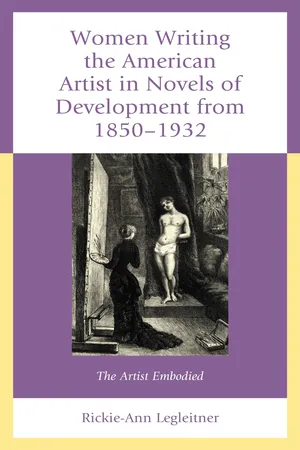
eBook - PDF
Women Writing the American Artist in Novels of Development from 1850-1932
The Artist Embodied
- 245 pages
- English
- PDF
- Available on iOS & Android
eBook - PDF
Women Writing the American Artist in Novels of Development from 1850-1932
The Artist Embodied
About this book
In nineteenth- and early twentieth-century artist novels, American women writers challenge cultural, social, and legal systems that attempt to limit or diminish women's embodied capabilities outside of the domestic. Women writers such as E.D.E.N. Southworth, Elizabeth Stuart Phelps, Kate Chopin, Willa Cather, Jessie Fauset, and Zelda Fitzgerald use the artist novel to highlight the structural and material limitations that women artists face when attempting to achieve critical success while navigating inequitable marriages and social codes that restrict women's mobility, education, and pursuit of vocation. These artist-rebel protagonists find that their very bodies demand an outlet to articulate desires that defy patriarchal rhetoric, and this demand becomes an artistic drive to express an embodied knowledge through artistic invention. Ultimately, these women writers empower their heroines to move beyond prescribed patriarchal identities in order to achieve autonomous subjectivity through their artistic development, challenging stereotypes surrounding gender, race, and ability and beginning to reshape cultural notions of marriage, motherhood, and artistry at the turn of the twentieth century.
Information
Table of contents
- Cover
- Half Title
- Title Page
- Copyright Page
- Contents
- Acknowledgments
- Statement on Language and Identity
- Introduction
- Chapter 1: Individuality and the Embodiment of Inequality in E.D.E.N. Southworth’s The Deserted Wife
- Chapter 2: Disabling Marriage and the Woman Artist in Elizabeth Stuart Phelps’s The Story of Avis
- Chapter 3: Embracing Fate: Artistry and Autonomy in Kate Chopin’s The Awakening
- Chapter 4: “That Sensuous Form”: Corporeal Artistic Creation in Willa Cather’s The Song of the Lark
- Chapter 5: The Body at Play: Artistic Passing in Jessie Fauset’s Plum Bun
- Chapter 6: The Cult of Artistry in Zelda Fitzgerald’s Save Me the Waltz
- Epilogue
- Works Cited
- Index
- About the Author
Trusted by 375,005 students
Access to over 1.5 million titles for a fair monthly price.
Study more efficiently using our study tools.
Frequently asked questions
Yes, you can cancel anytime from the Subscription tab in your account settings on the Perlego website. Your subscription will stay active until the end of your current billing period. Learn how to cancel your subscription
No, books cannot be downloaded as external files, such as PDFs, for use outside of Perlego. However, you can download books within the Perlego app for offline reading on mobile or tablet. Learn how to download books offline
Perlego offers two plans: Essential and Complete
- Essential is ideal for learners and professionals who enjoy exploring a wide range of subjects. Access the Essential Library with 800,000+ trusted titles and best-sellers across business, personal growth, and the humanities. Includes unlimited reading time and Standard Read Aloud voice.
- Complete: Perfect for advanced learners and researchers needing full, unrestricted access. Unlock 1.5M+ books across hundreds of subjects, including academic and specialized titles. The Complete Plan also includes advanced features like Premium Read Aloud and Research Assistant.
We are an online textbook subscription service, where you can get access to an entire online library for less than the price of a single book per month. With over 1.5 million books across 990+ topics, we’ve got you covered! Learn about our mission
Look out for the read-aloud symbol on your next book to see if you can listen to it. The read-aloud tool reads text aloud for you, highlighting the text as it is being read. You can pause it, speed it up and slow it down. Learn more about Read Aloud
Yes! You can use the Perlego app on both iOS and Android devices to read anytime, anywhere — even offline. Perfect for commutes or when you’re on the go.
Please note we cannot support devices running on iOS 13 and Android 7 or earlier. Learn more about using the app
Please note we cannot support devices running on iOS 13 and Android 7 or earlier. Learn more about using the app
Yes, you can access Women Writing the American Artist in Novels of Development from 1850-1932 by Rickie-Ann Legleitner in PDF and/or ePUB format, as well as other popular books in Literature & Literary Criticism for Women Authors. We have over 1.5 million books available in our catalogue for you to explore.