Constructivism dominates over other theories of knowledge in much of western academia, especially the humanities and social sciences. In Exposing the Roots of Constructivism: Nominalism and the Ontology of Knowledge, R. Scott Smith argues that constructivism is linked to the embrace of nominalism, the theory that everything is particular and located in space and time. Indeed, nominalism is sufficient for a view to be constructivist.
However, the natural sciences still enjoy great prestige from the "fact-value split." They are often perceived as giving us knowledge of the facts of reality, and not merely our constructs. In contrast, ethics and religion, which also have been greatly influenced by nominalism, usually are perceived as giving us just our constructs and opinions.
Yet, even the natural sciences have embraced nominalism, and Smith shows that this will undermine knowledge in those disciplines as well. Indeed, the author demonstrates that, at best, nominalism leaves us with only interpretations, but at worst, it undermines all knowledge whatsoever. However, there are many clear examples of knowledge we do have in the many different disciplines, and therefore those must be due to a different ontology of properties. Thus, nominalism should be rejected. In its place, the author defends a kind of Platonic realism about properties.
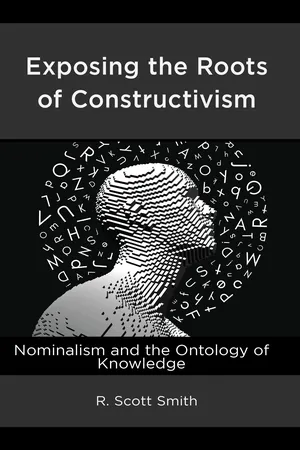
eBook - PDF
Exposing the Roots of Constructivism
Nominalism and the Ontology of Knowledge
- 181 pages
- English
- PDF
- Available on iOS & Android
eBook - PDF
About this book
Information
Topic
PhilosophySubtopic
Epistemology in PhilosophyTable of contents
- Cover
- Half Title
- Title Page
- Copyright Page
- Dedication
- Contents
- Preface
- Introduction
- Chapter 1: Tropes and Some Ontological Prerequisites for Knowledge
- Chapter 2: Austere and Metalinguistic Nominalism, and Our Knowledge of Reality
- Chapter 3: Nominalism and the History of Constructivism in Western Philosophy
- Chapter 4: Nominalism and the Practice of Science
- Chapter 5: Nominalism and Moral Knowledge
- Chapter 6: Nominalism and Academic Religion
- Chapter 7: Nominalism across Other Academic Disciplines
- Chapter 8: If Not Nominalism, Then What?
- Bibliography
- Index
- About the Author
Trusted by 375,005 students
Access to over 1.5 million titles for a fair monthly price.
Study more efficiently using our study tools.
Frequently asked questions
Yes, you can cancel anytime from the Subscription tab in your account settings on the Perlego website. Your subscription will stay active until the end of your current billing period. Learn how to cancel your subscription
No, books cannot be downloaded as external files, such as PDFs, for use outside of Perlego. However, you can download books within the Perlego app for offline reading on mobile or tablet. Learn how to download books offline
Perlego offers two plans: Essential and Complete
- Essential is ideal for learners and professionals who enjoy exploring a wide range of subjects. Access the Essential Library with 800,000+ trusted titles and best-sellers across business, personal growth, and the humanities. Includes unlimited reading time and Standard Read Aloud voice.
- Complete: Perfect for advanced learners and researchers needing full, unrestricted access. Unlock 1.5M+ books across hundreds of subjects, including academic and specialized titles. The Complete Plan also includes advanced features like Premium Read Aloud and Research Assistant.
We are an online textbook subscription service, where you can get access to an entire online library for less than the price of a single book per month. With over 1.5 million books across 990+ topics, we’ve got you covered! Learn about our mission
Look out for the read-aloud symbol on your next book to see if you can listen to it. The read-aloud tool reads text aloud for you, highlighting the text as it is being read. You can pause it, speed it up and slow it down. Learn more about Read Aloud
Yes! You can use the Perlego app on both iOS and Android devices to read anytime, anywhere — even offline. Perfect for commutes or when you’re on the go.
Please note we cannot support devices running on iOS 13 and Android 7 or earlier. Learn more about using the app
Please note we cannot support devices running on iOS 13 and Android 7 or earlier. Learn more about using the app
Yes, you can access Exposing the Roots of Constructivism by R. Scott Smith in PDF and/or ePUB format, as well as other popular books in Philosophy & Epistemology in Philosophy. We have over 1.5 million books available in our catalogue for you to explore.