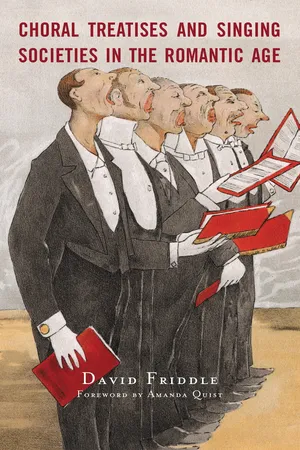
- 439 pages
- English
- PDF
- Available on iOS & Android
eBook - PDF
Choral Treatises and Singing Societies in the Romantic Age
About this book
Choral Treatises and Singing Societies in the Romantic Age charts the interrelated beginning and development of choral methods and community choruses beginning in the early nineteenth century. Using more than one-hundred musical examples, illustrations, tables, and photographs to document this phenomenon, author David Friddle writes persuasively about this unusual tandem expansion. Beginning in 1781, with the establishment of the first secular singing group in Germany, Friddle shows how as more and more choral ensembles were founded throughout Germany, then Europe, Scandinavia, and North America, the need for singing treatises quickly became apparent. Music pedagogues Hans Georg Nägeli, Michael Traugott Pfeiffer, and Johann Heinrich Pestalozzi invented the genre that became modern choral methods; initially these books were combinations of music fundamental primers, with frequent inclusion of choral works intended for performance. Eventually authors branched out into choral conducting textbooks, detailed instructions on how to found such a community-based organization, and eventually classroom music instruction. The author argues that one of the greatest legacies of this movement was the introduction of vocal music education into public schools, which led to greater musical literacy as well as the proliferation of volunteer choirs. All modern choral professionals can find the roots their career during this century.
Information
Subtopic
MusicTable of contents
- Contents
- Epigraph
- Foreword
- Chapter 1
- Chapter 2
- Chapter 3
- Chapter 4
- Bibliography
- Index
- Blank Page
Trusted by 375,005 students
Access to over 1.5 million titles for a fair monthly price.
Study more efficiently using our study tools.
Frequently asked questions
Yes, you can cancel anytime from the Subscription tab in your account settings on the Perlego website. Your subscription will stay active until the end of your current billing period. Learn how to cancel your subscription
No, books cannot be downloaded as external files, such as PDFs, for use outside of Perlego. However, you can download books within the Perlego app for offline reading on mobile or tablet. Learn how to download books offline
Perlego offers two plans: Essential and Complete
- Essential is ideal for learners and professionals who enjoy exploring a wide range of subjects. Access the Essential Library with 800,000+ trusted titles and best-sellers across business, personal growth, and the humanities. Includes unlimited reading time and Standard Read Aloud voice.
- Complete: Perfect for advanced learners and researchers needing full, unrestricted access. Unlock 1.5M+ books across hundreds of subjects, including academic and specialized titles. The Complete Plan also includes advanced features like Premium Read Aloud and Research Assistant.
We are an online textbook subscription service, where you can get access to an entire online library for less than the price of a single book per month. With over 1.5 million books across 990+ topics, we’ve got you covered! Learn about our mission
Look out for the read-aloud symbol on your next book to see if you can listen to it. The read-aloud tool reads text aloud for you, highlighting the text as it is being read. You can pause it, speed it up and slow it down. Learn more about Read Aloud
Yes! You can use the Perlego app on both iOS and Android devices to read anytime, anywhere — even offline. Perfect for commutes or when you’re on the go.
Please note we cannot support devices running on iOS 13 and Android 7 or earlier. Learn more about using the app
Please note we cannot support devices running on iOS 13 and Android 7 or earlier. Learn more about using the app
Yes, you can access Choral Treatises and Singing Societies in the Romantic Age by David Friddle in PDF and/or ePUB format, as well as other popular books in Media & Performing Arts & Music. We have over 1.5 million books available in our catalogue for you to explore.