The collective work deals with the problems of if, how, and why the histories of German Nazism and Soviet Communism should and could be situated within one coherent narrative. As historical phenomena, can Communism and Nazism fruitfully be compared to each other? Do they belong to the same historical contexts? Have they influenced, reacted to or learned from each other? Are they interpreted, represented and used together by posterity?
The background of the book is twofold. One is external. There is an ongoing debate about the historical entanglements of Communism and Nazism, especially about Auschwitz and Gulag, respectively. Our present fascination with the evil history of genocide has situated the Holocaust as the borderline event in Western historical thinking. The crimes against humanity perpetrated by the Soviet Communist regime do not have the same position but are considered more urgent in the East and Central European states that were subdued by both Nazi and Communist regimes.
The other, internal background is to develop an analytical perspective in which the "comnaz" nexus can be understood. Using a complex approach, the authors investigate Communist and Nazi histories as entangled phenomena, guided by three basic perspectives. Focusing on roots and developments, a genetic perspective highlights historical, process-oriented connections. A structural perspective indicates an attempt to narrow down "operational" parallels of the two political systems in the way they handled ideology to construct social utopia, used techniques of terror, etc. A third perspective is genealogical, emphasizing the processing and use of Communist and Nazi history by posterity in terms of meaning and memory: What past is worth remembering, celebrating, debating—but also distorting and forgetting? The chapters of the book address phenomena such as ideology, terror, secular religion, museum exhibits, and denial.
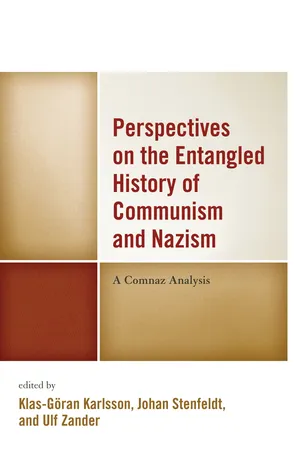
eBook - PDF
Perspectives on the Entangled History of Communism and Nazism
A Comnaz Analysis
- 211 pages
- English
- PDF
- Available on iOS & Android
eBook - PDF
Perspectives on the Entangled History of Communism and Nazism
A Comnaz Analysis
About this book
Information
Table of contents
- Contents
- Introduction
- Chapter One: The Evil Twins of Modern History?
- Chapter Two: Making Sense of Inhumanity
- Chapter Three: The Dystopian Trilemma
- Chapter Four: The Intertwined History of Political Violence in the Soviet Union and Nazi Germany
- Chapter Five: Herbert Norkus and Pavel Morozov as Totalitarian Child Martyrs
- Chapter Six: Communism’s Compelling Grasp
- Chapter Seven: The Lontsky Street Prison Memorial Museum
- Chapter Eight: Writing History, Denying the Past
- Bibliography
- Index
- About the Authors
Trusted by 375,005 students
Access to over 1.5 million titles for a fair monthly price.
Study more efficiently using our study tools.
Frequently asked questions
Yes, you can cancel anytime from the Subscription tab in your account settings on the Perlego website. Your subscription will stay active until the end of your current billing period. Learn how to cancel your subscription
No, books cannot be downloaded as external files, such as PDFs, for use outside of Perlego. However, you can download books within the Perlego app for offline reading on mobile or tablet. Learn how to download books offline
Perlego offers two plans: Essential and Complete
- Essential is ideal for learners and professionals who enjoy exploring a wide range of subjects. Access the Essential Library with 800,000+ trusted titles and best-sellers across business, personal growth, and the humanities. Includes unlimited reading time and Standard Read Aloud voice.
- Complete: Perfect for advanced learners and researchers needing full, unrestricted access. Unlock 1.5M+ books across hundreds of subjects, including academic and specialized titles. The Complete Plan also includes advanced features like Premium Read Aloud and Research Assistant.
We are an online textbook subscription service, where you can get access to an entire online library for less than the price of a single book per month. With over 1.5 million books across 990+ topics, we’ve got you covered! Learn about our mission
Look out for the read-aloud symbol on your next book to see if you can listen to it. The read-aloud tool reads text aloud for you, highlighting the text as it is being read. You can pause it, speed it up and slow it down. Learn more about Read Aloud
Yes! You can use the Perlego app on both iOS and Android devices to read anytime, anywhere — even offline. Perfect for commutes or when you’re on the go.
Please note we cannot support devices running on iOS 13 and Android 7 or earlier. Learn more about using the app
Please note we cannot support devices running on iOS 13 and Android 7 or earlier. Learn more about using the app
Yes, you can access Perspectives on the Entangled History of Communism and Nazism by Klas-Göran Karlsson,Johan Stenfeldt,Ulf Zander in PDF and/or ePUB format, as well as other popular books in History & European History. We have over 1.5 million books available in our catalogue for you to explore.