Through an examination of Methodist mission to Southeast Asia at the turn of the twentieth century, this broad-ranging book unites the history of globalization with the history of Christian mission and the history of Southeast Asia. The book explores the international connections forged by the Methodist Episcopal Church's Malaysia Mission between 1885 and 1915, putting them in the context of a wave of globalization that was sweeping the world at that time, including significant developments in Southeast Asia.
To establish intellectual connections between the study of globalization and this historical setting, the book suggests six metaphors for understanding the mission. Each metaphor is based on some aspect of secular globalization: the Methodist connection as a migratory network, mission agencies as multinational corporations, the Malaysia Mission as a franchise system, the Methodist Episcopal Church as a media conglomerate, mission institutions as civil society organizations, and Methodist mission as a global vision.
In chapters exploring each metaphor separately, the book reviews how each form of secular globalization functions to create transnational connections before examining the details of how the Malaysia Mission functioned in a similar fashion. Along the way, the book investigates the lives of all involved in the mission: missionaries, church members of the mission, and mission supporters. Although Southeast Asia (including the Straits Settlements, Federated Malay States, Sarawak, and Netherlands Indies) and the United States are important geographic foci for the book, India, China, Britain, Sri Lanka, Sweden, Germany, Australia, and Canada all have parts to play.
In exploring these metaphors, the book draws on several scholarly fields including migration studies, business history, media studies, political theory, and cultural history, blending them together into a social history of the mission. By so doing, it identifies both ways in which the effects of Christian mission paralleled other globalizing forces and unique contributions Christian mission made to turn-of-the-twentieth-century globalization.
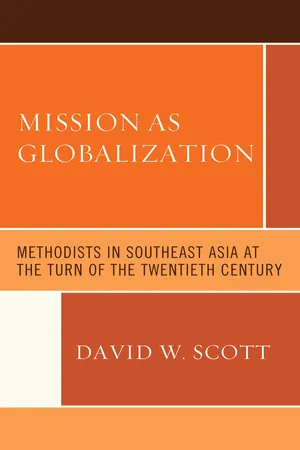
eBook - PDF
Mission as Globalization
Methodists in Southeast Asia at the Turn of the Twentieth Century
- 241 pages
- English
- PDF
- Available on iOS & Android
eBook - PDF
Mission as Globalization
Methodists in Southeast Asia at the Turn of the Twentieth Century
About this book
Information
Topic
Theology & ReligionSubtopic
Christian DenominationsTable of contents
- Contents
- Missionary Map of Malaysia
- Acknowledgments
- A Note on Names
- List of Abbreviations
- Introduction
- Chapter One: The Malaysia Mission in the Context of Southeast Asian Globalization
- Chapter Two: Methodist Mission as a Global Vision
- Chapter Three: Methodism as a Global Culture
- Chapter Four: Methodist Episcopal Church as a Media Conglomerate
- Chapter Five: Mission Agencies as Multinational Corporations
- Chapter Six: The Malaysia Mission as a Franchise System
- Chapter Seven: The Methodist Connection as a Migratory Network
- Epilogue
- Bibliography
- Index
- About the Author
Trusted by 375,005 students
Access to over 1.5 million titles for a fair monthly price.
Study more efficiently using our study tools.
Frequently asked questions
Yes, you can cancel anytime from the Subscription tab in your account settings on the Perlego website. Your subscription will stay active until the end of your current billing period. Learn how to cancel your subscription
No, books cannot be downloaded as external files, such as PDFs, for use outside of Perlego. However, you can download books within the Perlego app for offline reading on mobile or tablet. Learn how to download books offline
Perlego offers two plans: Essential and Complete
- Essential is ideal for learners and professionals who enjoy exploring a wide range of subjects. Access the Essential Library with 800,000+ trusted titles and best-sellers across business, personal growth, and the humanities. Includes unlimited reading time and Standard Read Aloud voice.
- Complete: Perfect for advanced learners and researchers needing full, unrestricted access. Unlock 1.5M+ books across hundreds of subjects, including academic and specialized titles. The Complete Plan also includes advanced features like Premium Read Aloud and Research Assistant.
We are an online textbook subscription service, where you can get access to an entire online library for less than the price of a single book per month. With over 1.5 million books across 990+ topics, we’ve got you covered! Learn about our mission
Look out for the read-aloud symbol on your next book to see if you can listen to it. The read-aloud tool reads text aloud for you, highlighting the text as it is being read. You can pause it, speed it up and slow it down. Learn more about Read Aloud
Yes! You can use the Perlego app on both iOS and Android devices to read anytime, anywhere — even offline. Perfect for commutes or when you’re on the go.
Please note we cannot support devices running on iOS 13 and Android 7 or earlier. Learn more about using the app
Please note we cannot support devices running on iOS 13 and Android 7 or earlier. Learn more about using the app
Yes, you can access Mission as Globalization by David W. Scott in PDF and/or ePUB format, as well as other popular books in Theology & Religion & Christian Denominations. We have over 1.5 million books available in our catalogue for you to explore.