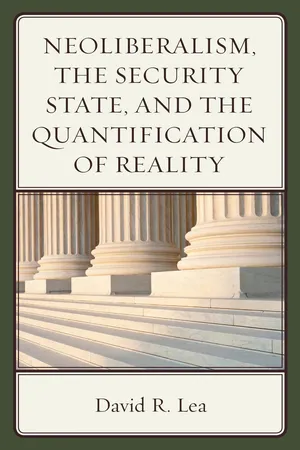
As the security state grows in power and dominance, commercial and financial interests increasingly penetrate our social existence. Neoliberalism, the Security State, and the Quantification of Reality addresses the relationship between these two trends in its discussion of neoliberalism, financialization, and managerialism, with a particular focus on the decline of professionalism, the restructuring of tertiary education, and the university's abandonment of the humanities. Additionally, David Lea links these developments with the failings of democratic institutions, the growth of the disciplinary society, and the emergence of the security state, which relentlessly governs by extraordinary fiat dividing, disempowering and excluding.
Lea identifies one such linkage inthe common form of rationality, which underlies contemporary approaches to reality. Others have noted that one of the most notable political developments of the last thirty years or so has been increasing public and governmental demand for the quantification of social phenomena. Moreover, A.W. Crosby has attributed Europe's unprecedented imperial success, which began in early European Modernity, to a paradigmatic shift from a qualitative world view grounded in Platonic and Neo-Platonic idealism to a more quantitative world view.
Nevertheless, this quantitative approach towards the natural and social worlds alienates humans from other species and even from ourselves and fails to represent life as we actually experience it. While a quantitative world view may have facilitated imperial success and the interlocking exercise of power and authority by the state and the economically empowered, this instrumental form of thinking rationales, strategies and facilitates policies that restrict and vitiate individual autonomy to create a seamless controlled conformity. This form of thinking that relies on the quantification of natural and social phenomena creates a value free equivalency, which at the same time invidiously divides society into the wealthy and the impoverished, the advantaged and the exploited, the politically included and the excluded.
- 253 pages
- English
- PDF
- Available on iOS & Android
eBook - PDF
Neoliberalism, the Security State, and the Quantification of Reality
About this book
Information
Topic
PhilosophySubtopic
Political PhilosophyTable of contents
- Contents
- Acknowledgments
- Chapter 1: Neoliberalism, Financialization,
- Chapter 2: Professionalism in an Age of Financialization and Managerialism
- Chapter 3: The Corporate University
- Chapter 4: The Future of the Humanities in Today’s Financial Markets
- Chapter 5: A Culture of Counting:The Quantification of Reality
- Chapter 6: The Clash of Cultures Thesis: Liberalism versus Communitarianism
- Chapter 7: Carl Schmitt on International Relations and the Crisis of Parliamentary Democracy
- Chapter 8: The Security Issue and the Security State
- Chapter 9: Foucault: The Disciplinary Society and Biopolitical Realities
- Chapter 10: Agamben: Interpreting the Biopolitical, Sovereignty, and Non-Identitarian Politics
- Chapter 11: Agamben and the Biopolitical: A Final Critical Evaluation
- Bibliography
- Index
- About the Author
Trusted by 375,005 students
Access to over 1.5 million titles for a fair monthly price.
Study more efficiently using our study tools.
Frequently asked questions
Yes, you can cancel anytime from the Subscription tab in your account settings on the Perlego website. Your subscription will stay active until the end of your current billing period. Learn how to cancel your subscription
No, books cannot be downloaded as external files, such as PDFs, for use outside of Perlego. However, you can download books within the Perlego app for offline reading on mobile or tablet. Learn how to download books offline
Perlego offers two plans: Essential and Complete
- Essential is ideal for learners and professionals who enjoy exploring a wide range of subjects. Access the Essential Library with 800,000+ trusted titles and best-sellers across business, personal growth, and the humanities. Includes unlimited reading time and Standard Read Aloud voice.
- Complete: Perfect for advanced learners and researchers needing full, unrestricted access. Unlock 1.5M+ books across hundreds of subjects, including academic and specialized titles. The Complete Plan also includes advanced features like Premium Read Aloud and Research Assistant.
We are an online textbook subscription service, where you can get access to an entire online library for less than the price of a single book per month. With over 1.5 million books across 990+ topics, we’ve got you covered! Learn about our mission
Look out for the read-aloud symbol on your next book to see if you can listen to it. The read-aloud tool reads text aloud for you, highlighting the text as it is being read. You can pause it, speed it up and slow it down. Learn more about Read Aloud
Yes! You can use the Perlego app on both iOS and Android devices to read anytime, anywhere — even offline. Perfect for commutes or when you’re on the go.
Please note we cannot support devices running on iOS 13 and Android 7 or earlier. Learn more about using the app
Please note we cannot support devices running on iOS 13 and Android 7 or earlier. Learn more about using the app
Yes, you can access Neoliberalism, the Security State, and the Quantification of Reality by David R. Lea in PDF and/or ePUB format, as well as other popular books in Philosophy & Political Philosophy. We have over 1.5 million books available in our catalogue for you to explore.