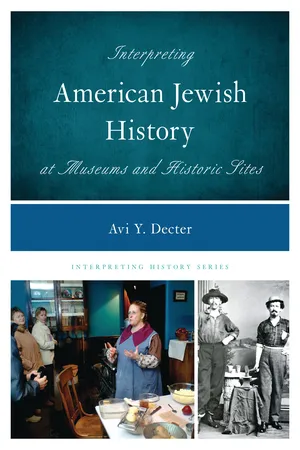
Jews are part and parcel of American history. From colonial port cities to frontier outposts, from commercial and manufacturing centers to rural villages, and from metropolitan regions to constructed communities, Jews are found everywhere and throughout four centuries of American history. From the early 17th century to the present, the story of American Jews has been one of immigration, adjustment, and accomplishment, sometimes in the face of prejudice and discrimination. This, then, is a narrative of minority-majority relations, of evolving norms and traditions, of ongoing conversations about community and culture, identity and meaning.
Interpreting American Jewish History at Museums and Historic Sites begins with a broad overview of American Jewish history in the context of a religious culture than extends back more than 3,000 years and which manifests itself in a variety of distinctive American forms. This is followed by five chapters, each looking at a major theme in American Jewish history: movement, home life, community, prejudice, and culture.
The book also describes and analyzes projects by history organizations, large and small, to interpret American Jewish life for general public audiences. These case studies cover a wide range of themes, approaches, formats.
The book concludes with a history of Jewish collections and Jewish museums in North America and a chapter on "next practice" that promote adaptive thinking, continuous innovation, and programs that are responsive to ever-changing circumstances.
- 249 pages
- English
- PDF
- Available on iOS & Android
eBook - PDF
Interpreting American Jewish History at Museums and Historic Sites
About this book
Information
Table of contents
- Contents
- List of Illustrations
- Acknowledgments
- Chapter 1
- Chapter 2
- Chapter 3
- Chapter 4
- Chapter 5
- Chapter 6
- Chapter 7
- Chapter 8
- Chapter 9
- Chapter 10
- Chapter 11
- Chapter 12
- Chapter 13
- Chapter 14
- Bibliography
- Index
- Contributors
Trusted by 375,005 students
Access to over 1.5 million titles for a fair monthly price.
Study more efficiently using our study tools.
Frequently asked questions
Yes, you can cancel anytime from the Subscription tab in your account settings on the Perlego website. Your subscription will stay active until the end of your current billing period. Learn how to cancel your subscription
No, books cannot be downloaded as external files, such as PDFs, for use outside of Perlego. However, you can download books within the Perlego app for offline reading on mobile or tablet. Learn how to download books offline
Perlego offers two plans: Essential and Complete
- Essential is ideal for learners and professionals who enjoy exploring a wide range of subjects. Access the Essential Library with 800,000+ trusted titles and best-sellers across business, personal growth, and the humanities. Includes unlimited reading time and Standard Read Aloud voice.
- Complete: Perfect for advanced learners and researchers needing full, unrestricted access. Unlock 1.5M+ books across hundreds of subjects, including academic and specialized titles. The Complete Plan also includes advanced features like Premium Read Aloud and Research Assistant.
We are an online textbook subscription service, where you can get access to an entire online library for less than the price of a single book per month. With over 1.5 million books across 990+ topics, we’ve got you covered! Learn about our mission
Look out for the read-aloud symbol on your next book to see if you can listen to it. The read-aloud tool reads text aloud for you, highlighting the text as it is being read. You can pause it, speed it up and slow it down. Learn more about Read Aloud
Yes! You can use the Perlego app on both iOS and Android devices to read anytime, anywhere — even offline. Perfect for commutes or when you’re on the go.
Please note we cannot support devices running on iOS 13 and Android 7 or earlier. Learn more about using the app
Please note we cannot support devices running on iOS 13 and Android 7 or earlier. Learn more about using the app
Yes, you can access Interpreting American Jewish History at Museums and Historic Sites by Avi Y. Decter in PDF and/or ePUB format, as well as other popular books in Business & Museum Administration. We have over 1.5 million books available in our catalogue for you to explore.