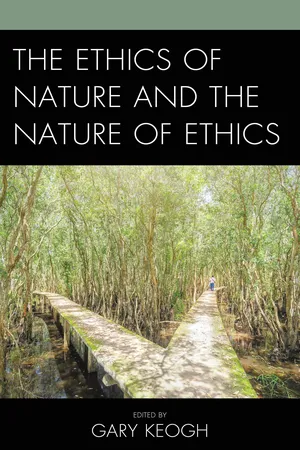
This volume explores questions which emerge from considering the relationship between nature and ethics through philosophical, theological, ethical and environmental lenses. It will examine the nature (understood as essence or character) of ethics itself and whether nature (understood as natural world) has embedded in it a moral code, as well as examining how particular ethical/theological worldviews influence our treatment of nature.
Is there an abstract, objective moral code in nature? If so, how do we gain access to this code of ethics? Is it only accessible through revelation, as in some religious traditions, or is this code of ethics more generally accessible to humanity? Indeed, does such an objective notion of ethics exist; could it be that ethics are a natural and subjective development? Is ethics a feature of nature, or have we invented it? There is, this volume might suggest, no consensus on these questions, as they at times divide and at times unite both the contributors to this volume and the bodies of scholarly work with which they engage.
As time moves forward, investigations into ethics in the context of the relationship between humanity and nature have become more complex, taking account of advances in the natural sciences and a growing appreciation of nature. How are we to understand our relationship with nature, and how does this have implications for our understandings of ethics? Are we now realising the repercussions of our failure to take seriously our experience of climate change?
This volume offers the reader a unique and underrepresented interdisciplinary perspective, from philosophers, theologians and environmentalists on the dynamic relationship between nature and ethics. It offers breadth in terms of the range of theoretical, cultural, philosophical and theological frameworks, but balances this with chapters providing an in-depth treatment of particular lenses, e.g. the work of Hegel, or the work of Gordon Kauffman. Through philosophical and theological investigation, these collected essays deepen and problematize the scientific and pragmatic discourses on nature, offering scholars solid resources to engage with some of the most pressing issues of our time in light of ongoing debates at many levels on dealing with climate change.
- 170 pages
- English
- PDF
- Available on iOS & Android
eBook - PDF
The Ethics of Nature and the Nature of Ethics
About this book
Information
Topic
Theology & ReligionSubtopic
Ethics & Moral PhilosophyTable of contents
- Contents
- Introduction
- I: The Nature of Ethics
- II: The Ethics of Nature
- Index
- About the Editor
- List of Contributors
Trusted by 375,005 students
Access to over 1.5 million titles for a fair monthly price.
Study more efficiently using our study tools.
Frequently asked questions
Yes, you can cancel anytime from the Subscription tab in your account settings on the Perlego website. Your subscription will stay active until the end of your current billing period. Learn how to cancel your subscription
No, books cannot be downloaded as external files, such as PDFs, for use outside of Perlego. However, you can download books within the Perlego app for offline reading on mobile or tablet. Learn how to download books offline
Perlego offers two plans: Essential and Complete
- Essential is ideal for learners and professionals who enjoy exploring a wide range of subjects. Access the Essential Library with 800,000+ trusted titles and best-sellers across business, personal growth, and the humanities. Includes unlimited reading time and Standard Read Aloud voice.
- Complete: Perfect for advanced learners and researchers needing full, unrestricted access. Unlock 1.5M+ books across hundreds of subjects, including academic and specialized titles. The Complete Plan also includes advanced features like Premium Read Aloud and Research Assistant.
We are an online textbook subscription service, where you can get access to an entire online library for less than the price of a single book per month. With over 1.5 million books across 990+ topics, we’ve got you covered! Learn about our mission
Look out for the read-aloud symbol on your next book to see if you can listen to it. The read-aloud tool reads text aloud for you, highlighting the text as it is being read. You can pause it, speed it up and slow it down. Learn more about Read Aloud
Yes! You can use the Perlego app on both iOS and Android devices to read anytime, anywhere — even offline. Perfect for commutes or when you’re on the go.
Please note we cannot support devices running on iOS 13 and Android 7 or earlier. Learn more about using the app
Please note we cannot support devices running on iOS 13 and Android 7 or earlier. Learn more about using the app
Yes, you can access The Ethics of Nature and the Nature of Ethics by Gary Keogh in PDF and/or ePUB format, as well as other popular books in Theology & Religion & Ethics & Moral Philosophy. We have over 1.5 million books available in our catalogue for you to explore.