A 2023 Choice Reviews Outstanding Academic Title
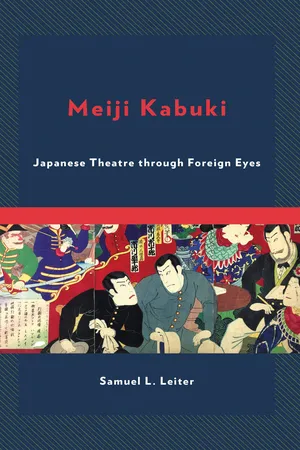
This book is an annotated collection of English-language documents by foreigners writing about Japan's kabuki theatre in the half-century after the country was opened to the West in 1853. Using memoirs, travelogues, diaries, letters, and reference books, it contains all significant writing about kabuki by foreigners—resident or transient—during the Meiji period (1868–1912), well before the first substantial non-Japanese book on the subject was published. Its chronologically organized chapters contain detailed introductions. Twenty-seven authors, represented by edited versions of their essays, are supplemented by detailed summaries of thirty-five others. The author provides insights into how Western visitors—missionaries, scholars, diplomats, military officers, adventurers, globetrotters, and even a precocious teenage girl—responded to a world-class theatre that, apart from a tiny number of pre-Meiji encounters, had been hidden from the world at large for over two centuries. It reveals prejudices and misunderstandings, but also demonstrates the power of great theatre to bring together people of differing cultural backgrounds despite the barriers of language, artistic convention, and the very practice of theatergoing. And, in Ichikawa Danjuro IX, it presents an actor knowledgeable foreigners considered one of the finest in the world.
- 439 pages
- English
- PDF
- Available on iOS & Android
eBook - PDF
About this book
Information
Table of contents
- Cover
- Half Title
- Title Page
- Copyright Page
- Dedication
- Contents
- List of Figures
- List of Figures
- Acknowledgments
- Part I: Overview
- Chapter 1: Introduction
- Chapter 2: A Brief Survey of Meiji Kabuki
- Part II: The 1860s
- Chapter 3: From Japan through American Eyes (1859; 1860)
- Chapter 4: From Ten Weeks in Japan: “Japanese Drama” (1860)
- Chapter 5: From Japan through American Eyes (1861; 1862)
- Chapter 6: From The Capital of the Tycoon: “Osaca” (1861)
- Chapter 7: From A Lady’s Visit to Manila and Japan (1862)
- Chapter 8: “Japanese Theatres” (1864?)
- Chapter 9: From A Diplomat in Japan (1866?)
- Chapter 10: More from the 1860s
- Part III: The 1870s
- Chapter 11: From Japanese Episodes (1872): “A Day in a Japanese Theatre”
- Chapter 12: From Clara’s Diary (1876): “Kabuki—the Japanese Theatre”
- Chapter 13: From Japan Day by Day (1877, 1878): “The Theatre”
- Chapter 14: From Unbeaten Tracks in Japan (1878): “Theatricals”
- Chapter 15: From Clara’s Diary (1878): “Chūshingura”
- Chapter 16: From Awakening Japan (1878; 1879)
- Chapter 17: From Clara’s Diary (1879): “Entertaining General Grant” “A Western-Style Drama”
- Chapter 18: More from the 1870s
- Part IV: The 1880s
- Chapter 19: From Japan Day by Day (1882): “The Theatre”
- Chapter 20: From Jinrikisha Days in Japan (1889): “The Japanese Theatre”
- Chapter 21: From A Japanese Interior (1889)
- Chapter 22: More from the 1880s
- Part V: The 1890s
- Chapter 23: From A Diplomatist’s Wife in Japan (1890): “Danjuro, a Great Actor”
- Chapter 24: From Lotos-Time in Japan (1894)
- Chapter 25: From The Japs at Home (1892)
- Chapter 26: From Japan: A Record in Colour (1896): “Art and the Drama”
- Chapter 27: “Japan’s Stage and Greatest Actor” (1896)
- Chapter 28: From Japanese Plays and Playfellows (1898): “Popular Plays”; “Afternoon Calls”
- Chapter 29: More from the 1890s
- Part VI: The 1900s
- Chapter 30: From Tales from Tokio (1900?): “Shibaya to Yakusha”
- Chapter 31: From Smiling ‘Round the World (1902): “Visit to a Japanese Theatre, Tokyo”
- Chapter 32: From Awakening Japan (1903)
- Chapter 33: From Present-Day Japan (1904): “The Drama”
- Chapter 34: From Things Japanese (1904): “Theatre”
- Chapter 35: From Rare Days in Japan (1906): “At the Theatre”
- Chapter 36: From Every-Day Japan (1909): “The Japanese Stage”
- Chapter 37: From Japan and the Japanese (1910)
- Chapter 38: From The Full Recognition of Japan (1911): “The Drama”
- Chapter 39: From Japan of the Japanese (1912): “The Theatre”
- Chapter 40: More from the 1900s (and Beyond)
- Glossary
- Bibliography
- Index
- About the Editor
Trusted by 375,005 students
Access to over 1.5 million titles for a fair monthly price.
Study more efficiently using our study tools.
Frequently asked questions
Yes, you can cancel anytime from the Subscription tab in your account settings on the Perlego website. Your subscription will stay active until the end of your current billing period. Learn how to cancel your subscription
No, books cannot be downloaded as external files, such as PDFs, for use outside of Perlego. However, you can download books within the Perlego app for offline reading on mobile or tablet. Learn how to download books offline
Perlego offers two plans: Essential and Complete
- Essential is ideal for learners and professionals who enjoy exploring a wide range of subjects. Access the Essential Library with 800,000+ trusted titles and best-sellers across business, personal growth, and the humanities. Includes unlimited reading time and Standard Read Aloud voice.
- Complete: Perfect for advanced learners and researchers needing full, unrestricted access. Unlock 1.5M+ books across hundreds of subjects, including academic and specialized titles. The Complete Plan also includes advanced features like Premium Read Aloud and Research Assistant.
We are an online textbook subscription service, where you can get access to an entire online library for less than the price of a single book per month. With over 1.5 million books across 990+ topics, we’ve got you covered! Learn about our mission
Look out for the read-aloud symbol on your next book to see if you can listen to it. The read-aloud tool reads text aloud for you, highlighting the text as it is being read. You can pause it, speed it up and slow it down. Learn more about Read Aloud
Yes! You can use the Perlego app on both iOS and Android devices to read anytime, anywhere — even offline. Perfect for commutes or when you’re on the go.
Please note we cannot support devices running on iOS 13 and Android 7 or earlier. Learn more about using the app
Please note we cannot support devices running on iOS 13 and Android 7 or earlier. Learn more about using the app
Yes, you can access Meiji Kabuki by Samuel L. Leiter in PDF and/or ePUB format, as well as other popular books in Social Sciences & Japanese History. We have over 1.5 million books available in our catalogue for you to explore.