The "Cartesian Theater" is Dennett's famous metaphor for the idea that a homunculus or "little man" watches the screen on which our thoughts appear. However, contrary to much academic teaching and scholarship, Spectator in the Cartesian Theater: Where Theories of Mind Went Wrong since Descartes shows that Descartes was not guilty of this fallacy for which he has been blamed. In his physiological writings neglected by philosophers, Descartes explained that the pseudo-explanation arises not from what is included in our theory of consciousness, but rather from what is missing. We fail to notice that the theory is incomplete because we are intuitively doing part of the explanatory work. That is, we are the spectators in the Cartesian Theater.
With detailed critiques, Peter Slezak shows that Searle's Chinese Room Argument, Kripke's theory of proper names, Davidson's semantics of natural language and Kosslyn's theory of visual imagery rely on what is intuitively meaningful to us rather than what follows from the theory. Slezak offers a novel solution to the elusive logic of the Cogito argument, showing it to be akin to the Liar Paradox. Since Descartes' perplexity is our own, this shows how the subjective certainty of consciousness and the mind-body problem can arise for a physical system. An intelligent computer would think that it isn't one.
eBook - PDF
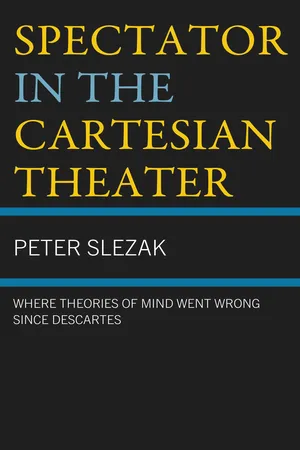
Spectator in the Cartesian Theater
Where Theories of Mind Went Wrong since Descartes
- 347 pages
- English
- PDF
- Available on iOS & Android
eBook - PDF
About this book
Information
Topic
PhilosophySubtopic
Language in PhilosophyTable of contents
- Contents
- Preface
- Acknowledgements
- Introduction: Illusions
- 1. Dangerous Meditations
- 2. Illusionism and The Phenomenological Fallacy
- 3. What It’s Like: Conscious Experience Itself
- 4. Cogito, Ergo Sum: The Diagonal Deduction
- 5. The Mind’s Eye: Visual Imagery
- 6. In the Chinese Room: Life Without Meaning1
- 7. Meaning: Interpretation or Explanation?
- 8. Proper Names: The Omniscient Observer
- 9. The Theory of Ideas: Fodor’s Guilty Passions
- 10. Descartes’ Neurocomputational Philosophy
- 11. What is Knowledge?The Gettier Problem
- 12. Disjunctivism: The Argument from Illusion (Again)
- 13. Newcomb’s Problem: Demons, Deceivers, and Liars
- Conclusion
- References
- Index
- About the Author
Trusted by 375,005 students
Access to over 1.5 million titles for a fair monthly price.
Study more efficiently using our study tools.
Frequently asked questions
Yes, you can cancel anytime from the Subscription tab in your account settings on the Perlego website. Your subscription will stay active until the end of your current billing period. Learn how to cancel your subscription
No, books cannot be downloaded as external files, such as PDFs, for use outside of Perlego. However, you can download books within the Perlego app for offline reading on mobile or tablet. Learn how to download books offline
Perlego offers two plans: Essential and Complete
- Essential is ideal for learners and professionals who enjoy exploring a wide range of subjects. Access the Essential Library with 800,000+ trusted titles and best-sellers across business, personal growth, and the humanities. Includes unlimited reading time and Standard Read Aloud voice.
- Complete: Perfect for advanced learners and researchers needing full, unrestricted access. Unlock 1.5M+ books across hundreds of subjects, including academic and specialized titles. The Complete Plan also includes advanced features like Premium Read Aloud and Research Assistant.
We are an online textbook subscription service, where you can get access to an entire online library for less than the price of a single book per month. With over 1.5 million books across 990+ topics, we’ve got you covered! Learn about our mission
Look out for the read-aloud symbol on your next book to see if you can listen to it. The read-aloud tool reads text aloud for you, highlighting the text as it is being read. You can pause it, speed it up and slow it down. Learn more about Read Aloud
Yes! You can use the Perlego app on both iOS and Android devices to read anytime, anywhere — even offline. Perfect for commutes or when you’re on the go.
Please note we cannot support devices running on iOS 13 and Android 7 or earlier. Learn more about using the app
Please note we cannot support devices running on iOS 13 and Android 7 or earlier. Learn more about using the app
Yes, you can access Spectator in the Cartesian Theater by Peter Slezak in PDF and/or ePUB format, as well as other popular books in Philosophy & Language in Philosophy. We have over 1.5 million books available in our catalogue for you to explore.