This book asks several critical questions relevant to those interested in public policy: What is a nudge? What are the ethical implications of and justifications for nudges? Are we able to have nudges without affecting one's freedom to choose? In what institutional context are nudges likely to work well and in what context are they likely to fail? The text explores several real-world instances of government attempts at successful choice architecture across a wide range of policy topics: internet privacy laws, environmental policy, education policy, the sharing economy, and creating a national culture.
This approach also highlights the spontaneous and evolutionary nature of social institutions like culture and trust. Attempts from policymakers to generate these social institutions where they did not exist previously are unlikely to succeed unless they are aligned with the unique characteristics of the society in question. This raises the question of whether the seemingly successful policy interventions were even necessary. A few of the chapters in this book directly examine these issues through case studies of both Latin America and Singapore.
Each chapter in this volume explores the ways in which individuals in society respond to attempts by policymakers to "nudge" them towards a specific outcome. Some chapters explore the theoretical arguments in favor of utilizing this behavioral policy approach. Others explore the feasibility and potential limitations of this approach to public policy. Several of the chapters apply market process theory to understand a particular case study where nudge policies have been put into practice. The chapters, authored by an interdisciplinary group of policy scholars, include discussions of internet privacy laws, the sharing economy, education policy, environmental policy, as well as social issues such as trust and culture.
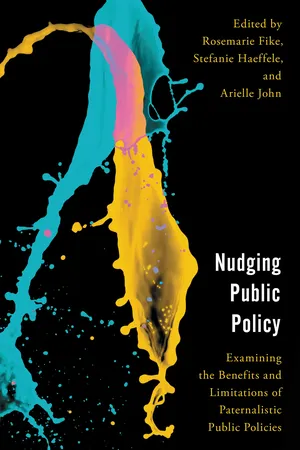
eBook - PDF
Nudging Public Policy
Examining the Benefits and Limitations of Paternalistic Public Policies
- 277 pages
- English
- PDF
- Available on iOS & Android
eBook - PDF
Nudging Public Policy
Examining the Benefits and Limitations of Paternalistic Public Policies
About this book
Information
Table of contents
- Cover
- Half Title
- Series Page
- Title Page
- Copyright Page
- Contents
- List of Figures and Tables
- List of Figures and Tables
- Introduction
- Chapter 1: Irrationality Is Not Unreasonable: Behavioral Economics, Rationality, and Implications for Public Policy
- Chapter 2: What Is a Nudge?
- Chapter 3: Why Nudges Should Be Local and Decentralized
- Chapter 4: Incentivized Migration in Colonial Contexts: The Challenge of Asymmetric Information in Public Policy Nudges
- Chapter 5: Nudge, Nations, and Cultural Change: The Process of Identity Formation in Singapore
- Chapter 6: Nudging Lobbyists to Register with Online Registration and Grace Periods
- Chapter 7: Nudging Choices in Education Policy
- Chapter 8: Public Policy, the Environment, and the Use of Green Nudges
- Chapter 9: The Paradoxes of the Privacy Paradox
- Chapter 10: Nudging, Trust, and the “Sharing Economy” in Latin America
- Index
- About the Contributors
Trusted by 375,005 students
Access to over 1.5 million titles for a fair monthly price.
Study more efficiently using our study tools.
Frequently asked questions
Yes, you can cancel anytime from the Subscription tab in your account settings on the Perlego website. Your subscription will stay active until the end of your current billing period. Learn how to cancel your subscription
No, books cannot be downloaded as external files, such as PDFs, for use outside of Perlego. However, you can download books within the Perlego app for offline reading on mobile or tablet. Learn how to download books offline
Perlego offers two plans: Essential and Complete
- Essential is ideal for learners and professionals who enjoy exploring a wide range of subjects. Access the Essential Library with 800,000+ trusted titles and best-sellers across business, personal growth, and the humanities. Includes unlimited reading time and Standard Read Aloud voice.
- Complete: Perfect for advanced learners and researchers needing full, unrestricted access. Unlock 1.5M+ books across hundreds of subjects, including academic and specialized titles. The Complete Plan also includes advanced features like Premium Read Aloud and Research Assistant.
We are an online textbook subscription service, where you can get access to an entire online library for less than the price of a single book per month. With over 1.5 million books across 990+ topics, we’ve got you covered! Learn about our mission
Look out for the read-aloud symbol on your next book to see if you can listen to it. The read-aloud tool reads text aloud for you, highlighting the text as it is being read. You can pause it, speed it up and slow it down. Learn more about Read Aloud
Yes! You can use the Perlego app on both iOS and Android devices to read anytime, anywhere — even offline. Perfect for commutes or when you’re on the go.
Please note we cannot support devices running on iOS 13 and Android 7 or earlier. Learn more about using the app
Please note we cannot support devices running on iOS 13 and Android 7 or earlier. Learn more about using the app
Yes, you can access Nudging Public Policy by Rosemarie Fike,Stefanie Haeffele,Arielle John in PDF and/or ePUB format, as well as other popular books in Economics & Business General. We have over 1.5 million books available in our catalogue for you to explore.