eBook - PDF
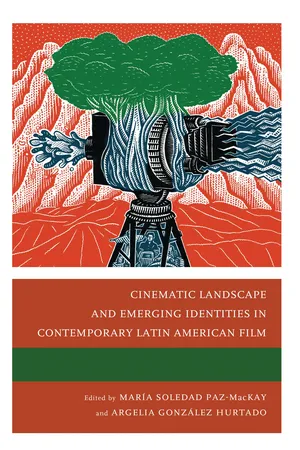
Cinematic Landscape and Emerging Identities in Contemporary Latin American Film
- 235 pages
- English
- PDF
- Available on iOS & Android
eBook - PDF
Cinematic Landscape and Emerging Identities in Contemporary Latin American Film
About this book
Cinematic Landscape and Emerging Identities in Contemporary Latin American Film offers a series of perspectives, produced from a diverse array of aesthetic and theoretical approaches, that build on previous studies about cinematic landscape and space while addressing it from a regional perspective. This book explores how contemporary Latin American filmmakers have included, created, or transformed different types of landscapes in their works. The chapters highlight the centrality of landscape as a meaningful space in film, composed in addition to the image, sound, and movement. The core of the edited collection revolves around films where landscape emerges as a crucial element to transmit the urgency of issues affecting diverse Latin American societies. The representation of emerging social actors, such as Indigenous groups, Afro-Latin Americans, LGBTQIA+ communities, migrants, environmentalists, and women, offers a localized view of sociocultural, political, and environmental challenges from marginalized and dissenting voices.
Information
Table of contents
- Cover
- Half Title
- Title Page
- Copyright Page
- Contents
- Acknowledgments
- Introduction
- Part I: Urban and Rural Landscapes
- Chapter 1: Beyond Utopias: Urban Landscapes in Contemporary Venezuelan Cinema
- Chapter 2: De vientres y aguas: Women and Landscape in El niño pez and El verano de los peces voladores
- Chapter 3: Enclaves of Entrapment: Capitalism’s Waste in Maquilapolis and 7 Prisoneiros
- Part II: Colonial, Postcolonial, and Historical Landscapes
- Chapter 4: Unraveling the Colonial Landscape in Lucrecia Martel’s Zama
- Chapter 5: Old Customs in the New Lima: Alternative Spaces in Octubre (2010) and Rosa Chumbe (2016)
- Chapter 6: Exploring Bolivian Cartography in Juan Carlos Valdivia’s Films: Landscapes, Crises, and Transformations
- Part III: Violence and Gendered Landscapes
- Chapter 7: The Disappearing Landscape: Narratives of Displacement in Two Venezuelan Ecofeminist Documentaries
- Chapter 8: Desert as a Memoryscape in El guardián de la memoria
- Chapter 9: Close-ups of Political Violence: Faces as Affective Landscape in Magallanes (2015)1
- Chapter 10: The Landscape of Confinement: Abject Exclusion in Fernando Pérez’s La pared de las palabras (2014)
- Part IV: Directors’ Points of View about Cinematic Landscape
- Chapter 11: In Conversation with Filmmaker Francisco Huichaqueo
- Chapter 12: Landscapes of Haptic Visualities and Affects: A Conversation with Cuban Filmmaker Patricia Ramos
- Index
- About the Editors
Trusted by 375,005 students
Access to over 1.5 million titles for a fair monthly price.
Study more efficiently using our study tools.
Frequently asked questions
Yes, you can cancel anytime from the Subscription tab in your account settings on the Perlego website. Your subscription will stay active until the end of your current billing period. Learn how to cancel your subscription
No, books cannot be downloaded as external files, such as PDFs, for use outside of Perlego. However, you can download books within the Perlego app for offline reading on mobile or tablet. Learn how to download books offline
Perlego offers two plans: Essential and Complete
- Essential is ideal for learners and professionals who enjoy exploring a wide range of subjects. Access the Essential Library with 800,000+ trusted titles and best-sellers across business, personal growth, and the humanities. Includes unlimited reading time and Standard Read Aloud voice.
- Complete: Perfect for advanced learners and researchers needing full, unrestricted access. Unlock 1.5M+ books across hundreds of subjects, including academic and specialized titles. The Complete Plan also includes advanced features like Premium Read Aloud and Research Assistant.
We are an online textbook subscription service, where you can get access to an entire online library for less than the price of a single book per month. With over 1.5 million books across 990+ topics, we’ve got you covered! Learn about our mission
Look out for the read-aloud symbol on your next book to see if you can listen to it. The read-aloud tool reads text aloud for you, highlighting the text as it is being read. You can pause it, speed it up and slow it down. Learn more about Read Aloud
Yes! You can use the Perlego app on both iOS and Android devices to read anytime, anywhere — even offline. Perfect for commutes or when you’re on the go.
Please note we cannot support devices running on iOS 13 and Android 7 or earlier. Learn more about using the app
Please note we cannot support devices running on iOS 13 and Android 7 or earlier. Learn more about using the app
Yes, you can access Cinematic Landscape and Emerging Identities in Contemporary Latin American Film by María Soledad Paz-MacKay,Argelia González Hurtado in PDF and/or ePUB format, as well as other popular books in Social Sciences & Popular Culture. We have over 1.5 million books available in our catalogue for you to explore.