In a time of changing technology and cultural shifts, it is difficult to measure some aspects of the workforce. Education and the American Workforce brings together a comprehensive collection of employment and education information from federal statistical agencies. This publicationis a compilation of data about employment and education from federal statistical agencies. The Census Bureau is the leading source of quality data about the nation's people and economy. The Bureau of Labor Statistics (BLS) is the principal federal agency responsible for measuring labor market activity, working conditions, and price changes in the economy. Together, these agencies produce a wealth of information about the American workforce.
Education and the American Workforce includes information about the jobs that people hold—the occupations that they pursue and the industries where they work—and the education levels that people have attained. The geographic location of jobs is important. People often move to locations where jobs are plentiful, moving away from areas where jobs have decreased as technology and trends have changed. The education level of a local population can have an impact on the type of jobs available, with employers establishing businesses where they expect to find employees with appropriate educational credentials.
This book uses the American Community Survey (ACS) to provide data on jobs and education in states, metropolitan areas, counties, cities, and congressional districts. The local area detail is necessarily less specific than the national data but the occupation categories use the same SOC categorization, grouped to protect the respondents' privacy. These sections include ACS data about the labor force, educational attainment, and field of degree, often by age, gender, race, and Hispanic origin. Also included are some personal and household characteristics that are relevant to employment and education, such as health insurance and computer access.
Some examples of interesting data found inside Education and the American Workforce include:
With no formal educational requirement and a median salary of $22,680, 4.5 million people are employed as retail salespersons, the most of any single occupation. Cashiers and food preparation/serving workers account for another 3.5 million each. There are 2.9 million registered nurses, the most numerous of occupations that require a bachelor's degree.
The biggest numeric decline is expected for Postal Service mail carriers, dropping by about 78,000 in ten years. When combined with other Postal Service occupations—such as clerks, sorters, postmasters, and others—a decline of 140,000 jobs is expected for the Postal Service.
Among the 75 largest counties, Bronx County, NY had the highest number of residents age 25 and over with less than a high school diploma at 29.4 percent while Montgomery County, PA had the lowest percentage at 6.2 percent.
Meanwhile, New York County, NY and Fairfax County, VA had the highest percentage of residents with a bachelor's degree or higher at 59.9 percent followed by Montgomery County, MD at 57.9 percent among the 75 largest counties. Nationally, between 2011 and 2015, 29.8 percent of the population had a bachelor's degree or higher.
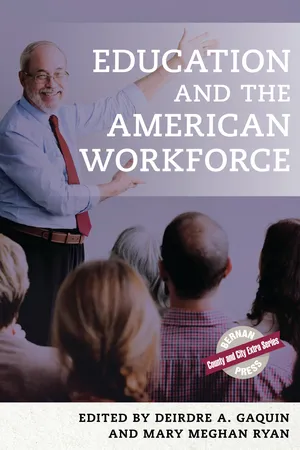
- 593 pages
- English
- PDF
- Available on iOS & Android
eBook - PDF
Education and the American Workforce
About this book
Information
Topic
Personal DevelopmentSubtopic
CareersTable of contents
- Cover
- Education and the American Workforce
- Education and the American Workforce
- Contents
- Preface
- Part A
- NATIONAL
- Part A. NATIONAL
- Part B
- STATES
- Part B. STATES
- Part C
- Counties
- Part C. COUNTIES
- Part D
- METROPOLITAN AREAS
- Part D. METROPOLITAN AREAS
- Part E
- CITIES
- Part E. CITIES
- Part F
- CONGRESSIONAL DISTRICTS
- Part F. CONGRESSIONAL DISTRICTS
- APPENDIXES
- APPENDIX A. GEOGRAPHIC CONCEPTS AND CODES
- APPENDIX B. SOURCE NOTES AND EXPLANATIONS
Trusted by 375,005 students
Access to over 1.5 million titles for a fair monthly price.
Study more efficiently using our study tools.
Frequently asked questions
Yes, you can cancel anytime from the Subscription tab in your account settings on the Perlego website. Your subscription will stay active until the end of your current billing period. Learn how to cancel your subscription
No, books cannot be downloaded as external files, such as PDFs, for use outside of Perlego. However, you can download books within the Perlego app for offline reading on mobile or tablet. Learn how to download books offline
Perlego offers two plans: Essential and Complete
- Essential is ideal for learners and professionals who enjoy exploring a wide range of subjects. Access the Essential Library with 800,000+ trusted titles and best-sellers across business, personal growth, and the humanities. Includes unlimited reading time and Standard Read Aloud voice.
- Complete: Perfect for advanced learners and researchers needing full, unrestricted access. Unlock 1.5M+ books across hundreds of subjects, including academic and specialized titles. The Complete Plan also includes advanced features like Premium Read Aloud and Research Assistant.
We are an online textbook subscription service, where you can get access to an entire online library for less than the price of a single book per month. With over 1.5 million books across 990+ topics, we’ve got you covered! Learn about our mission
Look out for the read-aloud symbol on your next book to see if you can listen to it. The read-aloud tool reads text aloud for you, highlighting the text as it is being read. You can pause it, speed it up and slow it down. Learn more about Read Aloud
Yes! You can use the Perlego app on both iOS and Android devices to read anytime, anywhere — even offline. Perfect for commutes or when you’re on the go.
Please note we cannot support devices running on iOS 13 and Android 7 or earlier. Learn more about using the app
Please note we cannot support devices running on iOS 13 and Android 7 or earlier. Learn more about using the app
Yes, you can access Education and the American Workforce by Deirdre A. Gaquin,Mary Meghan Ryan in PDF and/or ePUB format, as well as other popular books in Personal Development & Careers. We have over 1.5 million books available in our catalogue for you to explore.