Trauma is commonly understood as Post-Traumatic Stress Disorder (PTSD). Yet, as this book explains, the concept of PTSD is problematic because it is rooted in a solipsist Philosophy of the Subject. Within such a philosophical perspective, it is not only impossible to account for trauma's causality, but the traumatic 'event' is also prioritised over traumatic social and political structures as trauma is depoliticised as an (individual) internal cognitive object.
Rooted in Frankfurt School critical theory, this book thus urges us to rethink the concept of trauma: trauma should not be understood as impaired subjectivity but rather as broken intersubjectivity. Hence, it not only presents a critique of the notion 'PTSD', but – drawing on the philosophies of Jurgen Habermas, Nancy Fraser, Rahel Jaeggi and Heideggerian trauma theory in particular - it argues that trauma entails the violent imposition of traumatic status subordination. In traumatic status subordination, intersubjective parity (the counterfactual presupposition of being treated as an equal human being) is so violently betrayed that the symbolic realm of the lifeworld collapses. As the lifeworld collapses, one suffers an atomized state of speechless disorientation, wherein the potential of creative collective becoming is destroyed. In this sense, human induced trauma should thus be understood as a political tool par excellence.
As this monograph indicates, traumatic status subordination was a tool which the Egyptian counter-revolutionary actors (consisting of the Egyptian military, and its temporary subsidiary the Muslim Brotherhood) used unsparingly as they attempted to put the revolutionary genie back into the bottle. Importantly, the Egyptian military not only sought to destroy the object of revolutionary politics, but rather the underlying existential structures of the possibility of its very existence as such. And thus, in the violent instrumental pursuit of economic and political power, the counter-revolution inflicted multileveled status subordination. It did so through a consistent tripartite structural mechanism: the infliction of grave (deadly) violence, the procedural colonisation and repressive juridification of the public sphere, and the acceleration of neoliberal economic rationalism. This not only accumulated in Sisi's prisonification of society and his politics of death, but rather also threw activists ever deeper into an atomized state of demoralized silence as it destroyed the very potential of revolutionary and transformative becoming.
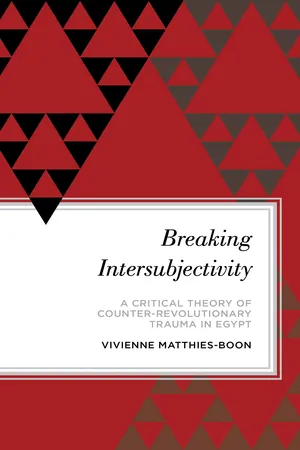
eBook - PDF
Breaking Intersubjectivity
A Critical Theory of Counter-Revolutionary Trauma in Egypt
- 353 pages
- English
- PDF
- Available on iOS & Android
eBook - PDF
Breaking Intersubjectivity
A Critical Theory of Counter-Revolutionary Trauma in Egypt
About this book
Information
Table of contents
- Cover
- Half Title
- Series Page
- Title Page
- Copyright Page
- Dedication
- Contents
- Acknowledgements
- Introduction
- Part I: Towards a Critical Theory of Trauma as Broken Subjectivity
- Chapter 1: Trauma Studies and the Philosophy of the Subject
- Chapter 2: Towards a Critical Trauma Studies: Trauma as Intersubjective Alienation
- Part II: Counter-Revolutionary Trauma in Egypt
- Chapter 3: A Legacy of Traumatic Status Subordination in Egypt: From Nasser to Mubarak
- Chapter 4: Revolutionary Becoming: The Politics of Prefigurative Intersubjective Parity
- Chapter 5: Supreme Council of Armed Forces: The Politics of Traumatic Status Subordination
- Chapter 6: Mohammed Morsi: The Politics of Traumatic Status Subordination
- Chapter 7: The Military’s Deadly Return
- Chapter 8: Abdel Fattah El Sisi: The Politics of Traumatic Status Subordination
- Part III: Breaking the Revolutionary Lifeworld and Potential of Creative Becoming
- Chapter 9: Breaking the Lifeworld: On the Existential Burden of Violence and Death
- Chapter 10: Deepening Intersubjective Imparity: Turning Violence Inwards
- Chapter 11: Conclusion
- Bibliography
- Index
- About the Author
Trusted by 375,005 students
Access to over 1.5 million titles for a fair monthly price.
Study more efficiently using our study tools.
Frequently asked questions
Yes, you can cancel anytime from the Subscription tab in your account settings on the Perlego website. Your subscription will stay active until the end of your current billing period. Learn how to cancel your subscription
No, books cannot be downloaded as external files, such as PDFs, for use outside of Perlego. However, you can download books within the Perlego app for offline reading on mobile or tablet. Learn how to download books offline
Perlego offers two plans: Essential and Complete
- Essential is ideal for learners and professionals who enjoy exploring a wide range of subjects. Access the Essential Library with 800,000+ trusted titles and best-sellers across business, personal growth, and the humanities. Includes unlimited reading time and Standard Read Aloud voice.
- Complete: Perfect for advanced learners and researchers needing full, unrestricted access. Unlock 1.5M+ books across hundreds of subjects, including academic and specialized titles. The Complete Plan also includes advanced features like Premium Read Aloud and Research Assistant.
We are an online textbook subscription service, where you can get access to an entire online library for less than the price of a single book per month. With over 1.5 million books across 990+ topics, we’ve got you covered! Learn about our mission
Look out for the read-aloud symbol on your next book to see if you can listen to it. The read-aloud tool reads text aloud for you, highlighting the text as it is being read. You can pause it, speed it up and slow it down. Learn more about Read Aloud
Yes! You can use the Perlego app on both iOS and Android devices to read anytime, anywhere — even offline. Perfect for commutes or when you’re on the go.
Please note we cannot support devices running on iOS 13 and Android 7 or earlier. Learn more about using the app
Please note we cannot support devices running on iOS 13 and Android 7 or earlier. Learn more about using the app
Yes, you can access Breaking Intersubjectivity by Vivienne Matthies-Boon in PDF and/or ePUB format, as well as other popular books in Politics & International Relations & Middle Eastern Politics. We have over 1.5 million books available in our catalogue for you to explore.