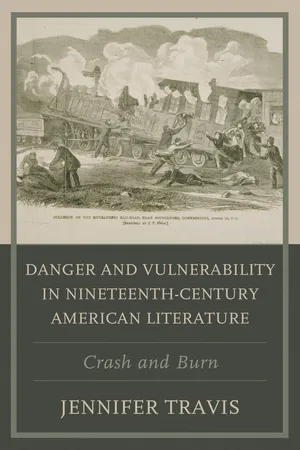
Nineteenth-Century Americans saw danger lurking everywhere: in railway cars and trolleys, fireplaces and floods, and amid social and political movements, from the abolition of slavery to suffrage. After the Civil War, Americans were shaken by financial panic and a volatile post-slave economy. They were awe-struck and progressively alarmed by technological innovations that promised speed and commercial growth, but also posed unprecedented physical hazard. Most of all, Americans were uncertain, particularly in light of environmental disasters like hurricanes and wildfires, about their own city on a hill and the once indisputable and protective hand of a beneficent God. The disasters, accidents, and social and political upheavals that characterized nineteenth-century culture had enormous explanatory power, metaphoric and real.
Today we speak of similar insecurities: financial, informational, environmental, and political, and we obsessively express our worry and fear for the future. Cultural theorist Paul Virilio refers to these feelings as the "threat horizon," one that endlessly identifies and produces new dangers.Why, he asks, does it seem easier for humanity to imagine a future shaped by ever-deadlier accidents than a decent future? Danger and Vulnerability in Nineteenth Century American Literature; or, Crash and Burn American invites readers to examine the "threat horizon" through its nascent expression in literary and cultural history. Against the emerging rhetoric of danger in the long nineteenth century, this book examines how a vocabulary of vulnerability in the American imaginary promoted the causes of the structurally disempowered in new and surprising ways, often seizing vulnerability as the grounds for progressive insight. The texts at the heart of this study, from nineteenth-century sensation novels to early twentieth-century journalistic fiction, imagine spectacular collisions, terrifying conflagrations, and all manner of catastrophe, social, political, and environmental. Together they write against illusions of inviolability in a growing technological and managerial culture, and they imagine how the recognition of universal vulnerability may challenge normative representations of social, political, and economic marginality.
eBook - PDF
Danger and Vulnerability in Nineteenth-century American Literature
Crash and Burn
- 175 pages
- English
- PDF
- Available on iOS & Android
eBook - PDF
About this book
Information
Table of contents
- Table of Contents
- List of Figures
- Acknowledgments
- Introduction
- Chapter One: A “damsel-errant in quest of adventures”
- Chapter Two: Crash Lit
- Chapter Three: “Hurts That Will Not Heal”
- Chapter Four: Burning Down the House
- Chapter Five: The Tremblor
- Bibliography
- Index
- About the Author
Trusted by 375,005 students
Access to over 1.5 million titles for a fair monthly price.
Study more efficiently using our study tools.
Frequently asked questions
Yes, you can cancel anytime from the Subscription tab in your account settings on the Perlego website. Your subscription will stay active until the end of your current billing period. Learn how to cancel your subscription
No, books cannot be downloaded as external files, such as PDFs, for use outside of Perlego. However, you can download books within the Perlego app for offline reading on mobile or tablet. Learn how to download books offline
Perlego offers two plans: Essential and Complete
- Essential is ideal for learners and professionals who enjoy exploring a wide range of subjects. Access the Essential Library with 800,000+ trusted titles and best-sellers across business, personal growth, and the humanities. Includes unlimited reading time and Standard Read Aloud voice.
- Complete: Perfect for advanced learners and researchers needing full, unrestricted access. Unlock 1.5M+ books across hundreds of subjects, including academic and specialized titles. The Complete Plan also includes advanced features like Premium Read Aloud and Research Assistant.
We are an online textbook subscription service, where you can get access to an entire online library for less than the price of a single book per month. With over 1.5 million books across 990+ topics, we’ve got you covered! Learn about our mission
Look out for the read-aloud symbol on your next book to see if you can listen to it. The read-aloud tool reads text aloud for you, highlighting the text as it is being read. You can pause it, speed it up and slow it down. Learn more about Read Aloud
Yes! You can use the Perlego app on both iOS and Android devices to read anytime, anywhere — even offline. Perfect for commutes or when you’re on the go.
Please note we cannot support devices running on iOS 13 and Android 7 or earlier. Learn more about using the app
Please note we cannot support devices running on iOS 13 and Android 7 or earlier. Learn more about using the app
Yes, you can access Danger and Vulnerability in Nineteenth-century American Literature by Jennifer Travis in PDF and/or ePUB format, as well as other popular books in Literature & Literary Criticism History & Theory. We have over 1.5 million books available in our catalogue for you to explore.