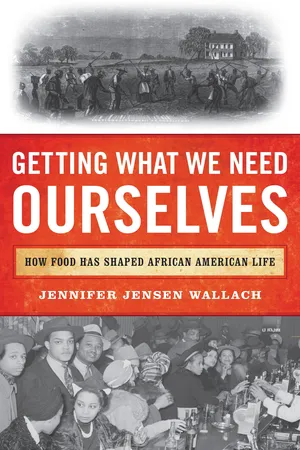
Beginning with an examination of West African food traditions during the era of the transatlantic slave trade and ending with a discussion of black vegan activism in the twenty-first century, Getting What We Need Ourselves: How Food Has Shaped African American Life tells a multi-faceted food story that goes beyond the well-known narrative of southern-derived "soul food" as the predominant form of black food expression. While this book considers the provenance and ongoing cultural resonance of emblematic foods such as greens and cornbread, it also examines the experiences of African Americans who never embraced such foods or who rejected them in search of new tastes and new symbols that were less directly tied to the past of plantation slavery.
This book tells the story of generations of cooks and eaters who worked to create food habits that they variously considered sophisticated, economical, distinctly black, all-American, ethical, and healthful in the name of benefiting the black community. Significantly, it also chronicles the enduring struggle of impoverished eaters who worried far more about having enough to eat than about what particular food filled their plates. Finally, it considers the experiences of culinary laborers, whether enslaved, poorly paid domestic servants, tireless entrepreneurs, or food activists and intellectuals who used their knowledge and skills to feed and educate others, making a lasting imprint on American food culture in the process.
Throughout African American history, food has both been used as a tool of empowerment and wielded as a weapon. Beginning during the era of slavery, African American food habits have often served as a powerful means of cementing the bonds of community through the creation of celebratory and affirming shared rituals. However, the system of white supremacy has frequently used food, or often the lack of it, as a means to attempt to control or subdue the black community. This study demonstrates that African American eaters who have worked to creative positive representations of black food practices have simultaneously had to confront an elaborate racist mythology about black culinary inferiority and difference. Keeping these tensions in mind, empty plates are as much a part of the history this book sets out to narrate as full ones, and positive characterizations of black foodways are consistently put into dialogue with distorted representations created by outsiders. Together these stories reveal a rich and complicated food history that defies simple stereotypes and generalizations.
eBook - PDF
Getting What We Need Ourselves
How Food Has Shaped African American Life
- 239 pages
- English
- PDF
- Available on iOS & Android
eBook - PDF
About this book
Information
Table of contents
- Contents
- Acknowledgments
- Introduction
- Chapter 1. Culinary Origins and Exchanges during the Transatlantic Slave Trade
- Chapter 2. Africanisms and Adaptation during the Era of Slavery
- Chapter 3. Foodways, Resiliency, and White Supremacy after the Civil War
- Chapter 4. The Quest to Cook and Eat
- Chapter 5. The Search for a Common Table during the Great Depression and World War II
- Chapter 6. Food as Politics during the Black Freedom Struggle
- Epilogue
- Notes
- Bibliography
- Index
- About the Author
Trusted by 375,005 students
Access to over 1.5 million titles for a fair monthly price.
Study more efficiently using our study tools.
Frequently asked questions
Yes, you can cancel anytime from the Subscription tab in your account settings on the Perlego website. Your subscription will stay active until the end of your current billing period. Learn how to cancel your subscription
No, books cannot be downloaded as external files, such as PDFs, for use outside of Perlego. However, you can download books within the Perlego app for offline reading on mobile or tablet. Learn how to download books offline
Perlego offers two plans: Essential and Complete
- Essential is ideal for learners and professionals who enjoy exploring a wide range of subjects. Access the Essential Library with 800,000+ trusted titles and best-sellers across business, personal growth, and the humanities. Includes unlimited reading time and Standard Read Aloud voice.
- Complete: Perfect for advanced learners and researchers needing full, unrestricted access. Unlock 1.5M+ books across hundreds of subjects, including academic and specialized titles. The Complete Plan also includes advanced features like Premium Read Aloud and Research Assistant.
We are an online textbook subscription service, where you can get access to an entire online library for less than the price of a single book per month. With over 1.5 million books across 990+ topics, we’ve got you covered! Learn about our mission
Look out for the read-aloud symbol on your next book to see if you can listen to it. The read-aloud tool reads text aloud for you, highlighting the text as it is being read. You can pause it, speed it up and slow it down. Learn more about Read Aloud
Yes! You can use the Perlego app on both iOS and Android devices to read anytime, anywhere — even offline. Perfect for commutes or when you’re on the go.
Please note we cannot support devices running on iOS 13 and Android 7 or earlier. Learn more about using the app
Please note we cannot support devices running on iOS 13 and Android 7 or earlier. Learn more about using the app
Yes, you can access Getting What We Need Ourselves by Jennifer Jensen Wallach in PDF and/or ePUB format, as well as other popular books in History & African American History. We have over 1.5 million books available in our catalogue for you to explore.