This work offers new ways of conceptualizing the decision-making paradigm of the Soviet party-state that was defined by the persistent shortage of qualified manpower that afflicted the Russian elite. The traditional Russian problems of under administration, combined with the unique features of the Soviet political system, resulted in a dichotomy between practical and ideological demands. The WWII era, examined in this book, provides a microcosm of pressures facing the Kremlin and illustrates the cyclical nature of policy formation forced on it by the paradoxes of the system.
As the party's responsibilities expanded into specialized economic and military areas, political experts increasingly depended on the specialized professionals. These trends grew increased drastically during the war. An unexpected consequence of the party's expansion into economic or military professions was the discovery that cooptation worked both ways and many party members become managers rather than ideological overseers. Throughout the existential crisis of the system—the war and its aftermath—the party would find itself in a fundamental conflict over its identity, challenged over its role both vis-a-vis the state and its own priorities.
After an abortive attempt to reverse the wartime trends, a new paradigm was articulated by the party during the last five years of Stalin's reign. This resulted in the emergence of a new elite consensus which envisioned the party as integral and invasive economic actor. This shift in the party's identity was the price of maintaining centralized political power and came at the expense of the focus on ideological purity.
In the long term, however, the diminished role of ideology robbed the party of its core value system and steadily eroded its legitimizing and self-energizing power. Over time, the new consensus would undermine the very foundations of the party-state construct. Yet if the USSR was to survive as a modern, industrialized state, the accommodation with the technocrats was necessary. The contradiction between ideological and pragmatic aims was inherent to the system, and demanded an eventual choice between the long-term health of the state and that of the party.
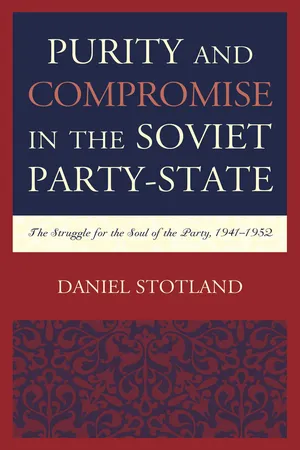
eBook - PDF
Purity and Compromise in the Soviet Party-State
The Struggle for the Soul of the Party, 1941–1952
- 315 pages
- English
- PDF
- Available on iOS & Android
eBook - PDF
Purity and Compromise in the Soviet Party-State
The Struggle for the Soul of the Party, 1941–1952
About this book
Information
Table of contents
- Cover
- Purity and Compromise in the Soviet Party-State
- Purity and Compromise in the Soviet Party-State
- Contents
- Acknowledgments
- Introduction
- Chapter 1
- Cadres Decide Everything
- Chapter 2
- The Irony of the Inferno
- Chapter 3
- The Great Reawakening
- Chapter 4
- The Last Puritan
- Chapter 5
- A More Perfect Union
- Conclusion
- Bibliography
- Index
- About the Author
Trusted by 375,005 students
Access to over 1.5 million titles for a fair monthly price.
Study more efficiently using our study tools.
Frequently asked questions
Yes, you can cancel anytime from the Subscription tab in your account settings on the Perlego website. Your subscription will stay active until the end of your current billing period. Learn how to cancel your subscription
No, books cannot be downloaded as external files, such as PDFs, for use outside of Perlego. However, you can download books within the Perlego app for offline reading on mobile or tablet. Learn how to download books offline
Perlego offers two plans: Essential and Complete
- Essential is ideal for learners and professionals who enjoy exploring a wide range of subjects. Access the Essential Library with 800,000+ trusted titles and best-sellers across business, personal growth, and the humanities. Includes unlimited reading time and Standard Read Aloud voice.
- Complete: Perfect for advanced learners and researchers needing full, unrestricted access. Unlock 1.5M+ books across hundreds of subjects, including academic and specialized titles. The Complete Plan also includes advanced features like Premium Read Aloud and Research Assistant.
We are an online textbook subscription service, where you can get access to an entire online library for less than the price of a single book per month. With over 1.5 million books across 990+ topics, we’ve got you covered! Learn about our mission
Look out for the read-aloud symbol on your next book to see if you can listen to it. The read-aloud tool reads text aloud for you, highlighting the text as it is being read. You can pause it, speed it up and slow it down. Learn more about Read Aloud
Yes! You can use the Perlego app on both iOS and Android devices to read anytime, anywhere — even offline. Perfect for commutes or when you’re on the go.
Please note we cannot support devices running on iOS 13 and Android 7 or earlier. Learn more about using the app
Please note we cannot support devices running on iOS 13 and Android 7 or earlier. Learn more about using the app
Yes, you can access Purity and Compromise in the Soviet Party-State by Daniel Stotland in PDF and/or ePUB format, as well as other popular books in History & Russian History. We have over 1.5 million books available in our catalogue for you to explore.