- 217 pages
- English
- PDF
- Available on iOS & Android
eBook - PDF
About this book
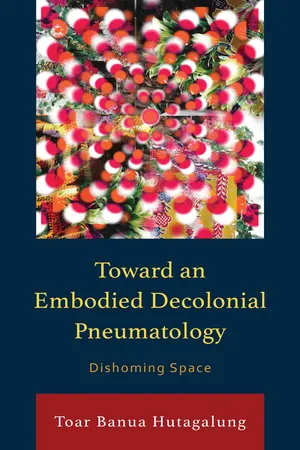
Everyone wants to be and to feel at home. Yet, being homely requires a space or place where one can admit feeling familiar with and the surroundings can accept the person. What does it mean then to be in a liminal space where one is considered not this or not that? In Toward an Embodied Decolonial Pneumatology: Dishoming Space, Toar Banua Hutagalung tries to analyze this existential question through a postcolonial/decolonial approach. One thing that is responsible for such liminal spaces is colonialism itself. Colonialism, through its multiple elements, such as biopolitics, racism, and sexuality, became a formation that looks like a home but is a site of oppression. Nevertheless, the author argues that liminality is not just a site of rejection. By addressing a case from the formation of Indonesian nationality as well as taking a closer hermeneutical look at Indonesian literature, the author contends that liminality conveys decolonial acts. Integrating an interdisciplinary approach from postcolonial/decolonial studies, theological anthropology, and pneumatology, the author asserts that the Holy Spirit always dwells and moves continuously in liminal spaces. It pulsates within the capillaries of every person to fight against colonial legacies. With such a decolonial pulse from the presence of the Spirit, one can re-member and recreate what home means.
Information
Topic
Theology & ReligionSubtopic
ReligionTable of contents
- Cover
- Contents
- Acknowledgments
- Introduction
- Pillars of Colonial Regulation
- Biopolitical Formation of Nationalism and Racism
- Return to Space
- Assemblages of Liminality
- Decolonial Archives in Literary Works
- Conclusion
- Bibliography
- Index
- About the Author
Trusted by 375,005 students
Access to over 1.5 million titles for a fair monthly price.
Study more efficiently using our study tools.
Frequently asked questions
Yes, you can cancel anytime from the Subscription tab in your account settings on the Perlego website. Your subscription will stay active until the end of your current billing period. Learn how to cancel your subscription
No, books cannot be downloaded as external files, such as PDFs, for use outside of Perlego. However, you can download books within the Perlego app for offline reading on mobile or tablet. Learn how to download books offline
Perlego offers two plans: Essential and Complete
- Essential is ideal for learners and professionals who enjoy exploring a wide range of subjects. Access the Essential Library with 800,000+ trusted titles and best-sellers across business, personal growth, and the humanities. Includes unlimited reading time and Standard Read Aloud voice.
- Complete: Perfect for advanced learners and researchers needing full, unrestricted access. Unlock 1.5M+ books across hundreds of subjects, including academic and specialized titles. The Complete Plan also includes advanced features like Premium Read Aloud and Research Assistant.
We are an online textbook subscription service, where you can get access to an entire online library for less than the price of a single book per month. With over 1.5 million books across 990+ topics, we’ve got you covered! Learn about our mission
Look out for the read-aloud symbol on your next book to see if you can listen to it. The read-aloud tool reads text aloud for you, highlighting the text as it is being read. You can pause it, speed it up and slow it down. Learn more about Read Aloud
Yes! You can use the Perlego app on both iOS and Android devices to read anytime, anywhere — even offline. Perfect for commutes or when you’re on the go.
Please note we cannot support devices running on iOS 13 and Android 7 or earlier. Learn more about using the app
Please note we cannot support devices running on iOS 13 and Android 7 or earlier. Learn more about using the app
Yes, you can access Toward an Embodied Decolonial Pneumatology by Toar Banua Hutagalung in PDF and/or ePUB format, as well as other popular books in Theology & Religion & Religion. We have over 1.5 million books available in our catalogue for you to explore.